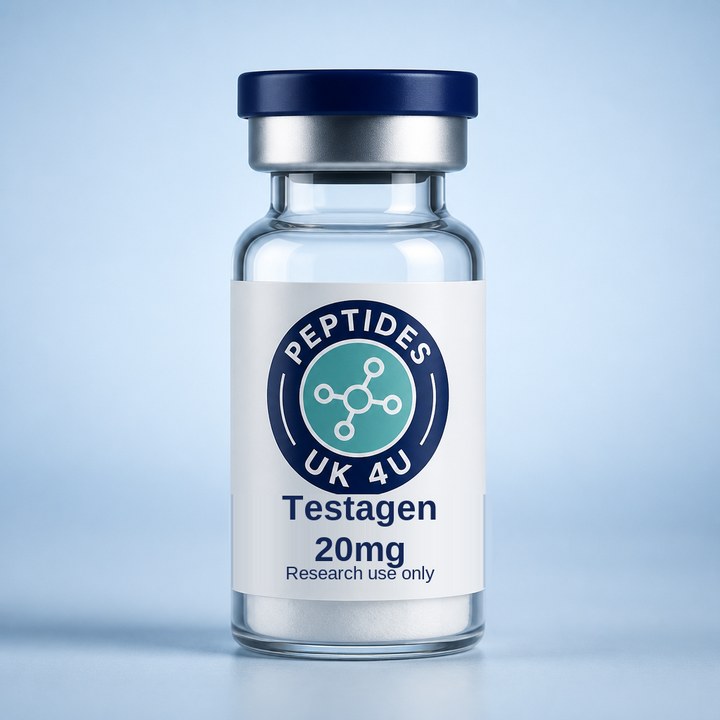
Testagen is a synthetic tetrapeptide studied for its role in modulating endocrine function, particularly the pituitary-gonadal axis. Dosage typically ranges from 100-300 mcg daily via subcutaneous injection, with gradual titration. It is reconstituted with bacteriostatic water for clear measurements using an insulin syringe.
- Dosed 100-300 mcg daily subcutaneously.
- Reconstitute a 20 mg vial with 3.0 mL of bacteriostatic water.
- 1 unit on a U-100 syringe equals approximately 66.7 mcg.
- Cycle length is typically 8-12 weeks, possibly extended to 16 weeks.
- Known as Lys-Glu-Asp-Gly (KEDG) and originates from anterior pituitary extracts.
Reconstitution
Vial strength
20 mg
Bacteriostatic water
3 mL
Concentration
6.67 mg/mL
1 unit = 0.01 mL = 66.7 mcg
- 1Draw 3.0 mL of bacteriostatic water into a sterile syringe.
- 2Inject the water slowly down the inside wall of the Testagen vial, avoiding foaming.
- 3Gently swirl or roll the vial until all the powder is completely dissolved (do not shake).
- 4Label the reconstituted vial with the date and refrigerate it at 2–8 °C (35.6–46.4 °F), protected from light.
Dosing schedule
| Phase | Dose | On a U-100 syringe |
|---|---|---|
| Weeks 1-2 | 100 mcg | 1.5 units (0.015 mL) |
| Weeks 3-4 | 150 mcg | 2.25 units (0.0225 mL) |
| Weeks 5-8 | 200 mcg | 3 units (0.03 mL) |
| Weeks 9-12 (optional) | 250–300 mcg | 3.75–4.5 units (0.0375–0.045 mL) |
Protocol detail
| Start | Begin with 100 mcg daily; increase dose by approximately 50 mcg every two weeks as tolerated. |
|---|---|
| Target | Aim for a daily dose of 200–300 mcg by Weeks 5–12. |
| Frequency | Once per day, administered subcutaneously. |
| Cycle Length | Typically 8–12 weeks; with an optional extension up to 16 weeks. |
| Timing | Inject at a consistent time each day, ensuring rotation of injection sites. |
Overview at a glance
| Goal | Support endocrine function research, particularly pituitary–gonadal axis modulation. |
|---|---|
| Schedule | Daily subcutaneous injections for 8–12 weeks (extendable to 16 weeks). |
| Dose Range | 100–300 mcg daily with gradual titration. |
| Reconstitution | 3.0 mL per 20 mg vial (~6.67 mg/mL) for accurate unit measurements. |
| Storage | Lyophilized frozen; reconstituted refrigerated; avoid repeated freeze-thaw cycles. |
How it works
Testagen (Lys-Glu-Asp-Gly) is a synthetic tetrapeptide classified as a bioregulatory peptide derived from anterior pituitary extracts. Preclinical studies indicate it may normalize thyroid hormone levels in hypophysectomized avian models and modulate endocrine signaling within the pituitary-gonadal axis. The hypothesized mechanism involves gene-regulatory processes that influence hormone synthesis and secretion. Currently, there are no human clinical trials for Testagen; all understanding is based on preclinical and in vitro research, suggesting its potential in endocrine support and modulation.
Reported effects
- Preclinical studies suggest normalization of thyroid hormone parameters.
- Research indicates potential modulation of male reproductive hormones.
Reported side effects
- No published human safety or efficacy data; side-effect profile in humans remains unknown.
- Occasional mild injection-site reactions (redness/itch) may occur.
Storage
Lyophilised (unmixed)
Freeze at -20 °C (-4 °F) in dry, dark conditions; minimize moisture exposure.
After reconstitution
Refrigerate at 2–8 °C (35.6–46.4 °F); avoid freeze-thaw cycles. Protect from light.
Supplies
| Peptide vials | 1 vial for 8 weeks (~14 mg used), 2 vials for 12 weeks (~25 mg used) or 16 weeks (~36 mg used). |
|---|---|
| Insulin Syringes | 30- or 50-unit recommended. Approximately 56 for 8 weeks, 84 for 12 weeks, 112 for 16 weeks. |
| Bacteriostatic Water | Use ~3.0 mL per vial for reconstitution. One 10 mL bottle is sufficient for up to 16 weeks. |
| Alcohol Swabs | Approximately 112 for 8 weeks (2 x 100-count boxes), 168 for 12 weeks (2 x 100-count boxes), or 224 for 16 weeks (3 x 100-count boxes). |
Important notes
- Use new, sterile insulin syringes and dispose of them in a sharps container.
- Rotate injection sites (abdomen, thighs, upper arms) to lessen local irritation.
- Inject slowly and wait a few seconds before withdrawing the needle.
- Document daily dose and injection site to maintain protocol consistency.
- Due to low injection volumes, using a 30- or 50-unit insulin syringe is recommended for precision.
Frequently asked questions
What is Testagen primarily studied for?
Testagen is a synthetic tetrapeptide being researched for its role in modulating endocrine function, specifically within the pituitary-gonadal axis and its potential to normalize thyroid hormone levels in preclinical models.
How should I reconstitute a 20 mg vial of Testagen?
To reconstitute a 20 mg vial, you should add 3.0 mL of bacteriostatic water. This will result in a concentration of approximately 6.67 mg/mL, where 1 unit on a U-100 insulin syringe roughly corresponds to 66.7 mcg.
Are there any human studies or known side effects for Testagen?
Currently, there are no published human clinical trials for Testagen, so its safety and efficacy in humans, as well as a complete side-effect profile, remain unknown. Preclinical data suggest only occasional mild injection-site reactions.
What is the recommended cycle length and frequency for Testagen?
The educational protocol suggests a cycle length of 8-12 weeks, which can optionally be extended to 16 weeks. Injections are typically administered once daily via subcutaneous route.
Educational reference only. These figures summarise how Testagen is commonly described in research literature and supplier documentation. They are not a prescription, not medical advice, and not a recommendation to self-administer anything.
Related protocols
IGF-1 LR3 (1 mg Vial)
Extended-release IGF-1 analog for anabolic and metabolic research.
Oxytocin (10 mg Vial)
The 'love hormone' for research into social behavior and metabolism.
PNC-27 (30 mg Vial)
Experimental peptide with preclinical cytotoxic effects on cancer cells.
Semax (10 mg Vial)
Synthetic neurotrophic peptide for intranasal research applications.