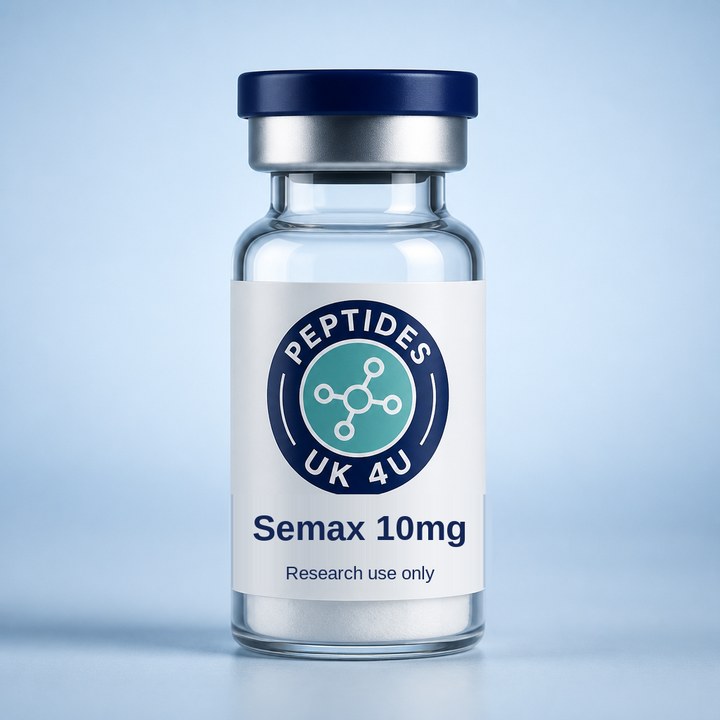
Semax is a synthetic heptapeptide derived from ACTH(4-10) known for its neurotrophic properties. This guide outlines how to prepare and administer a 10 mg vial for intranasal research. Calculations are provided for both 5 mL and 10 mL final solution volumes, detailing the resulting concentration and mcg per spray for a verified 0.10 mL actuator.
- Derived from ACTH(4-10) sequence.
- Administered intranasally in human studies.
- Available as 5 mL (200 mcg/spray) or 10 mL (100 mcg/spray) final volumes for a 0.10 mL actuator.
- Measurement and device variables are crucial for accurate dosing.
- Used in studies for cognitive function and neurological recovery.
Reconstitution
Vial strength
10 mg
Bacteriostatic water
3 mL
Concentration
3.33 mg/mL
Initial concentration before final volume adjustment
- 1Confirm the 10 mg vial, selected sterile vehicle, actuator bottle capacity, and documented pump output.
- 2Add 3.0 mL of compatible sterile vehicle to the vial using aseptic technique.
- 3Gently swirl until the contents are fully dissolved, avoiding shaking.
- 4Transfer the entire 3.0 mL solution into a sterile 5 mL or 10 mL nasal actuator bottle.
- 5Add enough additional vehicle to achieve an exact final volume of 5.0 mL or 10.0 mL (approx. 2.0 mL or 7.0 mL respectively).
- 6Secure the pump and label the bottle with all relevant preparation details and dates.
- 7Prime the pump as per instructions and record priming sprays in your research log.
Protocol detail
| 200 mcg | 1 spray for 5 mL option, 2 sprays for 10 mL option |
|---|---|
| 300 mcg | 1.5 theoretical sprays for 5 mL option, 3 sprays for 10 mL option |
| 400 mcg | 2 sprays for 5 mL option, 4 sprays for 10 mL option |
| 500 mcg | 2.5 theoretical sprays for 5 mL option, 5 sprays for 10 mL option |
Overview at a glance
| Human Research Route | Intranasal drops or solution |
|---|---|
| Peptide Amount | 10,000 mcg total in the vial |
| 5 mL Option | 2,000 mcg/mL and 200 mcg per verified 0.10 mL spray |
| 10 mL Option | 1,000 mcg/mL and 100 mcg per verified 0.10 mL spray |
| Final-Volume Rule | Bring the transferred solution to an exact measured final volume |
How it works
Semax is a synthetic peptide based on the ACTH(4-10) sequence, designed to lack the hormonal activity of full-length ACTH. Its mechanism of action involves neurotrophic signaling pathways, influencing attention, memory, and various neurological outcomes. The intranasal route delivers the peptide to the nasal mucosa, which is then absorbed into the bloodstream or transported to the central nervous system. Precise calculations involving final solution volume and actuator output determine the exact amount of Semax delivered with each spray, allowing for controlled research applications without endocrine side effects.
Reported effects
- Supports cognitive function
- Enhances attention
- Aids memory processes
- Potential for neurological recovery
- Lacks hormonal effects of ACTH
Reported side effects
- Possible mild nasal mucosal irritation (with prolonged use)
Storage
Lyophilised (unmixed)
Refer to manufacturer's instructions, typically refrigerated.
After reconstitution
Store protected from light, at no more than 10 °C, do not freeze. Specifics depend on formulation.
Supplies
| Peptide vials | One Semax 10 mg vial per prepared bottle |
|---|---|
| Sterile vehicle | Sterile 0.9% sodium chloride or other validated sterile nasal research vehicle |
| Nasal actuator bottle | One 5 mL or 10 mL bottle suitable for single-user research |
| Metered pump | Compatible actuator documented or verified at 0.10 mL per complete spray |
| Calibrated transfer tools | Sterile syringes or pipettes for precise volume measurement |
| Sterile transfer needle | If the peptide vial has a rubber septum |
| Clean handling supplies | Alcohol pads, clean gloves, disinfected work surface |
| Label and research log | For recording all preparation and usage details |
| Storage materials | Light-protective refrigerated storage |
| Sharps container | If needles are used |
Important notes
- Always use a measured final volume, not just the bottle capacity.
- Verify the actuator pump output (e.g., 0.10 mL per spray).
- Prime the pump correctly as specified and record priming sprays.
- Maintain consistent bottle orientation and full stroke for each spray.
- Theoretical spray counts may vary due to priming and residual volume.
- This content is for educational purposes only and not medical advice.
Frequently asked questions
What is the primary route of administration for Semax in human research?
Human research for Semax primarily utilizes the intranasal route, typically through drops or a measured solution administered via a nasal spray.
How do I calculate the concentration of Semax per spray?
The concentration per spray is calculated by dividing the total Semax amount (e.g., 10,000 mcg) by the final solution volume (in mL), then multiplying by the verified volume (in mL) dispensed per spray by your actuator. For example, a 10 mL solution with a 0.10 mL actuator delivers 100 mcg/spray.
Can I use fractionated sprays to achieve a specific dose?
While mathematical calculations may result in fractional sprays, a metered nasal pump cannot deliver half of a full actuation. Doses requiring fractional sprays are theoretical and necessitate careful consideration of the research protocol and the device's limitations.
Why is it important to verify the actuator pump output?
Verifying the actuator pump output is crucial because pump volumes can vary significantly between devices (e.g., 0.025 mL to 0.20 mL per spray). This ensures accurate dosing and consistency in research, as a discrepancy in pump output will directly affect the amount of Semax delivered per spray.
Educational reference only. These figures summarise how Semax is commonly described in research literature and supplier documentation, including the Semax listing at peptidesuk4u.co.uk. They are not a prescription, not medical advice, and not a recommendation to self-administer anything.
Related protocols
Semax (5 mg Vial)
Synthetic peptide for cognitive and neurological research.
Adamax (10 mg Vial)
Advanced nootropic for enhanced cognition, neuroprotection, and neuroplasticity.
IGF-1 LR3 (1 mg Vial)
Extended-release IGF-1 analog for anabolic and metabolic research.
Oxytocin (10 mg Vial)
The 'love hormone' for research into social behavior and metabolism.