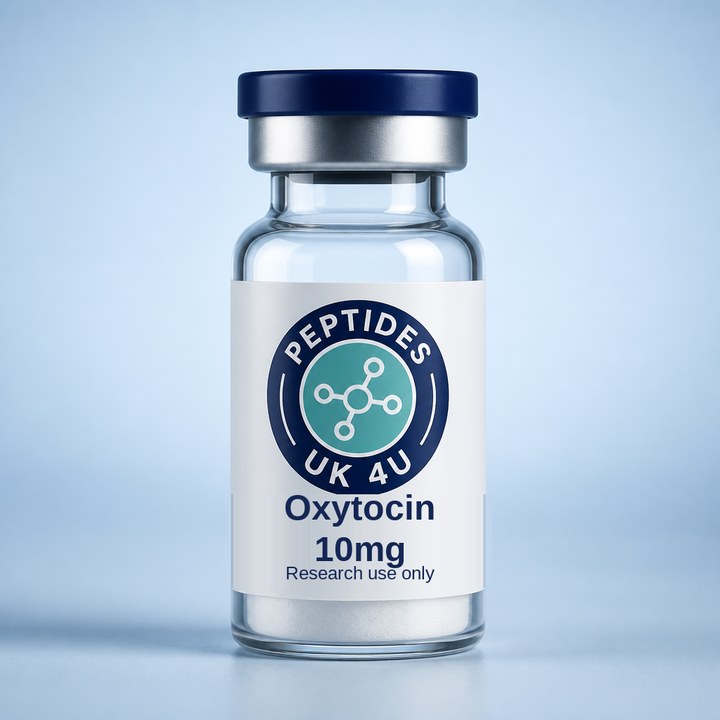
Oxytocin is a hormone that influences social behavior, childbirth, and lactation, available as a 10 mg lyophilized powder for research. It is typically dosed subcutaneously or intranasally at 100-500 mcg daily in research protocols, requiring reconstitution with bacteriostatic water for administration.
- Known for roles in childbirth, lactation, and social bonding.
- Administered via subcutaneous injection or intranasally in research.
- Diluted with 3 mL bacteriostatic water for a concentration of ~3.33 mg/mL.
- Dosage typically increases gradually from 100 mcg to 500 mcg daily.
- Stable for up to 28-30 days in the refrigerator after reconstitution.
Reconstitution
Vial strength
10 mg
Bacteriostatic water
3 mL
Concentration
3.33 mg/mL
1 unit = 0.01 mL = 33.3 mcg
- 1Draw 3.0 mL bacteriostatic water using a sterile syringe.
- 2Slowly inject the water down the inner wall of the oxytocin vial, avoiding direct spraying onto the powder to prevent foaming.
- 3Gently swirl or roll the vial between your hands until the powder is completely dissolved; do not shake the vial.
- 4Label the reconstituted vial with the date and store it in the refrigerator at 2-8 °C (35.6-46.4 °F), protected from light.
Dosing schedule
| Phase | Dose | On a U-100 syringe |
|---|---|---|
| Weeks 1-2 | 100 mcg | 3 units (0.03 mL) |
| Weeks 3-4 | 200 mcg | 6 units (0.06 mL) |
| Weeks 5-6 | 300 mcg | 9 units (0.09 mL) |
| Weeks 7-8 | 400 mcg | 12 units (0.12 mL) |
| Weeks 9-12 | 500 mcg | 15 units (0.15 mL) |
Protocol detail
| Start | Begin with 100 mcg daily for the first two weeks, then increase to 200 mcg for weeks 3-4. |
|---|---|
| Titration | Gradually increase the daily dose by approximately 100 mcg every two weeks, provided it is well-tolerated (300 mcg for weeks 5-6, 400 mcg for weeks 7-8). |
| Target | Reach a target dose of 500 mcg daily by weeks 9-12, which is a common upper limit in research protocols. |
| Frequency | Administer once per day via subcutaneous injection, rotating injection sites regularly. |
| Cycle Length | The protocol typically lasts 8-12 weeks, with an option to extend to 16 weeks. |
| Timing | Injections can be given at any consistent time, as oxytocin's effects are acute due to its rapid clearance. |
Overview at a glance
| Goal | Investigate oxytocin's influence on social behavior, stress reduction, metabolic functions, and pain modulation. |
|---|---|
| Schedule | Daily subcutaneous injections for 8-12 weeks, with an option to extend to 16 weeks. |
| Dose Range | 100-500 mcg daily, achieved through gradual titration. |
| Reconstitution | 3.0 mL bacteriostatic water per 10 mg vial, resulting in a concentration of approximately 3.33 mg/mL for precise unit measurements. |
| Storage | Lyophilized powder can be frozen or refrigerated. Reconstituted solution must be refrigerated and is stable for up to 28-30 days. Avoid repeated freeze-thaw cycles. |
How it works
Oxytocin functions by binding to oxytocin receptors (OXTRs) located throughout the body, both in the brain and peripheral tissues. Within the brain, it acts as a neuromodulator, influencing areas tied to emotion and social behaviors, leading to effects like increased trust and reduced stress. Peripherally, oxytocin induces smooth muscle contractions, such as those in labor, and can also affect pain perception and inflammation, potentially through local nerve and immune cell interactions. While peripheral administration mainly targets OXTRs outside the brain, intranasal delivery is often used in research to directly engage central receptors by bypassing the blood-brain barrier.
Reported effects
- Increased trust and social bonding
- Reduced social anxiety
- Potential for improved social cognition
- Mood modulation and reduced stress
- Analgesic (pain-reducing) effects
- Appetite and metabolic regulation (e.g., reduced caloric intake, increased fat oxidation)
- Potential for weight loss and improved insulin sensitivity
Reported side effects
- Generally well-tolerated at research doses
- No reliable or serious side effects reported with short-term use at typical research doses
Storage
Lyophilised (unmixed)
Freeze at -20 °C (-4 °F) or refrigerate at 2-8 °C (35.6-46.4 °F); protect from light and moisture.
After reconstitution
Refrigerate at 2-8 °C (35.6-46.4 °F) for up to 28-30 days; do not subject to repeated freeze-thaw cycles.
Supplies
| Peptide vials (Oxytocin, 10 mg each) | Approximately 3-6 vials needed for an 8-16 week protocol. |
|---|---|
| Insulin Syringes (U-100) | 7 per week; ensure adequate supply for the protocol length (e.g., 56 for 8 weeks). |
| Bacteriostatic Water (10 mL bottles) | 1-2 bottles needed for reconstitution, using 3.0 mL per vial. |
| Alcohol Swabs | Approximately 14 per week for vial and injection site sanitation; consider 100-count boxes. |
Important notes
- Use new sterile insulin syringes for each injection and dispose of them in a sharps container.
- Rotate injection sites (e.g., abdomen, thighs, upper arms) to minimize local irritation.
- Inject slowly and use aseptic technique to prevent contamination.
- Discard any reconstituted solution that appears cloudy, discolored, or contains particles.
- Maintain detailed records of daily doses and injection sites for consistency.
Frequently asked questions
What is the primary role of oxytocin in the body?
Oxytocin is a hormone well-known for its involvement in social bonding, trust, childbirth, and lactation. In research, it's also explored for its effects on stress, anxiety, and metabolic regulation.
How should I store Oxytocin after it has been mixed?
Once reconstituted with bacteriostatic water, Oxytocin should be stored in the refrigerator at 2-8 °C (35.6-46.4 °F). It remains stable for up to 28-30 days. It's important to protect it from light and avoid refreezing.
Why is gradual dosing recommended for Oxytocin?
A gradual dosing approach, starting at 100 mcg and slowly increasing to 500 mcg over several weeks, allows individuals to assess tolerance and response to the peptide. This method helps in identifying the most effective dose while minimizing potential reactions.
Can Oxytocin be taken intranasally, or is subcutaneous injection the only recommended route?
While this protocol specifically details subcutaneous injection, oxytocin is also studied and administered intranasally in research settings. Intranasal delivery is often considered for studies aiming to target central nervous system receptors more directly.
Educational reference only. These figures summarise how Oxytocin is commonly described in research literature and supplier documentation. They are not a prescription, not medical advice, and not a recommendation to self-administer anything.
Related protocols
Oxytocin (5 mg Vial)
The 'love hormone' influencing social bonds and regulating physiological processes.
IGF-1 LR3 (1 mg Vial)
Extended-release IGF-1 analog for anabolic and metabolic research.
5-Amino-1MQ (10 mg Vial)
Inhibitor of NNMT for metabolic support and fat metabolism.
5-Amino-1MQ (50 mg Vial)
NNMT inhibitor for metabolic support, fat metabolism, and NAD+ levels.