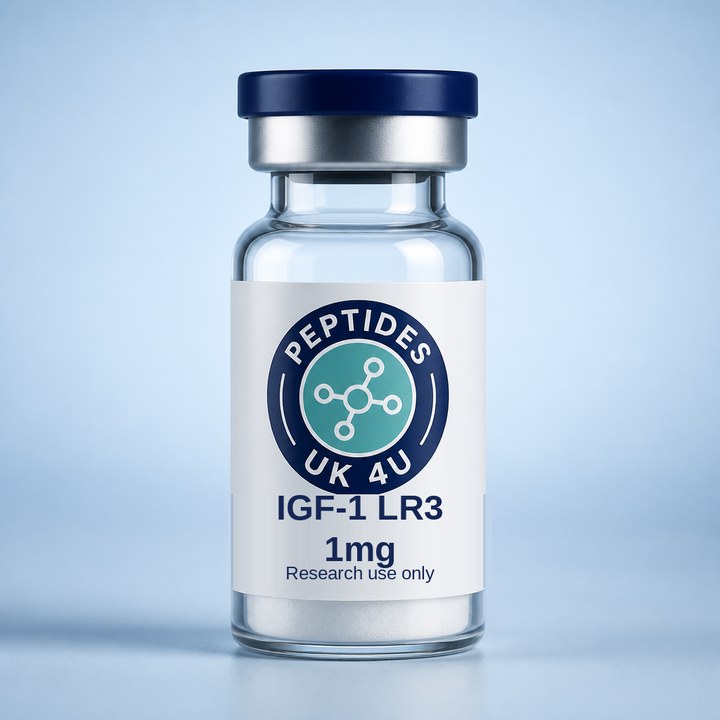
IGF-1 LR3 is a modified version of human IGF-1 designed with an extended half-life, allowing for once-daily dosing in research settings. It is administered via subcutaneous injection, with typical daily doses ranging from 20-50 mcg, often titrated gradually to assess tolerance. The peptide is reconstituted with bacteriostatic water, and careful attention to blood glucose levels is recommended during its use.
- Modified IGF-1 with extended half-life.
- Typical dose range 20-50 mcg daily, gradually increasing.
- Administered subcutaneously, once per day.
- Requires reconstitution with 3.0 mL bacteriostatic water.
- Important to monitor blood glucose due to insulin-like effects.
Reconstitution
Vial strength
1 mg
Bacteriostatic water
3 mL
Concentration
0.333 mg/mL
1 unit = 0.01 mL = 3.33 mcg on a U-100 insulin syringe
- 1Draw 3.0 mL of bacteriostatic water using a sterile syringe.
- 2Slowly inject the water down the inner wall of the IGF-1 LR3 vial to prevent foaming; do not shake the vial.
- 3Gently swirl or roll the vial until the lyophilized powder fully dissolves, creating a clear solution.
- 4Label the reconstituted vial with the date and store it in a refrigerator at 2-8 °C (35.6-46.4 °F), protected from light.
- 5Use the reconstituted solution within 30 days, or aliquot and freeze for longer storage.
Dosing schedule
| Phase | Dose | On a U-100 syringe |
|---|---|---|
| Weeks 1-2 | 20 mcg | 6 units (0.06 mL) |
| Weeks 3-4 | 40 mcg | 12 units (0.12 mL) |
| Weeks 5-8 | 50 mcg | 15 units (0.15 mL) |
Protocol detail
| Start (Weeks 1–2) | Administer 20 mcg daily to assess individual tolerance, with particular attention to potential effects on blood glucose. |
|---|---|
| Titrate (Weeks 3–4) | If the initial 20 mcg dose is well-tolerated without significant hypoglycemic symptoms, increase the daily dose to 40 mcg. |
| Maintain (Weeks 5–8) | Continue with a daily dose of 50 mcg. This level is generally considered the higher end for conservative research protocols. |
| Frequency | Injections are given once per day subcutaneously, often coinciding with meals (morning or post-workout) to help manage insulin-like effects. |
| Cycle Length | An 8-week cycle is standard, though 12-week protocols exist. Responses may diminish beyond weeks 6-8. |
| Site Rotation | Systematically rotate injection sites among the abdomen, thighs, and upper arms to minimize irritation or tissue changes. |
Overview at a glance
| Goal | To investigate anabolic processes and metabolic regulation through enhanced, long-acting IGF-1 activity. |
|---|---|
| Schedule | Daily subcutaneous injections for an 8-week standard cycle, potentially extending to 12 weeks with planned off-periods. |
| Dose Range | 20–50 mcg daily, beginning with gradual titration. Conservative protocols typically remain at or below 50 mcg/day. |
| Reconstitution | Each 1 mg vial is reconstituted with 3.0 mL of bacteriostatic water, yielding a concentration of approximately 0.333 mg/mL (333 mcg/mL) for accurate dosing. |
| Storage | Lyophilized powder should be stored frozen at -20 °C (-4 °F). Once reconstituted, the solution must be refrigerated at 2-8 °C (35.6-46.4 °F) and kept from light. Avoid refreezing thawed solutions. |
| Cycling | A common approach involves 8 weeks of use followed by a 4–8 week break to help prevent potential desensitization of receptors. |
How it works
IGF-1 LR3 is a synthetic analog of human insulin-like growth factor-1. It's modified with an additional 13 amino acids at the N-terminus and a glutamic acid substitution, which significantly reduces its binding to IGF binding proteins. This modification extends the peptide's half-life from minutes to several hours, boosting its systemic availability and allowing for once-daily administration. It exerts anabolic and metabolic effects by binding to IGF-1 receptors, promoting cellular growth and protein synthesis. Due to its insulin-like properties, close monitoring of blood glucose is advised, especially during the initial phases of use. It is intended for research purposes only.
Reported effects
- Enhanced anabolic signaling
- Increased protein synthesis
- Extended system bioavailability
- Metabolic regulatory effects
Reported side effects
- Hypoglycemia risk (low blood sugar)
- Injection site reactions (irritation, redness)
- Potential receptor desensitization with continuous long-term use
Storage
Lyophilised (unmixed)
Store at -20 °C (-4 °F) or colder for up to 12 months. Short-term storage at 2-8 °C (35.6-46.4 °F) is acceptable for several months.
After reconstitution
Refrigerate at 2-8 °C (35.6-46.4 °F) immediately and use within 30 days. For longer storage, prepare aliquots and freeze at -20 °C (-4 °F) for 3-6 months. Avoid repeated freeze-thaw cycles.
Supplies
| Peptide vials (IGF-1 LR3, 1 mg each) | Approx. 3 vials for 8 weeks, 4 vials for 12 weeks, 6 vials for 16 weeks. |
|---|---|
| Insulin Syringes (U-100, 0.5 mL or 1 mL) | Approx. 56 for 8 weeks, 84 for 12 weeks, 112 for 16 weeks (1 per day). |
| Bacteriostatic Water (10 mL bottles) | Approx. 1 bottle for 8 weeks, 2 bottles for 12-16 weeks (3.0 mL per vial). |
| Alcohol Swabs | Approx. 200-300 swabs for 8-16 weeks (2 per day). |
| Sharps Container | For safe disposal of used needles and syringes. |
| Fast-acting carbohydrate source | Glucose tablets or juice, to address potential hypoglycemia. |
Important notes
- Always use a sterile syringe for each injection and dispose of it properly in a sharps container.
- Rotate injection sites regularly to prevent local irritation and tissue hardening.
- Inject slowly and steadily, waiting a few seconds before withdrawing the needle.
- Be aware of hypoglycemia symptoms and keep fast-acting carbohydrates on hand.
- Administer with or after food to help mitigate blood glucose effects.
- Doses above 50–60 mcg/day are not well-supported by research and may increase risks.
Frequently asked questions
What is the primary difference between IGF-1 LR3 and regular IGF-1?
IGF-1 LR3 is a modified version of natural IGF-1 with an extended half-life. This means it stays active in the body for a much longer period, allowing for once-daily dosing compared to the more frequent dosing required for native IGF-1.
Why is it important to take IGF-1 LR3 with food or post-workout?
IGF-1 LR3 has insulin-like effects, which can lower blood glucose levels. Taking it with food or after a workout helps mitigate these effects and reduces the risk of hypoglycemia (low blood sugar).
How should I store IGF-1 LR3 after it has been mixed?
Once reconstituted with bacteriostatic water, IGF-1 LR3 should be refrigerated at 2-8 °C (35.6-46.4 °F) and used within 30 days. For longer storage beyond 30 days, it's best to prepare sterile aliquots and freeze them at -20 °C (-4 °F).
Can IGF-1 LR3 be used continuously without breaks?
It's generally recommended to follow a cycling protocol, such as 8 weeks on and 4-8 weeks off. Continuous use, especially beyond 6-8 weeks, may lead to diminished effects due to potential receptor desensitization.
Educational reference only. These figures summarise how IGF-1 LR3 is commonly described in research literature and supplier documentation. They are not a prescription, not medical advice, and not a recommendation to self-administer anything.
Related protocols
Oxytocin (10 mg Vial)
The 'love hormone' for research into social behavior and metabolism.
5-Amino-1MQ (10 mg Vial)
Inhibitor of NNMT for metabolic support and fat metabolism.
5-Amino-1MQ (50 mg Vial)
NNMT inhibitor for metabolic support, fat metabolism, and NAD+ levels.
HGH 191AA (10IU Vial)
Recombinant human growth hormone for body composition and metabolic health.