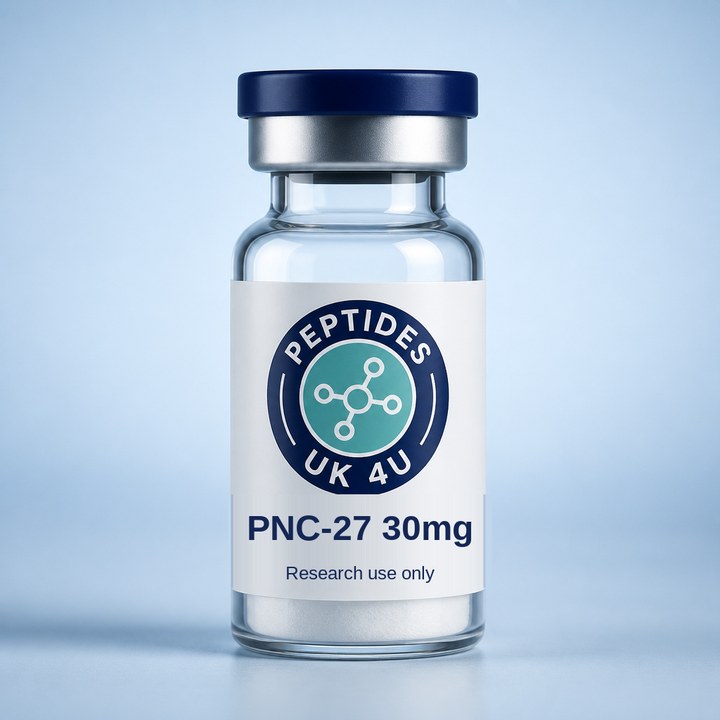
PNC-27 is a synthetic peptide studied preclinically for its selective cytotoxicity towards cancer cells. Educational protocols suggest a daily subcutaneous dose ranging from 100-500 mcg, gradually increasing over time. This peptide is not FDA approved and lacks established human safety data.
- Experimental peptide, not FDA approved for human use.
- Preclinical studies show selective cytotoxicity toward cancer cells.
- Dosed subcutaneously, typically once daily with gradual titration.
- Reconstitute 30 mg with 3.0 mL bacteriostatic water for 10 mg/mL concentration.
- No established human safety or efficacy data exists.
Reconstitution
Vial strength
30 mg
Bacteriostatic water
3 mL
Concentration
10 mg/mL
1 unit = 0.01 mL = 100 mcg
- 1Draw 3.0 mL bacteriostatic water with a sterile syringe.
- 2Inject slowly down the inside wall of the vial, being careful to avoid foaming.
- 3Gently swirl or roll the vial until the peptide is fully dissolved (do not shake).
- 4Label the reconstituted vial and store it in the refrigerator at 2-8 °C (35.6-46.4 °F), protected from light.
Dosing schedule
| Phase | Dose | On a U-100 syringe |
|---|---|---|
| Weeks 1-2 | 100 mcg | 1 unit (0.01 mL) |
| Weeks 3-4 | 200 mcg | 2 units (0.02 mL) |
| Weeks 5-8 | 300 mcg | 3 units (0.03 mL) |
| Weeks 9-12 | 400 mcg | 4 units (0.04 mL) |
| Weeks 13-16 | 500 mcg | 5 units (0.05 mL) |
Protocol detail
| Start | 100 mcg daily for 1-2 weeks; increase by ~100 mcg every 2 weeks as tolerated. |
|---|---|
| Target | 300-500 mcg daily by Weeks 5-16. |
| Frequency | Once per day (subcutaneous). |
| Cycle Length | 8-12 weeks; optional extension to 16 weeks. |
| Timing | Any consistent time; rotate injection sites. |
Overview at a glance
| Goal | Educational exploration of a p53-derived peptide studied preclinically for selective cancer-cell membrane disruption. |
|---|---|
| Schedule | Daily subcutaneous injections for 8-12 weeks (extend to 16 weeks if desired). |
| Dose Range | 100-500 mcg daily with gradual titration. |
| Reconstitution | 3.0 mL per 30 mg vial (10 mg/mL) for simplified unit measurements. |
| Storage | Lyophilized frozen; reconstituted refrigerated; avoid repeated freeze-thaw. |
How it works
PNC-27 is a chimeric peptide combining a segment from the p53 tumor suppressor protein with a membrane-penetrating sequence. Preclinical research suggests it selectively targets and binds to HDM-2 on cancer cell surfaces. This binding reportedly causes membrane destabilization and necrotic cell death, while generally sparing healthy cells. Studies in mouse tumor models have shown it inhibits cancer cell growth. However, it's crucial to note that no human clinical trials have been conducted, and all proposed dosing protocols are theoretical, based solely on preclinical observations.
Reported effects
- Preclinical selective cytotoxicity toward cancer cells
- Mechanisms suggest direct membrane lysis in affected cells
- Potential for cancer cell growth inhibition in mouse models
Reported side effects
- No human safety data available
- Possible injection-site reactions (redness, irritation) with subcutaneous administration
Storage
Lyophilised (unmixed)
Store at -20 °C (-4 °F) or colder, in dry, dark conditions. Short-term refrigeration (2-8 °C) is acceptable for days to weeks.
After reconstitution
Refrigerate at 2-8 °C (35.6-46.4 °F); use within approximately 30 days and avoid freeze-thaw cycles.
Supplies
| Peptide vials | PNC-27, 30 mg each. Approximately 1 vial for 8-12 weeks, 2 vials for 16 weeks. |
|---|---|
| Insulin Syringes | U-100 or 30/50 unit for precision. Approximately 56-112 syringes for 8-16 weeks. |
| Bacteriostatic Water | 10 mL bottles. 3.0 mL per vial for reconstitution. One 10 mL bottle is sufficient for up to 16 weeks. |
| Alcohol Swabs | One for vial stopper + one for injection site daily. 2-3 x 100-count boxes for 8-16 weeks. |
Important notes
- PNC-27 has no FDA approval and no established human safety data.
- This information is strictly for educational and research purposes.
- Always use new sterile insulin syringes and dispose of them in a sharps container.
- Rotate injection sites (abdomen, thighs, upper arms) to reduce local irritation and prevent lipohypertrophy.
- Document daily dose and injection site rotation for consistency.
Frequently asked questions
Is PNC-27 approved for human use?
No, PNC-27 is an experimental compound and is not approved by the FDA for human use. There is no established human safety or efficacy data.
What is the recommended reconstitution for a 30 mg vial of PNC-27?
It is recommended to reconstitute a 30 mg vial with 3.0 mL of bacteriostatic water. This yields a concentration of 10 mg/mL, making it easy to measure doses using a U-100 insulin syringe (1 unit = 100 mcg).
How long can reconstituted PNC-27 be stored?
Once reconstituted, PNC-27 should be refrigerated at 2-8 °C (35.6-46.4 °F) and used within approximately 30 days. Avoid repeated freeze-thaw cycles as this can degrade the peptide.
What are the common side effects observed for PNC-27?
Since there is no human safety data for PNC-27, specific common side effects are unknown. However, with subcutaneous injections in general, local reactions such as redness or irritation at the injection site may occur.
Educational reference only. These figures summarise how PNC-27 is commonly described in research literature and supplier documentation. They are not a prescription, not medical advice, and not a recommendation to self-administer anything.
Related protocols
IGF-1 LR3 (1 mg Vial)
Extended-release IGF-1 analog for anabolic and metabolic research.
Oxytocin (10 mg Vial)
The 'love hormone' for research into social behavior and metabolism.
Semax (10 mg Vial)
Synthetic neurotrophic peptide for intranasal research applications.
Testagen (20 mg Vial)
Synthetic tetrapeptide modulating endocrine function for research protocols.