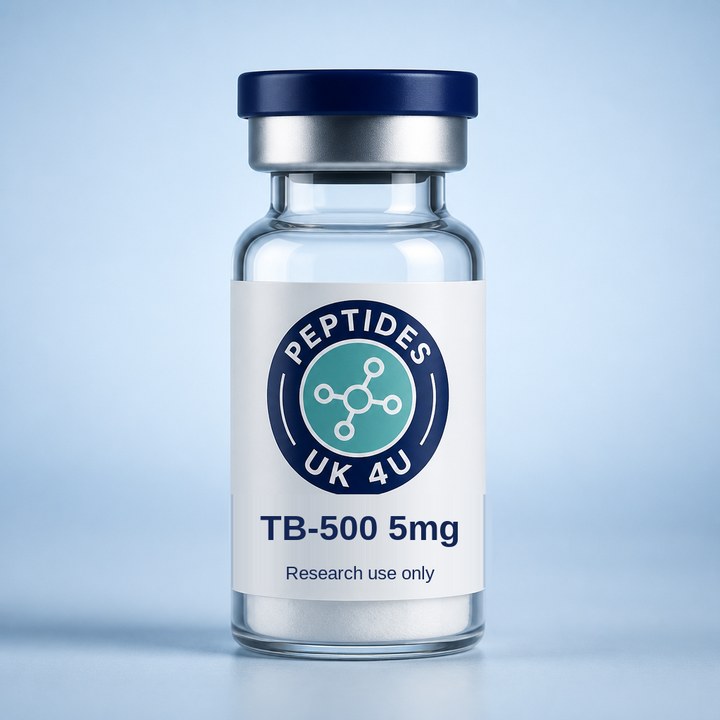
TB-500 is a synthetic peptide fragment derived from thymosin beta-4, a naturally occurring protein involved in tissue repair. This peptide is commonly researched for its potential in wound healing and tissue regeneration, with typical dosing protocols ranging from 500-1000 mcg daily via subcutaneous injection.
- Derived from naturally occurring thymosin beta-4.
- Commonly studied for wound healing and tissue repair.
- Administered via once-daily subcutaneous injection.
- Reconstituted with 3.0 mL bacteriostatic water for easy dosing.
Reconstitution
Vial strength
5 mg
Bacteriostatic water
3 mL
Concentration
1.67 mg/mL
1 unit = 0.01 mL = 16.7 mcg
- 1Draw 3.0 mL of bacteriostatic water using a sterile syringe.
- 2Inject the water slowly down the inside wall of the TB-500 vial, avoiding direct contact with the peptide powder to prevent foaming.
- 3Gently swirl or roll the vial until the powder is completely dissolved; do not shake the vial forcefully.
- 4Label the reconstituted vial with the date and concentration, then refrigerate at 2–8 °C (35.6–46.4 °F), protected from light.
Dosing schedule
| Phase | Dose | On a U-100 syringe |
|---|---|---|
| Weeks 1-2 | 500 mcg | 30 units (0.30 mL) |
| Weeks 3-4 | 600 mcg | 36 units (0.36 mL) |
| Weeks 5-8 | 750 mcg | 45 units (0.45 mL) |
| Weeks 9-12 | 1000 mcg | 60 units (0.60 mL) |
Protocol detail
| Start | Begin with 500 mcg daily, increasing by approximately 100–150 mcg every two weeks as tolerated. |
|---|---|
| Target | Reach a daily dose of 750–1000 mcg by Weeks 5-12. |
| Frequency | Once per day. |
| Cycle Length | Typically 8–12 weeks, with an option to extend to 16 weeks based on research goals. |
| Timing | Administer at a consistent time each day, rotating injection sites systematically. |
Overview at a glance
| Goal | Support tissue repair, wound healing, and angiogenesis. |
|---|---|
| Schedule | Daily subcutaneous injections for 8–12 weeks; extendable to 16 weeks. |
| Dose Range | 500–1000 mcg daily with gradual titration. |
| Reconstitution | 3.0 mL bacteriostatic water per 5 mg vial for 1.67 mg/mL concentration. |
| Storage | Frozen for lyophilized powder; refrigerated for reconstituted solution (avoid freezing). |
How it works
TB-500 is a synthetic fragment mimicking the active region of thymosin beta-4 (Tβ4), a protein naturally involved in cell migration and actin dynamics. This peptide promotes angiogenesis, which is the formation of new blood vessels, and accelerates wound healing by enhancing cell motility and tissue regeneration. Research indicates it supports the repair process by upregulating factors that contribute to collagen deposition and reducing recovery time in injured tissues. Some studies suggest it might function as a prodrug, breaking down into an active pentapeptide metabolite that drives its primary biological effects.
Reported effects
- Accelerated wound healing and tissue repair
- Enhanced angiogenesis (new blood vessel formation)
- Potential reduction in inflammation
- Support for cell migration and regeneration
Reported side effects
- Occasional mild injection-site reactions (redness, tenderness)
- Limited human safety data available
Storage
Lyophilised (unmixed)
Store at -20 °C (-4 °F) in dry, dark conditions; minimize moisture exposure.
After reconstitution
Refrigerate at 2–8 °C (35.6–46.4 °F); do not freeze reconstituted solution. Use within 28 days.
Supplies
| Peptide vials | Approximately 8-16 vials (5 mg each) for an 8-16 week protocol. |
|---|---|
| Insulin Syringes (U-100) | Around 56-112 syringes for an 8-16 week protocol (7 per week). |
| Bacteriostatic Water | Use 3.0 mL per 5 mg vial for reconstitution; typically 3-5 bottles of 10 mL. |
| Alcohol Swabs | Roughly 112-224 swabs for an 8-16 week protocol (2 per day). |
Important notes
- Use a new sterile insulin syringe for each injection and dispose of it in a sharps container.
- Rotate injection sites (e.g., abdomen, thighs, upper arms) to prevent irritation.
- Inject slowly and wait a few seconds before withdrawing the needle to prevent backflow.
- TB-500 is not FDA-approved for human use and is banned by WADA for athletic performance.
Frequently asked questions
How does TB-500 differ from Thymosin Beta-4?
TB-500 is a synthetic fragment (Ac-LKKTETQ) that represents the active region of the larger, naturally occurring 43-amino-acid protein, Thymosin Beta-4 (Tβ4). While Tβ4 has diverse roles, TB-500 specifically focuses on the actin-binding and cell-migration properties critical for its regenerative effects.
Can TB-500 be stacked with other peptides?
Yes, TB-500 is often studied in conjunction with other peptides, particularly BPC-157, to create synergistic effects for enhanced healing and recovery. Blends combining these peptides are common in research protocols.
Why is it important to rotate injection sites?
Rotating injection sites in areas like the abdomen, thighs, and upper arms helps to prevent local irritation, tissue damage, and the formation of lipohypertrophy (fat lumps) that can occur from repeated injections in the same spot. It also helps ensure consistent absorption of the peptide.
What is bacteriostatic water and why is it used for reconstitution?
Bacteriostatic water for injection contains 0.9% benzyl alcohol as a preservative, which inhibits the growth of most common contaminating bacteria. This allows for multi-dose use of a reconstituted peptide vial over several weeks, maintaining sterility and shelf-life.
Educational reference only. These figures summarise how TB-500 is commonly described in research literature and supplier documentation. They are not a prescription, not medical advice, and not a recommendation to self-administer anything.
Related protocols
TB-500 (10 mg Vial)
Accelerates healing and tissue repair with daily subcutaneous injections.
BPC-157 (5 mg Vial)
A synthetic gastric peptide investigated for tissue repair and healing.
GHK-Cu (50 mg Vial)
Naturally occurring copper peptide for tissue remodeling and skin repair.
MGF (5 mg Vial)
Supports muscle repair and regeneration through localized growth factor signaling.