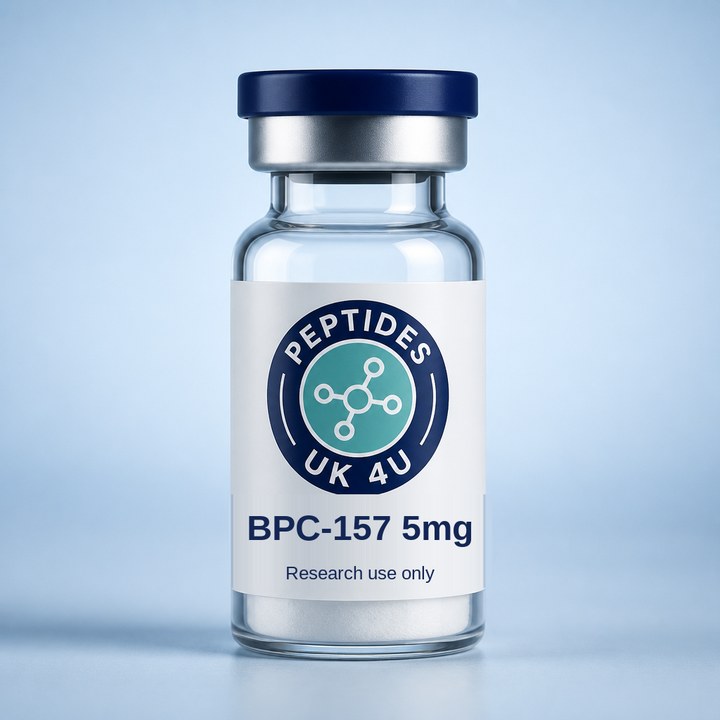
BPC-157 is a synthetic peptide studied for its potential in tissue healing and repair. Derived from a human gastric protein, it has shown promise in preclinical models for accelerating wound recovery and reducing inflammation. Dosing protocols typically involve daily subcutaneous injections, titrating the dose over several weeks.
- 200-600 mcg daily by subcutaneous injection.
- Reconstitute 5 mg vial with 3.0 mL bacteriostatic water for 1.67 mg/mL concentration.
- 1 unit on a U-100 syringe equals approximately 16.7 mcg.
- Preclinical studies indicate benefits for tissue healing and anti-inflammatory effects.
- Human clinical data is limited, mainly to early safety trials.
Reconstitution
Vial strength
5 mg
Bacteriostatic water
3 mL
Concentration
1.67 mg/mL
1 unit = 0.01 mL = 16.7 mcg
- 1Draw 3.0 mL of bacteriostatic water with a sterile syringe.
- 2Slowly inject the water down the inner wall of the BPC-157 vial, being careful to avoid creating foam.
- 3Gently swirl or roll the vial until the powder completely dissolves; do not shake.
- 4Label the reconstituted vial with the date and refrigerate it at 2–8 °C (35.6–46.4 °F), protected from light.
Dosing schedule
| Phase | Dose | On a U-100 syringe |
|---|---|---|
| Weeks 1-2 | 200 mcg | 12 units (0.12 mL) |
| Weeks 3-4 | 400 mcg | 24 units (0.24 mL) |
| Weeks 5-8+ | 600 mcg | 36 units (0.36 mL) |
Protocol detail
| Start | Begin with 200 mcg daily and incrementally increase the dose by roughly 200 mcg every two weeks, as tolerated. |
|---|---|
| Target | Aim to reach a daily dose of 400–600 mcg by Weeks 5–8 and beyond. |
| Frequency | Administer one subcutaneous injection per day. |
| Cycle Length | The duration of the cycle is typically 8–12 weeks, with the possibility of extending it to 16 weeks. |
| Timing | Inject at a consistent time each day, remembering to rotate injection sites regularly. |
Overview at a glance
| Goal | To support the body's natural tissue healing and recovery processes based on preclinical research findings. |
|---|---|
| Schedule | Daily subcutaneous injections for an initial period of 8–12 weeks, with an option to extend to 16 weeks. |
| Dose Range | A daily dose of 200–600 mcg, gradually increased over the protocol duration. |
| Reconstitution | Mix a 5 mg vial with 3.0 mL of bacteriostatic water, resulting in a concentration of approximately 1.67 mg/mL for precise unit measurements. |
| Storage | Keep lyophilized peptide frozen; once reconstituted, store in the refrigerator. Prevent repeated freezing and thawing cycles. |
How it works
BPC-157 is a synthetic 15-amino-acid peptide derived from a human gastric protein capable of modulating nitric oxide pathways and growth-factor expression. Preclinical studies suggest it promotes angiogenesis and collagen deposition, which are crucial for repairing damaged tissues. Animal models have shown accelerated healing in various injuries, including those of the gut, tendons, ligaments, and muscles. While initial human safety trials have been conducted, comprehensive efficacy data from large-scale human studies are still emerging, meaning its full therapeutic potential and mechanisms in humans are under active investigation.
Reported effects
- Supports tissue repair in gut, tendon, muscle, and skin injury models (animal studies)
- Exhibits anti-inflammatory and cytoprotective effects in preclinical settings
- Reported good tolerability in Phase I safety studies without serious adverse events
Reported side effects
- Occasional mild injection-site reactions (redness, itching)
- Long-term human safety and efficacy are still being investigated
Storage
Lyophilised (unmixed)
Store at -20 °C (-4 °F) in dry, dark conditions; minimize moisture exposure. Allow to reach room temperature before opening.
After reconstitution
Refrigerate at 2–8 °C (35.6–46.4 °F); avoid freeze–thaw cycles. Protect from light.
Supplies
| Peptide vials (BPC-157, 5 mg each) | For an 8-week protocol, approximately 6 vials; for 12 weeks, 9 vials; and for 16 weeks, 12 vials. |
|---|---|
| Insulin Syringes (U-100) | You will need 7 syringes per week. This equates to 56 for 8 weeks, 84 for 12 weeks, and 112 for 16 weeks. |
| Bacteriostatic Water (10 mL bottles) | Plan to use about 3.0 mL per vial. This means 2 bottles for 8 weeks, 3 for 12 weeks, and 4 for 16 weeks. |
| Alcohol Swabs | Use one for the vial stopper and one for the injection site daily. Roughly 14 swabs per week; 112 for 8 weeks (2 x 100-count boxes), 168 for 12 weeks (2 x 100-count boxes), and 224 for 16 weeks (3 x 100-count boxes). |
Important notes
- Always use a new, sterile insulin syringe for each injection and dispose of it in a sharps container.
- Rotate injection sites frequently (e.g., abdomen, thighs, upper arms) to minimize local skin irritation.
- Inject slowly and allow a few seconds before removing the needle.
- Keep a record of your daily dose and injection site rotation.
- Human data for BPC-157 is preliminary; consult a qualified healthcare provider for clinical decisions.
Frequently asked questions
What is BPC-157 and what is it used for?
BPC-157 is a synthetic peptide derived from human gastric protein, primarily studied for its potential in tissue healing and repair. Preclinical research suggests it may help with wound recovery and reduce inflammation in various tissues like gut, tendons, and muscles.
How do I reconstitute BPC-157?
To reconstitute a 5 mg vial, draw 3.0 mL of bacteriostatic water with a sterile syringe. Slowly inject the water down the side of the vial to avoid foaming, then gently swirl or roll the vial until the peptide dissolves completely. Do not shake the vial.
What is the typical dosing schedule for BPC-157?
A common protocol starts with 200 mcg daily for the first 1-2 weeks. The dose can then be gradually increased by approximately 200 mcg every two weeks, aiming for 400-600 mcg daily by weeks 5-8. Injections are typically subcutaneous and once daily.
Are there any side effects or important considerations for BPC-157?
Mild injection site reactions, such as redness or itching, may occur. It's crucial to rotate injection sites daily and always use sterile supplies. While preclinical data is promising, comprehensive human clinical data is still limited, so any clinical decisions should be made in consultation with a qualified healthcare provider.
Educational reference only. These figures summarise how BPC-157 is commonly described in research literature and supplier documentation. They are not a prescription, not medical advice, and not a recommendation to self-administer anything.
Related protocols
BPC-157 (10 mg Vial)
A synthetic peptide studied for tissue protection and accelerated healing.
KLOW (80 mg Blend)
Multi-peptide blend for enhanced healing, regeneration, and anti-inflammatory support.
Ara-290 (16 mg Vial)
Targets innate repair receptor for anti-inflammatory and tissue-protective effects.
GHK-Cu (100 mg Vial)
Copper peptide supporting collagen, tissue repair, and antioxidant benefits.