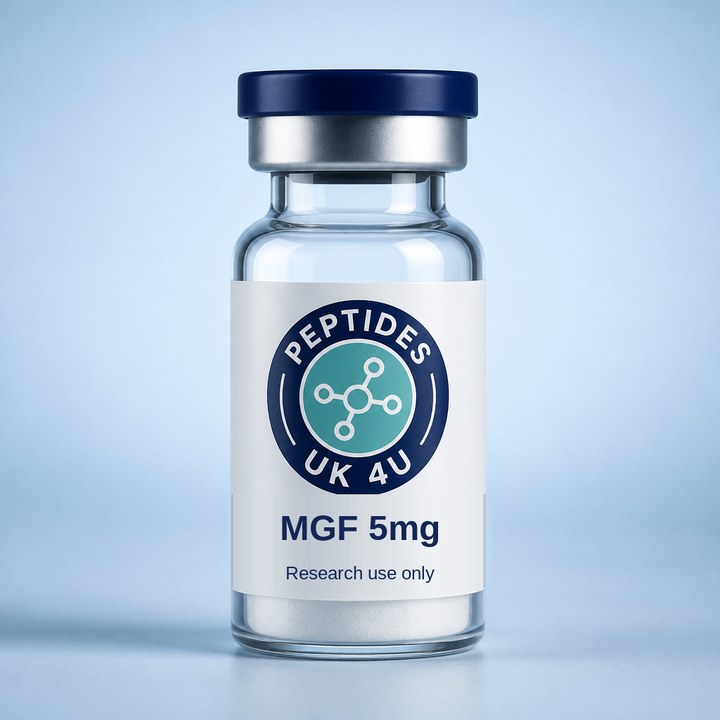
MGF is a peptide that plays a role in muscle repair and regeneration. This protocol outlines a daily subcutaneous injection approach, with doses ranging from 100-300 mcg, gradually increasing over an 8-12 week cycle. It is reconstituted at a concentration of approximately 1.67 mg/mL for precise dosing.
- Derived from IGF-1, activated by mechanical stress.
- Dosed subcutaneously once daily.
- Gradual titration from 100 mcg to 300 mcg over several weeks.
- Requires reconstitution with 3.0 mL bacteriostatic water.
- Primarily acts as a localized tissue repair signal.
Reconstitution
Vial strength
5 mg
Bacteriostatic water
3 mL
Concentration
1.67 mg/mL
1 unit = 0.01 mL = 16.7 mcg
- 1Draw 3.0 mL bacteriostatic water with a sterile syringe.
- 2Inject slowly down the vial wall; avoid foaming.
- 3Gently swirl or roll until dissolved (do not shake).
- 4Label and refrigerate at 2-8 °C (35.6-46.4 °F), protected from light; use within approximately 30 days.
Dosing schedule
| Phase | Dose | On a U-100 syringe |
|---|---|---|
| Week 1 | 100 mcg | 6 units (0.06 mL) |
| Week 2 | 150 mcg | 9 units (0.09 mL) |
| Week 3 | 200 mcg | 12 units (0.12 mL) |
| Week 4 | 250 mcg | 15 units (0.15 mL) |
| Weeks 5-8 | 300 mcg | 18 units (0.18 mL) |
Protocol detail
| Start | 100 mcg daily; increase by approximately 50 mcg weekly as tolerated. |
|---|---|
| Target | 250-300 mcg daily by Weeks 4-8. |
| Frequency | Once per day (subcutaneous). |
| Cycle Length | 8-12 weeks; optional extension to 16 weeks. |
| Timing | Any consistent time; rotate injection sites. |
Overview at a glance
| Goal | Support tissue repair and regenerative processes through localized growth factor signaling. |
|---|---|
| Schedule | Daily subcutaneous injections for 8-12 weeks (extend to 16 weeks if desired). |
| Dose Range | 100-300 mcg daily with gradual titration. |
| Reconstitution | 3.0 mL per 5 mg vial (~1.67 mg/mL) for accurate unit measurements. |
| Storage | Lyophilized frozen; reconstituted refrigerated; avoid repeated freeze-thaw. |
How it works
MGF is created when the IGF-1 gene is spliced in response to mechanical stress or tissue injury. This peptide has a unique C-terminal E domain that sets it apart from systemic IGF-1. Studies suggest MGF activates satellite cells (muscle stem cells), stimulates osteoblast proliferation, and supports neurogenesis. Its effects are localized and temporary, indicating it functions primarily as a tissue-specific repair signal rather than a body-wide growth factor, promoting healing where it's needed most.
Reported effects
- Promotes satellite cell activation and myoblast proliferation in muscle tissue.
- Supports bone defect healing and osteoblast activity in animal models.
- May promote neurogenesis and neuroprotection in aging brain tissue.
Reported side effects
- Generally well tolerated in preclinical settings.
- Occasional mild injection-site reactions may occur.
- Long-term safety data in humans is limited.
Storage
Lyophilised (unmixed)
Store at -20 °C (-4 °F) or colder for long-term; refrigerate at 4 °C (39.2 °F) for short-term.
After reconstitution
Refrigerate at 2-8 °C (35.6-46.4 °F); use within approximately 30 days; avoid freeze-thaw cycles.
Supplies
| Peptide vials (MGF, 5 mg each) | Approximately 3 vials for 8 weeks, 5 vials for 12 weeks, and 8 vials for 16 weeks. |
|---|---|
| Insulin Syringes (U-100) | Approximately 56 for 8 weeks, 84 for 12 weeks, and 112 for 16 weeks (one per day). |
| Bacteriostatic Water (10 mL bottles) | 1 bottle for 8-week cycle, 2 bottles for 12-week cycle, 3 bottles for 16-week cycle. |
| Alcohol Swabs | Approximately 112 for 8 weeks, 168 for 12 weeks, and 224 for 16 weeks (two per day). |
Important notes
- Use new sterile insulin syringes and dispose of them correctly in a sharps container.
- Rotate injection sites (abdomen, thighs, upper arms) to reduce local irritation.
- Inject slowly; wait a few seconds before withdrawing the needle.
- Document daily dose and site rotation to maintain consistency and track progress.
Frequently asked questions
What is the primary function of MGF?
MGF (Mechano Growth Factor) is primarily known for its role in localized muscle repair, satellite cell activation, and tissue regeneration, particularly in response to mechanical stress or injury.
How long should I cycle MGF?
A typical MGF cycle is 8-12 weeks, with an optional extension up to 16 weeks, following a gradual titration schedule for daily subcutaneous injections.
Why is it important to rotate injection sites?
Rotating injection sites (e.g., abdomen, thighs, upper arms) helps prevent localized irritation, scar tissue formation, and improves absorption of the peptide.
Can I use MGF for systemic growth?
No, MGF is understood to act as a localized, transient repair signal rather than a systemic growth factor. Its effects are primarily focused on the site of action, differentiating it from other growth factors like IGF-1.
Educational reference only. These figures summarise how MGF is commonly described in research literature and supplier documentation. They are not a prescription, not medical advice, and not a recommendation to self-administer anything.
Related protocols
BPC-157 + TB-500 (10 mg Blend)
Advanced blend for tissue repair, wound healing, and recovery.
KLOW (80 mg Blend)
Multi-peptide blend for enhanced healing, regeneration, and anti-inflammatory support.
Tri-Heal (45 mg Blend)
Advanced blend for tissue repair and inflammation modulation.
BPC-157 (10 mg Vial)
A synthetic peptide studied for tissue protection and accelerated healing.