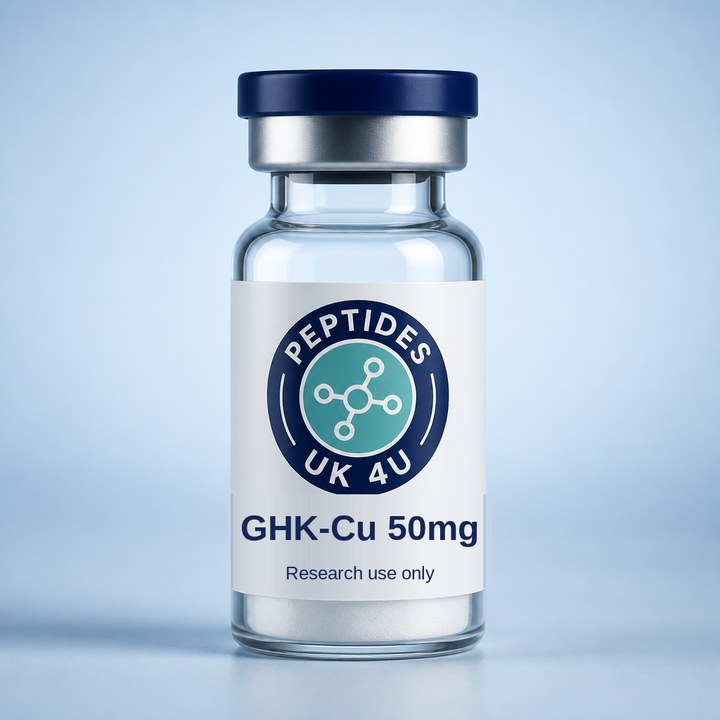
GHK-Cu is a naturally occurring copper peptide studied for its roles in tissue remodeling, antioxidant defense, and skin repair. This protocol outlines its use with a 50 mg vial, reconstituted to a specific concentration for subcutaneous administration, with varying dosage regimens for research purposes.
- 50 mg vial reconstituted with 3.0 mL for a 16.67 mg/mL concentration.
- Dosages range from 1.0 mg to 2.0 mg per injection.
- Administered subcutaneously 3 to 5 days per week.
- 1.0 mg equals 6 units, 1.5 mg equals 9 units, and 2.0 mg equals 12 units on a U-100 syringe.
Reconstitution
Vial strength
50 mg
Bacteriostatic water
3 mL
Concentration
16.67 mg/mL
1 unit = 0.01 mL = 166.7 mcg
- 1Draw 3.0 mL of sterile diluent (bacteriostatic water) using a sterile syringe.
- 2Carefully add the diluent to the GHK-Cu vial, allowing it to run down the inside wall to prevent foaming.
- 3Gently swirl or roll the vial until the peptide is completely dissolved; do not shake vigorously.
- 4Label the reconstituted vial with the concentration (16.67 mg/mL), preparation date, and storage instructions.
Dosing schedule
| Phase | Dose | On a U-100 syringe |
|---|---|---|
| Weeks 1-4 | 1.0 mg (1000 mcg) | 6 units (0.06 mL) |
| Weeks 5-8 | 1.5 mg (1500 mcg) | 9 units (0.09 mL) |
| Weeks 9-12+ | 2.0 mg (2000 mcg) | 12 units (0.12 mL) |
Protocol detail
| Standard Model | Weeks 1-4 at 1.0 mg (6 units); Weeks 5-8 at 1.5 mg (9 units); Weeks 9-12+ at 2.0 mg (12 units), 5 days per week. |
|---|---|
| Alternative Model | 2.0 mg (12 units), three times per week (e.g., Monday, Wednesday, Friday). |
| Route Context | Calculations are for subcutaneous research use. |
| Cycle Context | The main schedule spans 8 to 12+ weeks, with supply planning for up to 16 weeks. |
Overview at a glance
| Goal | To provide research dosage, reconstitution, supply, and measurement details for GHK-Cu in a consistent protocol. |
|---|---|
| Schedule | Standard schedule uses 5 days per week; an alternative uses 3 times per week. |
| Amount Range | 1.0 mg to 2.0 mg per administration in research protocols. |
| Reconstitution | A final volume of 3.0 mL yields 16.67 mg/mL. |
| Measurement | 1.0 mg = 6 units, 1.5 mg = 9 units, and 2.0 mg = 12 units on a U-100 syringe. |
How it works
GHK-Cu is a naturally occurring peptide that binds copper and plays a role in extracellular matrix signaling and remodeling. It has been researched for its involvement in collagen-related pathways, antioxidant defense, and tissue repair. Studies have explored its effects in human topical applications for skin and wound care, and an animal model provided insight into local administration. The observed effects are linked to the specific route, formulation, concentration, and design of each study, with current research highlighting its potential in regenerative processes.
Reported effects
- Supports research on collagen-related signaling and tissue repair.
- Examined in human topical and wound-care studies for skin outcomes.
- Linked to extracellular matrix remodeling and antioxidant defense.
Reported side effects
Storage
Lyophilised (unmixed)
Store according to vial and batch documentation, protecting from moisture, light, and temperature extremes.
After reconstitution
Stability is dependent on concentration, pH, diluent, sterility, container, preservatives, and temperature. Minimize light and moisture exposure. Record preparation date, concentration, and disposal date.
Supplies
| Peptide vials | 1-3 vials of 50 mg GHK-Cu, depending on protocol length (8-16 weeks). |
|---|---|
| Insulin Syringes (U-100, 29-31 gauge) | 24-80 syringes, depending on protocol length and frequency. |
| Sterile or Bacteriostatic Water (10 mL bottles) | 3-9 mL needed, depending on the number of vials. |
| Alcohol Swabs | 48-160 swabs for preparing vial stoppers and injection sites. |
Important notes
- Always use sterile equipment for each preparation and administration.
- Follow aseptic technique, ensuring the skin antiseptic dries before injection.
- Rotate injection sites systematically and dispose of sharps safely.
- Document the date, amount, preparation identifier, and injection site for consistent research.
Frequently asked questions
What is the recommended reconstitution for a 50 mg GHK-Cu vial?
For a 50 mg GHK-Cu vial, it is recommended to reconstitute with 3.0 mL of sterile or bacteriostatic water, resulting in a concentration of 16.67 mg/mL.
How do I measure the correct dose of GHK-Cu using a U-100 syringe?
When reconstituted to 16.67 mg/mL, 1.0 mg of GHK-Cu equals 6 units, 1.5 mg equals 9 units, and 2.0 mg equals 12 units on a U-100 insulin syringe.
Can I use GHK-Cu every day?
The standard protocol suggests administration 5 days per week, with an alternative protocol using it 3 times per week. Daily use without breaks is not specified in the protocol.
What are the key differences between the standard and alternative dosing protocols?
The standard protocol for GHK-Cu involves increasing doses from 1.0 mg to 2.0 mg over 12+ weeks, administered 5 days per week. The alternative protocol maintains a consistent dose of 2.0 mg, administered 3 times per week over the same period.
Educational reference only. These figures summarise how GHK-Cu is commonly described in research literature and supplier documentation, including the GHK-Cu listing at peptidesuk4u.co.uk. They are not a prescription, not medical advice, and not a recommendation to self-administer anything.
Related protocols
GHK-Cu (100 mg Vial)
Copper peptide supporting collagen, tissue repair, and antioxidant benefits.
MGF (5 mg Vial)
Supports muscle repair and regeneration through localized growth factor signaling.
TB-500 (10 mg Vial)
Accelerates healing and tissue repair with daily subcutaneous injections.
TB-500 (5 mg Vial)
Accelerates healing and tissue repair for enhanced recovery.