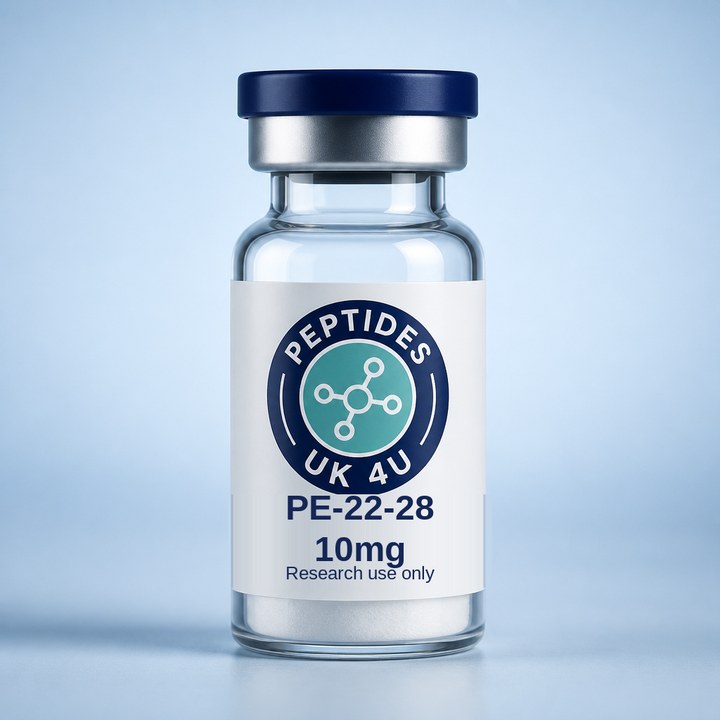
PE-22-28 is a synthetic heptapeptide derived from a sortilin propeptide, designed to act as a selective antagonist of TREK-1 potassium channels. Research protocols suggest daily subcutaneous injections, with dosages typically ranging from 50 to 200 mcg, gradually increasing over an 8-16 week cycle.
- Synthetic heptapeptide targeting TREK-1 potassium channels.
- Preclinical studies indicate rapid antidepressant-like effects.
- Promotes neurogenesis and neuroprotection.
- Dosed subcutaneously, gradually increasing from 50 mcg up to 200 mcg daily.
- Reconstitute 10 mg vial with 3.0 mL bacteriostatic water for a 3.33 mg/mL concentration.
Reconstitution
Vial strength
10 mg
Bacteriostatic water
3 mL
Concentration
3.33 mg/mL
1 unit = 0.01 mL = 33.3 mcg
- 1Draw 3.0 mL of bacteriostatic water using a sterile syringe.
- 2Carefully inject the water down the inner wall of the PE-22-28 vial, avoiding direct impact on the peptide powder.
- 3Gently swirl or roll the vial until the peptide completely dissolves; do not shake.
- 4Label the reconstituted vial with the date and refrigerate it at 2–8 °C (35.6–46.4 °F), keeping it protected from light.
Dosing schedule
| Phase | Dose | On a U-100 syringe |
|---|---|---|
| Weeks 1-2 | 50 mcg | 1.5 units (0.015 mL) |
| Weeks 3-8 | 100 mcg | 3 units (0.03 mL) |
| Weeks 9-12 (Optional) | 150 mcg | 4.5 units (0.045 mL) |
| Weeks 13-16 (Optional) | 200 mcg | 6 units (0.06 mL) |
Protocol detail
| Start | Begin with 50 µg daily for Weeks 1–2 to assess tolerability. |
|---|---|
| Increase | Advance to 100 µg daily for Weeks 3–8 as a standard maintenance dose. |
| Optional Titration | If well-tolerated and further effects are desired, consider 150 µg for Weeks 9–12 or 200 µg for Weeks 13–16. |
| Frequency | Once per day, administered subcutaneously. |
| Cycle Length | Typically 12–16 weeks, with an 8-week minimum. |
| Timing | Administer at a consistent time each day and systematically rotate injection sites. |
Overview at a glance
| Goal | Support rapid neuroplasticity, mood regulation, and neuroprotection through selective TREK-1 inhibition. |
|---|---|
| Schedule | Daily subcutaneous injections for 12–16 weeks (minimum 8 weeks). |
| Dose Range | 50–200 µg daily with conservative titration; 100–150 µg is often sufficient. |
| Reconstitution | 3.0 mL per 10 mg vial (~3.33 mg/mL) for precise low-volume measurements. |
| Storage | Lyophilized frozen; reconstituted refrigerated; replace vials every 4 weeks. |
How it works
PE-22-28 acts as a potent and selective inhibitor of TREK-1 potassium channels. This inhibition leads to neuronal depolarization, increasing the excitability and firing of serotonergic neurons, consequently boosting monoamine neurotransmission. Preclinical studies show this mechanism rapidly induces antidepressant-like effects, enhanced neurogenesis, and synaptogenesis, typical changes that usually take weeks with traditional antidepressants. It also activates CaMKII/CREB pathways, supporting neuronal survival and plasticity. PE-22-28 is a modified spadin analog with higher potency and longer duration, and it has demonstrated neuroprotective qualities in stroke models.
Reported effects
- Rapid antidepressant effects in preclinical models
- Enhanced neuroplasticity, neurogenesis, and synaptogenesis
- Neuroprotective qualities, particularly in stroke models
- Favorable safety profile with no cardiac or metabolic side effects observed preclinically
Reported side effects
- No TREK-1-related side effects or withdrawal observed (preclinical)
- Potential for mild injection-site reactions (redness, tenderness)
- No human data available; all evidence is from cell culture and animal studies
Storage
Lyophilised (unmixed)
Freeze at -20 °C (-4 °F) in dry, dark conditions; minimize moisture exposure.
After reconstitution
Refrigerate at 2–8 °C (35.6–46.4 °F), protected from light. Use within 4 weeks for optimal potency, replace vial every 4 weeks.
Supplies
| Peptide vials | 10 mg PE-22-28 vials. Typically 2 vials for 8 weeks, 3 for 12 weeks, and 4 for 16 weeks to ensure potency by replacing every 4 weeks. |
|---|---|
| Insulin Syringes (U-100) | Approximately 7 syringes per week (1 per day). Examples: 56 for 8 weeks, 84 for 12 weeks, 112 for 16 weeks. Consider 30- or 50-unit syringes for doses under 10 units. |
| Bacteriostatic Water | 10 mL bottles. Approximately 3.0 mL per vial for reconstitution. Examples: one 10 mL bottle for 8-12 weeks, two 10 mL bottles for 16 weeks. |
| Alcohol Swabs | Two per day (one for vial, one for injection site). Examples: 112 for 8 weeks (~two 100-count boxes), 168 for 12 weeks (~two 100-count boxes), 224 for 16 weeks (~three 100-count boxes). |
Important notes
- Always use a new, sterile insulin syringe for each injection and dispose of it immediately in a sharps container.
- Systematically rotate injection sites (abdomen, thighs, upper arms) to minimize local irritation and ensure consistent absorption.
- Inject slowly and wait a few seconds before withdrawing the needle to prevent leakage.
- Document daily doses, site rotations, and any observations to maintain protocol adherence and consistency.
- Due to PE-22-28's high potency, conservative dosing is recommended, as many preclinical effects manifest at low microgram ranges.
Frequently asked questions
What is the optimal concentration for PE-22-28 after reconstitution?
To ensure precise dosing for low volumes, it's recommended to reconstitute a 10 mg PE-22-28 vial with 3.0 mL of bacteriostatic water, resulting in a concentration of approximately 3.33 mg/mL. This makes it easier to measure small doses using typical insulin syringes.
How long can reconstituted PE-22-28 be stored?
After reconstitution, PE-22-28 should be refrigerated at 2–8 °C (35.6–46.4 °F) and protected from light. For optimal potency, it's advised to use the reconstituted solution within 4 weeks and replace the vial with a fresh one even if some peptide remains, due to bacteriostatic water's sterility guarantee of 28 days after first puncture.
Why is gradual dose titration recommended for PE-22-28?
Gradual dose titration, starting at 50 mcg and slowly increasing, allows the user to assess individual tolerance and response. Given PE-22-28's high potency, many individuals find lower doses (100–150 mcg) to be sufficient, and a conservative approach helps determine the minimum effective dose while minimizing potential reactions.
Are there any human studies available for PE-22-28?
Currently, all available evidence and research regarding PE-22-28 are derived from cell culture and animal studies. There are no published human clinical trials, and thus, its safety profile and pharmacokinetics in humans remain unestablished. This peptide is intended for research purposes only and not for human consumption.
Educational reference only. These figures summarise how PE-22-28 is commonly described in research literature and supplier documentation, including the PE-22-28 listing at peptidesuk4u.co.uk. They are not a prescription, not medical advice, and not a recommendation to self-administer anything.
Related protocols
Adamax (10 mg Vial)
Advanced nootropic for enhanced cognition, neuroprotection, and neuroplasticity.
Ara-290 (16 mg Vial)
Targets innate repair receptor for anti-inflammatory and tissue-protective effects.
Cerebrolysin (60 mg Vial)
Porcine-derived peptide supporting brain health and neuronal function.
Oxytocin (10 mg Vial)
The 'love hormone' for research into social behavior and metabolism.