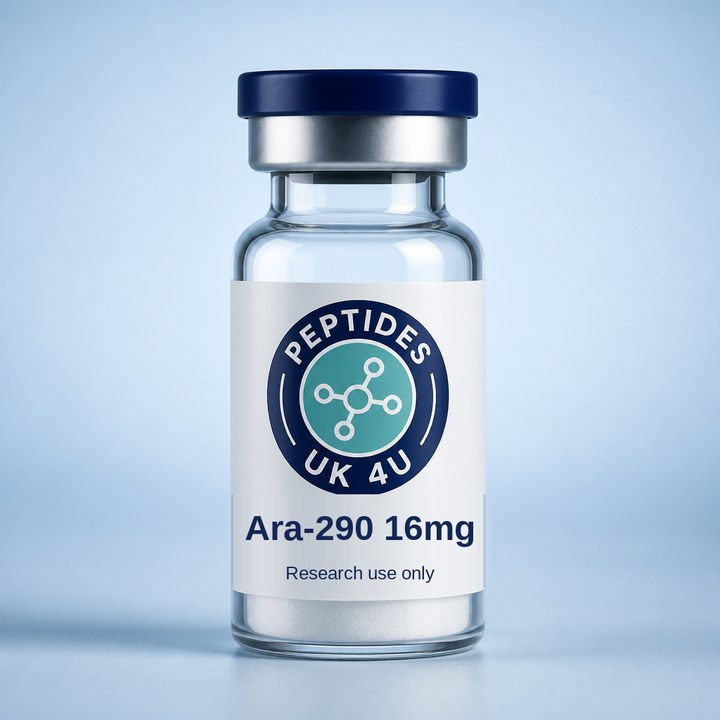
Ara-290 is an 11-amino acid peptide derived from erythropoietin that selectively activates the innate repair receptor (IRR). This activation promotes anti-inflammatory and tissue-protective effects without stimulating red blood cell production. It is typically dosed via subcutaneous injection.
- Derived from erythropoietin's helix-B domain.
- Activates the innate repair receptor (IRR) for healing.
- Does not stimulate red blood cell production.
- Clinical trials show benefits for diabetic and sarcoidosis-related neuropathies.
- Dosing typically starts at 2 mg then increases to 4 mg daily.
Reconstitution
Vial strength
16 mg
Bacteriostatic water
2 mL
Concentration
8 mg/mL
1 unit = 0.01 mL = 80 mcg
- 1Draw 2.0 mL of bacteriostatic water with a sterile syringe.
- 2Inject the water slowly down the inside wall of the Ara-290 vial to avoid foaming.
- 3Gently swirl or roll the vial until the peptide powder is completely dissolved; do not shake vigorously.
- 4Label the vial with the reconstitution date and store it in the refrigerator at 2–8 °C, protected from light.
Dosing schedule
| Phase | Dose | On a U-100 syringe |
|---|---|---|
| Week 1 | 2 mg | 25 units (0.25 mL) |
| Weeks 2-8 (or up to 16) | 4 mg | 50 units (0.50 mL) |
Protocol detail
| Start | Administer 2 mg daily during the initial week to assess individual tolerance. |
|---|---|
| Target | Increase to 4 mg daily from week 2 onward for the duration of the cycle. |
| Frequency | Once per day via subcutaneous injection. |
| Cycle Length | Standard cycle is 4–8 weeks, with potential extension up to 16 weeks based on individual needs. |
| Timing | Inject at a consistent time each day and ensure rotation of injection sites. |
Overview at a glance
| Goal | Support tissue protection, anti-inflammatory signaling, and neuropathic symptom management through IRR activation. |
|---|---|
| Schedule | Daily subcutaneous injections for 4–8 weeks; may extend to 16 weeks based on individual response. |
| Dose Range | 2–4 mg daily, with 4 mg being the target dose. |
| Reconstitution | 2.0 mL bacteriostatic water per 16 mg vial (yielding 8 mg/mL concentration). |
| Storage | Lyophilized vials can be refrigerated or frozen; reconstituted solution must be refrigerated and used within 28 days. |
How it works
Ara-290, also known as cibinetide, functions by binding to the innate repair receptor (IRR). This receptor is a unique combination of EPOR and CD131, distinct from the classical erythropoietin receptor. This specific interaction triggers anti-apoptotic and anti-inflammatory signaling within cells, promoting tissue protection and repair mechanisms without stimulating red blood cell production. Preclinical studies indicate that Ara-290 can alter a pro-inflammatory environment to one that fosters healing and regeneration. Furthermore, it has demonstrated analgesic properties through immunomodulation and direct inhibition of TRPV1 ion channels, which are involved in pain perception.
Reported effects
- Improved metabolic control in type 2 diabetes
- Reduced neuropathic pain scores
- Increased corneal nerve fiber density (nerve regrowth)
- Anti-inflammatory and anti-apoptotic effects
- No erythropoietic side effects
Reported side effects
- Mild injection-site reactions (redness, discomfort)
Storage
Lyophilised (unmixed)
Refrigerate at 2–8 °C (35.6–46.4 °F) or freeze at -20 °C (-4 °F) for extended storage. Allow to reach room temperature before opening.
After reconstitution
Refrigerate at 2–8 °C (35.6–46.4 °F) for up to 28 days. Do not freeze. Protect from light. Discard if discolored or cloudy.
Supplies
| Peptide vials (16 mg each) | Approximately 14-28 vials for 8-16 weeks. |
|---|---|
| U-100 Insulin Syringes | About 7 syringes per week (56-112 for 8-16 weeks). |
| Bacteriostatic Water (10 mL bottles) | 2.0 mL per vial for reconstitution; roughly 3-6 bottles for 8-16 weeks. |
| Alcohol Swabs | Two swabs daily (one for vial, one for injection site); 112-224 swabs for 8-16 weeks. |
Important notes
- Always use a new, sterile insulin syringe for each injection and dispose of it in a sharps container.
- Rotate injection sites (abdomen, thighs, upper arms) to prevent irritation and tissue changes.
- Inject slowly and patiently.
- Maintain a record of your daily dose and injection site for consistency.
- No significant adverse effects reported at 4 mg/day in clinical trials lasting 28 days.
Frequently asked questions
What makes Ara-290 different from original erythropoietin (EPO)?
Unlike full EPO, Ara-290 is designed to activate the innate repair receptor (IRR) without stimulating red blood cell production. This means it offers anti-inflammatory and tissue-protective benefits without the risk of increased hematocrit or other EPO-related side effects.
How long does it take to see benefits from Ara-290?
Clinical trials for conditions like diabetic neuropathy and sarcoidosis-related small-fiber neuropathy have shown improvements within 4-8 weeks of daily administration. However, individual results may vary, and some protocols extend to 16 weeks.
Can I combine Ara-290 with other peptides or medications?
While Ara-290 has shown to be well-tolerated in studies, it's crucial to consult with a qualified healthcare professional before combining it with any other peptides or medications to ensure safety and avoid potential interactions.
Is it important to rotate injection sites?
Yes, rotating injection sites is very important. It helps prevent localized irritation, discomfort, and the development of lipohypertrophy (fat lumps) which can occur with repeated injections in the same area. Choose sites like the abdomen, thighs, and upper arms.
Educational reference only. These figures summarise how Ara-290 is commonly described in research literature and supplier documentation. They are not a prescription, not medical advice, and not a recommendation to self-administer anything.
Related protocols
BPC-157 (10 mg Vial)
A synthetic peptide studied for tissue protection and accelerated healing.
BPC-157 (5 mg Vial)
A synthetic gastric peptide investigated for tissue repair and healing.
KLOW (80 mg Blend)
Multi-peptide blend for enhanced healing, regeneration, and anti-inflammatory support.
Adamax (10 mg Vial)
Advanced nootropic for enhanced cognition, neuroprotection, and neuroplasticity.