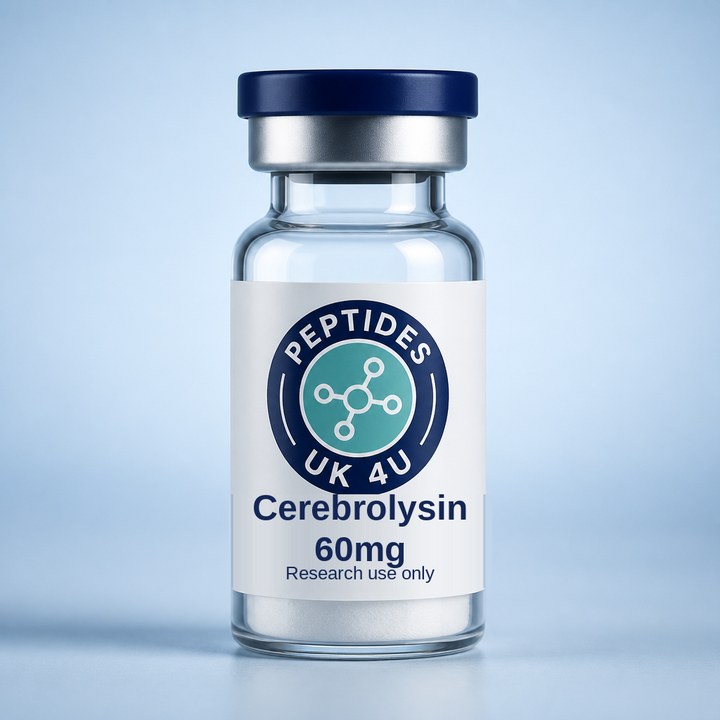
Cerebrolysin is a peptide derived from porcine brain that contains low-molecular-weight neuropeptides and amino acids. It is believed to support neuronal health by mimicking natural neurotrophic factors and modulating inflammation. This protocol outlines a gradual subcutaneous dosing regimen over several weeks.
- Derived from porcine brain tissue.
- Mimics natural neurotrophic factors like NGF and BDNF.
- Crosses the blood-brain barrier.
- Gradual titration of dose over several weeks.
- Reconstituted solution is stable for 7 days in the refrigerator.
Reconstitution
Vial strength
60 mg
Bacteriostatic water
3 mL
Concentration
20 mg/mL
1 unit = 0.01 mL = 200 mcg (0.2 mg)
- 1Draw 3.0 mL of bacteriostatic water using a sterile syringe.
- 2Inject the water slowly down the inside wall of the Cerebrolysin vial, avoiding direct impact on the peptide powder to prevent foaming.
- 3Gently swirl or roll the vial until the peptide is completely dissolved. Do not shake the vial.
- 4Label the reconstituted vial with the date and concentration, then refrigerate it at 2-8 °C (35.6-46.4 °F), protecting it from light. Use the solution within 7 days.
Dosing schedule
| Phase | Dose | On a U-100 syringe |
|---|---|---|
| Week 1 | 20 mg | 100 units (1.0 mL) once daily |
| Week 2 | 24 mg | 60 units (0.6 mL) AM + 60 units (0.6 mL) PM |
| Week 3 | 28 mg | 70 units (0.7 mL) AM + 70 units (0.7 mL) PM |
| Week 4+ | 32 mg | 80 units (0.8 mL) AM + 80 units (0.8 mL) PM |
Protocol detail
| Start | Begin with 20 mg daily (100 units). Increase the dose by approximately 4 mg (20 units) per week, based on individual tolerance. |
|---|---|
| Target | Aim for a daily dose of 28-32 mg by Weeks 3-4. |
| Frequency | Administer once or twice daily via subcutaneous injection. Split doses exceeding 20 mg into separate morning and evening administrations. |
| Cycle Length | Follow an 8-12 week cycle, with the option to prolong it to 16 weeks. |
| Timing | Inject at a consistent time or times each day. Ensure to rotate injection sites regularly. |
Overview at a glance
| Goal | To support neuroprotection and neuronal survival by acting like neurotrophic factors. |
|---|---|
| Schedule | Daily subcutaneous injections over an 8-12 week period, with an option to extend to 16 weeks. |
| Dose Range | A daily dose of 20-32 mg, with a plan for gradual increase. |
| Reconstitution | Use 3.0 mL of water per 60 mg vial, resulting in a 20 mg/mL concentration for accurate unit measurements. |
| Storage | Lyophilized vials at room temperature (up to 25 °C); reconstituted solution refrigerated (2-8 °C). Do not freeze. |
How it works
Cerebrolysin is a complex mixture of low-molecular-weight neuropeptides and amino acids extracted from porcine brain. It can cross the blood-brain barrier, providing direct neurotrophic support. The peptide mimics the actions of natural neurotrophic factors like NGF and BDNF, promoting neuronal survival, growth, and repair. It also modulates neuroinflammatory pathways, contributing to its neuroprotective effects. Preclinical studies suggest it can reduce neuronal damage and improve recovery in models of ischemic brain injury. This broad mechanism of action contributes to its potential in neurological applications.
Reported effects
- Neuroprotection
- Neuronal survival and growth
- Improved cognitive function (in some studies)
- Modulation of neuroinflammation
- Potential for recovery in ischemic models
Reported side effects
- Mild injection-site reactions (redness, discomfort)
- Dizziness (rare)
- Headache (rare)
- Gastrointestinal upset (rare)
Storage
Lyophilised (unmixed)
Store at controlled room temperature, up to 25 °C (77 °F), in a dry, dark place. Do not freeze.
After reconstitution
Refrigerate at 2-8 °C (35.6-46.4 °F), protected from light. Use within 7 days. Do not freeze.
Supplies
| Peptide vials (Cerebrolysin, 60 mg each) | 8 weeks: ~26 vials; 12 weeks: ~42 vials; 16 weeks: ~58 vials (based on ~1.9 doses per vial at max daily dose) |
|---|---|
| Insulin Syringes (U-100) | 8 weeks: ~105 syringes; 12 weeks: ~161 syringes; 16 weeks: ~217 syringes |
| Bacteriostatic Water (10 mL bottles) | 8 weeks: ~8 bottles; 12 weeks: ~13 bottles; 16 weeks: ~18 bottles (using 3.0 mL per vial for reconstitution) |
| Alcohol Swabs | 8 weeks: 210 swabs (3x 100-count boxes); 12 weeks: 322 swabs (4x 100-count boxes); 16 weeks: 434 swabs (5x 100-count boxes) |
Important notes
- Always use new, sterile insulin syringes and dispose of them in a sharps container.
- Rotate injection sites (e.g., abdomen, thighs, upper arms) to minimize local irritation and prevent lipohypertrophy.
- Inject slowly and wait a few seconds before removing the needle.
- Maintain detailed records of your daily dose, administration time, and injection site rotation.
- For doses over 100 units (1.0 mL), split the dose into two separate injections at different sites.
Frequently asked questions
What is Cerebrolysin and where does it come from?
Cerebrolysin is a peptide preparation derived from the brains of pigs. It contains several low-molecular-weight neuropeptides and amino acids that are thought to support various brain functions.
How does Cerebrolysin work in the body?
It functions by mimicking natural neurotrophic factors, such as NGF and BDNF, which promote neuron health, growth, and survival. It also helps modulate inflammation in the brain and can cross the blood-brain barrier.
Can I take more than 20mg of Cerebrolysin at once?
Yes, the protocol suggests gradually increasing the daily dose up to 32 mg. For doses exceeding 20 mg (100 units), it's recommended to split the dose into two separate injections administered in the morning and evening.
How long can I store Cerebrolysin after it's reconstituted?
Once reconstituted with bacteriostatic water, Cerebrolysin should be stored in the refrigerator between 2-8 °C (35.6-46.4 °F), protected from light, and used within 7 days.
Educational reference only. These figures summarise how Cerebrolysin is commonly described in research literature and supplier documentation. They are not a prescription, not medical advice, and not a recommendation to self-administer anything.
Related protocols
Adamax (10 mg Vial)
Advanced nootropic for enhanced cognition, neuroprotection, and neuroplasticity.
Pinealon (20 mg Vial)
Neuroprotective tripeptide supporting cognitive function and neuronal resilience.
Selank (10 mg Vial)
Anxiolytic heptapeptide for mood and cognitive support.
Selank (5 mg Vial)
Anxiolytic heptapeptide for mood, stress, and cognitive support.