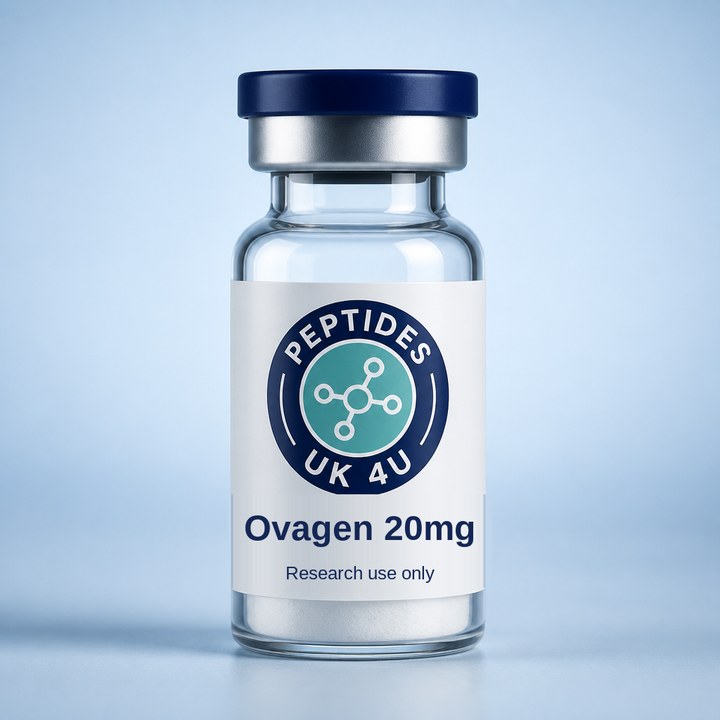
Ovagen is an ultrashort tripeptide being researched for its potential role in regulating gastrointestinal and liver tissues. This educational protocol outlines a 16-week subcutaneous dosing regimen, starting at 10 mcg daily and gradually increasing to 150 mcg daily.
- Synthetic ultrashort tripeptide (Glu-Asp-Leu; EDL)
- Research into gastrointestinal and liver tissue bioregulation
- Dosed via subcutaneous injection, gradually increasing over 16 weeks
- Reconstituted concentration of 10 mg/mL
- Preclinical and cell-based data only; no human trials
Reconstitution
Vial strength
20 mg
Bacteriostatic water
2 mL
Concentration
10 mg/mL
1 unit = 0.01 mL = 100 mcg (on a U-100 syringe)
- 1Draw 2.0 mL of bacteriostatic water with a sterile syringe.
- 2Inject the water slowly down the side of the Ovagen vial, avoiding direct contact with the peptide powder to prevent foaming.
- 3Gently swirl or roll the vial until the peptide is completely dissolved (do not shake).
- 4Label the reconstituted vial with the date/time, diluent volume, final concentration, and initials. Refrigerate at 2–8 °C (35.6–46.4 °F), protected from light.
Dosing schedule
| Phase | Dose | On a U-100 syringe |
|---|---|---|
| Weeks 1–2 | 10 mcg | 0.1 units (0.001 mL) |
| Weeks 3–4 | 20 mcg | 0.2 units (0.002 mL) |
| Weeks 5–6 | 50 mcg | 0.5 units (0.005 mL) |
| Weeks 7–8 | 100 mcg | 1 unit (0.01 mL) |
| Weeks 9–16 | 100–150 mcg | 1–1.5 units (0.01–0.015 mL) |
Protocol detail
| Start | Begin with 10 μg daily for Weeks 1–2; increase to 20 μg daily for Weeks 3–4. |
|---|---|
| Escalate | Increase to 50 μg daily for Weeks 5–6; then to 100 μg daily for Weeks 7–8. |
| Maintenance | Continue with 100–150 μg daily for Weeks 9–16. |
| Frequency | Once per day (subcutaneous). |
| Timing | Inject at a consistent time each day; rotate injection sites. |
Overview at a glance
| Goal | Support gastrointestinal and hepatic tissue bioregulation over time. |
|---|---|
| Schedule | Daily subcutaneous injections for 16 weeks with gradual titration. |
| Dose Range | 10–150 μg daily with slow escalation. |
| Reconstitution | 2.0 mL per 20 mg vial (10 mg/mL) for precise microgram measurements. |
| Storage | Lyophilized frozen; reconstituted refrigerated; avoid repeated freeze–thaw. |
How it works
Ovagen, also known as EDL, is a very short peptide believed to enter cells and interact with DNA, influencing gene expression and protein synthesis. Research suggests it may play a role in modulating aging-related gene markers like p16, p21, p53, and SIRT-6 in kidney cell cultures, indicating potential cell-protective effects. Ultrashort peptides like Ovagen are known to influence various cellular processes including differentiation, proliferation, and programmed cell death through gene regulation. Additionally, EDL has been identified as an inhibitor for HIV-1 protease, binding to its active site.
Reported effects
- May support gastrointestinal tissue bioregulation
- May support hepatic (liver) tissue bioregulation
- In vitro studies show increased cell proliferation
- Modulates aging-related gene markers (p16, p21, p53, SIRT-6) in cell cultures
- Potential cytoprotective effects
Reported side effects
- Side effects are not well-characterized due to lack of human clinical data
- Mild injection-site reactions (redness/itch) may occur with subcutaneous administration
Storage
Lyophilised (unmixed)
Store at -20 °C (-4 °F) or colder in dry, dark conditions; for long-term stability, -80 °C (-112 °F) is optimal.
After reconstitution
Refrigerate at 2–8 °C (35.6–46.4 °F); use within a few days or aliquot and freeze to minimize hydrolysis. Do not store thawed solution longer than 1–2 days. Avoid freeze-thaw cycles.
Supplies
| Peptide vials | 1 x 20 mg Ovagen vial (sufficient for 16-week protocol) |
|---|---|
| Insulin Syringes (U-100, 30-unit or 50-unit) | Approximately 120 syringes for 16 weeks (7/week + extras) |
| Bacteriostatic Water (10 mL bottles) | 1 x 10 mL bottle (2.0 mL needed per vial) |
| Alcohol Swabs | Approximately 224 swabs for 16 weeks (2/day), recommend 3 x 100-count boxes |
Important notes
- Use new, sterile insulin syringes (30-unit or 50-unit recommended for accuracy).
- Dispose of all used syringes in a sharps container.
- Always rotate injection sites (e.g., abdomen, thighs, upper arms) to minimize local irritation.
- Inject slowly and wait a few seconds before withdrawing the needle.
- Document your daily dose and injection site rotation to ensure consistency.
Frequently asked questions
What kind of syringe should I use for Ovagen?
Due to the very small volumes involved in Ovagen dosing, it is highly recommended to use U-100 insulin syringes, specifically the 30-unit or 50-unit sizes. These smaller syringes offer better readability and accuracy for microgram-level measurements, especially when injecting only 0.1 to 1.5 units.
Can I shake the vial during reconstitution?
No, you should never shake the vial when reconstituting Ovagen or other peptides. Shaking can damage the peptide structure. Instead, inject the bacteriostatic water slowly down the side of the vial and then gently swirl or roll the vial between your fingers until the powder is fully dissolved.
How long can reconstituted Ovagen be stored?
Once reconstituted, Ovagen should be stored in the refrigerator at 2–8 °C (35.6–46.4 °F). It is best used within a few days. For longer storage, it is advisable to aliquot the solution into smaller, single-dose vials and freeze them. Avoid repeated freeze-thaw cycles as this can degrade the peptide.
Are there human studies on Ovagen?
Currently, there are no controlled human clinical trials available for Ovagen. All existing data comes from preclinical and cell-based in vitro studies. This protocol is for educational and research purposes only.
Educational reference only. These figures summarise how Ovagen is commonly described in research literature and supplier documentation. They are not a prescription, not medical advice, and not a recommendation to self-administer anything.
Related protocols
Ara-290 (16 mg Vial)
Targets innate repair receptor for anti-inflammatory and tissue-protective effects.
BPC-157 (10 mg Vial)
A synthetic peptide studied for tissue protection and accelerated healing.
BPC-157 (5 mg Vial)
A synthetic gastric peptide investigated for tissue repair and healing.
GHK-Cu (100 mg Vial)
Copper peptide supporting collagen, tissue repair, and antioxidant benefits.