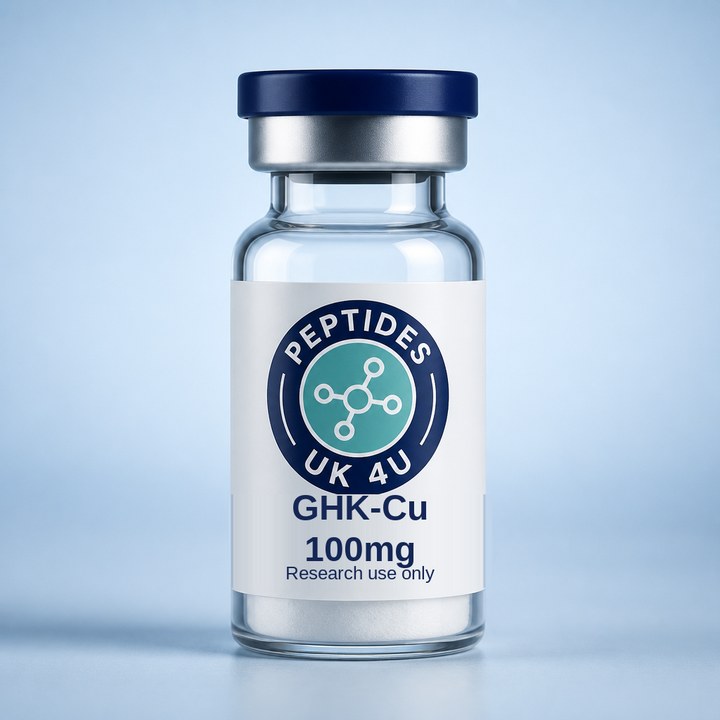
GHK-Cu is a naturally occurring copper peptide researched for its roles in collagen synthesis, tissue repair, and antioxidant defense. Dosing protocols often involve subcutaneous injections administered daily or several times per week, with dosage adjustments over several weeks.
- GHK-Cu is a naturally occurring copper-binding tripeptide.
- Commonly studied for collagen-related pathways, tissue remodeling, and antioxidant defense.
- Typically administered subcutaneous.
- Research protocols often involve progressing doses over several weeks.
Reconstitution
Vial strength
100 mg
Bacteriostatic water
3 mL
Concentration
33.33 mg/mL
1 unit = 0.01 mL = 333.3 mcg
- 1Draw 3.0 mL of sterile diluent with a sterile syringe.
- 2Add the diluent slowly down the vial wall to minimize foaming.
- 3Gently swirl or roll the vial until the peptide is fully dissolved. Do not shake.
- 4Label the vial with the 33.33 mg/mL concentration, preparation date, and storage instructions.
Dosing schedule
| Phase | Dose | On a U-100 syringe |
|---|---|---|
| Weeks 1-4 | 1.0 mg | 3 units (0.03 mL) |
| Weeks 5-8 | 1.5 mg | 4.5 units (0.045 mL) |
| Weeks 9-12+ | 2.0 mg | 6 units (0.06 mL) |
Protocol detail
| Standard Model | Weeks 1-4: 1.0 mg (3 units); Weeks 5-8: 1.5 mg (4.5 units); Weeks 9-12+: 2.0 mg (6 units), administered 5 days per week. |
|---|---|
| Alternative Model | 2.0 mg (6 units) administered three times per week (e.g., Monday, Wednesday, Friday), for 8-12+ weeks. |
| Route | Subcutaneous injections. |
| Cycle Length | Protocols typically cover 8-12+ weeks, with supplies calculated up to 16 weeks. |
Overview at a glance
| Goal | To outline GHK-Cu research dosages, reconstitution, supply needs, and measurement context for a 100 mg vial. |
|---|---|
| Schedule Options | Standard approach is 5 days per week; an alternative uses 3 times per week. |
| Dose Range | 1.0 mg to 2.0 mg per administration. |
| Reconstitution | 3.0 mL sterile water added to 100 mg vial yields 33.33 mg/mL. |
| Measurement | 1.0 mg equals 3 units, 1.5 mg equals 4.5 units, and 2.0 mg equals 6 units on a U-100 syringe. |
How it works
GHK-Cu is a naturally occurring tripeptide that binds to copper, playing a crucial role in various biological processes. Its mechanism of action involves extracellular-matrix signaling, contributing to collagen-related pathways, antioxidant defense, and tissue remodeling. Research indicates its potential to support skin and tissue repair, with studies often focusing on its benefits in topical and wound-care applications. The peptide influences the cellular environment to promote regenerative processes.
Reported effects
- Supports research into collagen-related signaling and extracellular-matrix remodeling.
- Contributes to tissue repair and antioxidant defense.
- Examined for skin and tissue outcomes in topical and wound-care settings.
- Penetration research provides context for topical delivery.
Reported side effects
- No specific side effects listed in the source, but general injection site reactions and individual sensitivities may occur.
Storage
Lyophilised (unmixed)
Follow manufacturer's instructions for temperature, moisture, and light protection. Minimize unnecessary light, moisture exposure, and repeated freeze-thaw cycles.
After reconstitution
Stability depends on concentration, pH, diluent, sterility, container, preservatives, and temperature. Record preparation date, concentration, storage temperature, and disposal date.
Supplies
| Peptide vials | For a 12-week standard protocol, 1 x 100 mg GHK-Cu vial is typically sufficient. |
|---|---|
| Insulin Syringes (U-100, 29-31 gauge) | Approximately 60 syringes for a 12-week standard protocol (5 per week). |
| Sterile or Bacteriostatic Water | 3.0 mL per 100 mg vial (e.g., 1 x 10 mL bottle for 1-3 vials). |
| Alcohol Swabs | Approximately 120 swabs for a 12-week standard protocol (10 per week), generally 2 x 100-count boxes. |
Important notes
- Always use new sterile equipment for each preparation and administration.
- Follow aseptic technique, allowing skin antiseptic to dry completely before injecting.
- Select and rotate injection sites consistently, documenting each administration.
- Properly dispose of all sharps in a suitable container.
Frequently asked questions
What is the primary concentration after reconstituting a 100 mg vial with 3.0 mL of water?
After reconstituting a 100 mg GHK-Cu vial with 3.0 mL of sterile water, the resulting concentration will be 33.33 mg/mL.
How many units on a U-100 syringe correspond to a 2.0 mg dose?
A 2.0 mg dose of GHK-Cu, when reconstituted to 33.33 mg/mL, corresponds to 6 units on a U-100 syringe.
What is the recommended frequency for the standard GHK-Cu protocol?
The standard approach recommends administering GHK-Cu once daily, five days per week, often progressing through different dosages over several weeks.
Can GHK-Cu be used topically instead of via subcutaneous injection?
While the provided protocol covers subcutaneous administration, published research also explores GHK-Cu in topical and wound-care formulations, suggesting potential benefits through various routes depending on the specific application and goals.
Educational reference only. These figures summarise how GHK-Cu is commonly described in research literature and supplier documentation, including the GHK-Cu listing at peptidesuk4u.co.uk. They are not a prescription, not medical advice, and not a recommendation to self-administer anything.
Related protocols
GHK-Cu (50 mg Vial)
Naturally occurring copper peptide for tissue remodeling and skin repair.
BPC-157 (10 mg Vial)
A synthetic peptide studied for tissue protection and accelerated healing.
BPC-157 (5 mg Vial)
A synthetic gastric peptide investigated for tissue repair and healing.
MGF (5 mg Vial)
Supports muscle repair and regeneration through localized growth factor signaling.