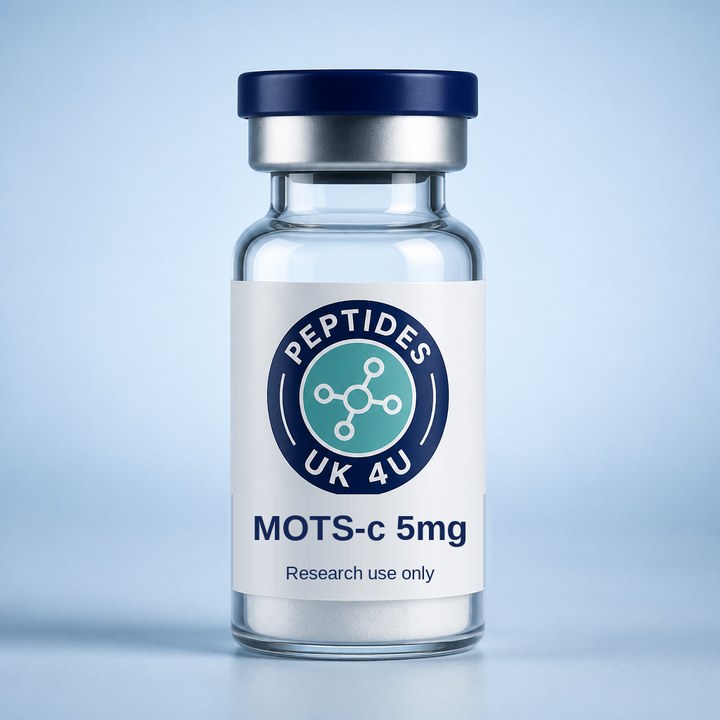
MOTS-c is a naturally occurring peptide that supports metabolic health and enhances insulin sensitivity by activating AMPK, similar to exercise. It is typically administered via subcutaneous injection daily, with doses gradually increasing over several weeks to optimize benefits.
- A mitochondrial-derived peptide regulating metabolic homeostasis.
- Activates AMPK, improving glucose uptake and fat oxidation.
- Levels increase significantly with exercise and decrease with age.
- Typically dosed daily, titrating up over several weeks.
- Requires cycling with equal time on and off.
Reconstitution
Vial strength
5 mg
Bacteriostatic water
3 mL
Concentration
1.67 mg/mL
1 unit = 0.01 mL = 16.7 mcg
- 1Draw 3.0 mL of bacteriostatic water using a sterile syringe.
- 2Slowly inject the water down the inner wall of the peptide vial to avoid foaming.
- 3Gently swirl or roll the vial until the peptide powder is fully dissolved; do not shake vigorously.
- 4Label the reconstituted vial with the date and refrigerate it at 2–8 °C (35.6–46.4 °F), protected from light. Use within 2–4 weeks.
Dosing schedule
| Phase | Dose | On a U-100 syringe |
|---|---|---|
| Weeks 1–2 | 500 mcg | 30 units (0.30 mL) |
| Weeks 3–4 | 1000 mcg | 60 units (0.60 mL) |
| Weeks 5–6 | 1500 mcg | 90 units (0.90 mL) |
| Weeks 7–8 | 2000 mcg | 120 units (two 60‑unit injections) |
Protocol detail
| Start | Begin with 500 mcg (0.5 mg) daily for weeks 1–2 as a conservative baseline dose. |
|---|---|
| Titrate | Increase to 1000 mcg (1.0 mg) daily for weeks 3–4, then advance to 1500 mcg (1.5 mg) for weeks 5–6. |
| Target | If well-tolerated, aim for 1500–2000 mcg (1.5–2.0 mg) daily by weeks 7–8. |
| Frequency | Inject once per day subcutaneously; morning administration is preferred to align with natural physiological patterns. |
| Cycle Length | Implement a cycle of 4–8 weeks on, followed by an equal duration of 4–8 weeks off, to avoid continuous long-term use. |
| Timing | Maintain consistent daily timing for injections and rotate injection sites (abdomen, thighs, upper arms). |
Overview at a glance
| Goal | Support metabolic homeostasis, enhance insulin sensitivity, and promote healthy aging through AMPK activation. |
|---|---|
| Schedule | Daily subcutaneous injections for 4–8 weeks, followed by an equal-length break (cycling approach). |
| Dose Range | 500–2000 mcg daily with gradual titration over weeks. |
| Reconstitution | 3.0 mL per 5 mg vial (~1.67 mg/mL) for accurate unit measurements. |
| Storage | Lyophilized frozen at -20 °C (-4 °F); reconstituted refrigerated at 2–8 °C (35.6–46.4 °F); use within 2–4 weeks. |
How it works
MOTS-c is a mitochondrial-derived peptide that activates crucial metabolic pathways. It enhances glucose uptake and increases fat oxidation, primarily targeting skeletal muscle and adipose tissue. This action helps reduce lipid accumulation and improve insulin sensitivity. Preclinical studies indicate it can prevent diet-induced obesity and restore insulin sensitivity. Unlike metformin, which primarily affects the liver, MOTS-c directly influences peripheral tissues. Its levels naturally rise with exercise and decline with age, suggesting its potential to counteract age-related metabolic decline and support overall cellular energy regulation.
Reported effects
- Enhanced insulin sensitivity and glucose metabolism
- Increased fat oxidation and reduced obesity in animal models
- Improved exercise capacity and muscle health during aging
- Modest lifespan extension in rodents with intermittent dosing
- No negative impact on IGF-1 or glucose tolerance
Reported side effects
- Mild injection-site reactions (redness, inflammation, bruising)
- Long-term human safety data is not yet established
- Theoretical risk of downregulation with prolonged continuous use
Storage
Lyophilised (unmixed)
Freeze at -20 °C (-4 °F) in dry, dark conditions with desiccant; stable for months to years.
After reconstitution
Refrigerate at 2–8 °C (35.6–46.4 °F); use within 2–4 weeks for optimal potency.
Supplies
| Peptide vials | Approximately 12-24 vials for an 8-16 week protocol (5mg each) |
|---|---|
| Insulin Syringes (U-100) | 7 syringes per week (approx. 56-112 for an 8-16 week protocol) |
| Bacteriostatic Water (10 mL bottles) | 4-8 bottles for an 8-16 week protocol (~3.0 mL per vial) |
| Alcohol Swabs | 2 swabs per day (approx. 112-224 for an 8-16 week protocol) |
Important notes
- Always use new sterile insulin syringes and rotate injection sites.
- Inject slowly and allow the solution to reach room temperature before administration.
- For doses exceeding 100 units, consider splitting into multiple injections or using a more concentrated reconstitution.
- Document daily doses, times, and sites to monitor effectiveness and consistency.
- MOTS-c is an experimental research peptide not approved for human use by regulatory agencies.
Frequently asked questions
What is the primary function of MOTS-c?
MOTS-c is a peptide that regulates metabolic homeostasis, primarily by activating AMPK. This improves insulin sensitivity, increases glucose utilization, and enhances fat oxidation, especially in muscle and fat tissues.
Why is it recommended to cycle MOTS-c?
Cycling MOTS-c (e.g., 4-8 weeks on, followed by 4-8 weeks off) is suggested to prevent potential downregulation of its effects and to allow the body to maintain its natural responses. Long-term continuous use has not been fully studied.
Can I combine MOTS-c with exercise and diet for better results?
Yes, pairing MOTS-c with a balanced, protein-rich diet and consistent resistance training and aerobic activity is recommended. These lifestyle factors can significantly enhance AMPK activation and overall metabolic benefits.
What should I do if my MOTS-c dose is very small and hard to measure accurately?
If your dose falls below 30 units (0.30 mL) on a U-100 syringe, consider using smaller 50-unit or 30-unit insulin syringes. These smaller syringes have finer graduations, making precise measurement of very small volumes easier.
Educational reference only. These figures summarise how MOTS-c is commonly described in research literature and supplier documentation, including the MOTS-c listing at peptidesuk4u.co.uk. They are not a prescription, not medical advice, and not a recommendation to self-administer anything.
Related protocols
MOTS-c (10 mg Vial)
Metabolic regulator enhancing insulin sensitivity, fat oxidation, and exercise capacity.
MOTS-c (20 mg Vial)
Metabolic regulator enhancing insulin sensitivity, fat oxidation, and exercise capacity.
MOTS-c (40 mg Vial)
Metabolic regulator enhancing insulin sensitivity and fat oxidation.
5-Amino-1MQ (10 mg Vial)
Inhibitor of NNMT for metabolic support and fat metabolism.