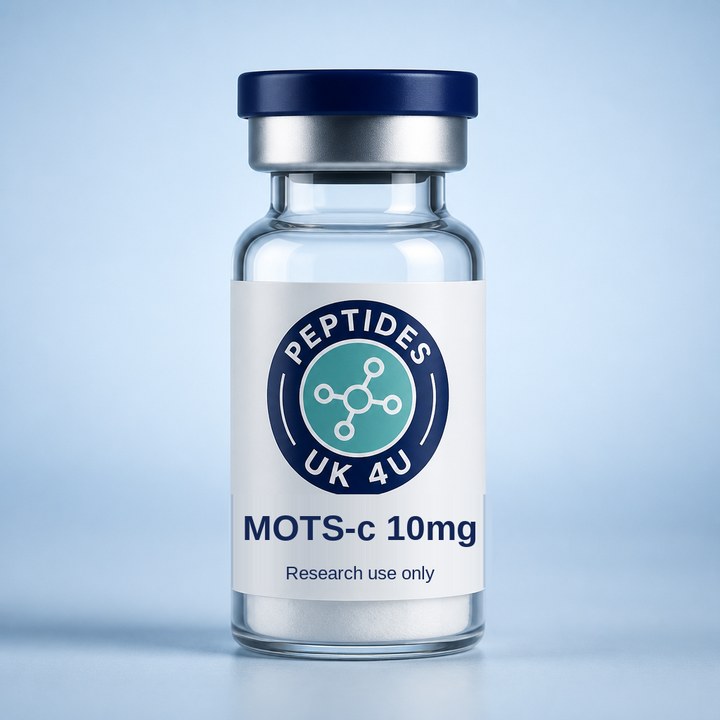
MOTS-c is a mitochondrial-derived peptide that functions as a metabolic regulator, influencing insulin sensitivity and fat utilization. This protocol outlines a gradual dosing strategy over several weeks, starting at a lower dose and slowly increasing, administered daily via subcutaneous injection after reconstitution with bacteriostatic water.
- A 10 mg vial reconstituted with 3.0 mL of bacteriostatic water yields a concentration of approximately 3.33 mg/mL.
- Dosing typically ranges from 200 mcg to 1,000 mcg (1 mg) daily.
- Administered via subcutaneous injection once per day.
- Protocols often involve a gradual titration over 10 weeks, increasing the dose every two weeks.
- Store lyophilized peptide frozen; store reconstituted peptide refrigerated for up to 7 days.
Reconstitution
Vial strength
10 mg
Bacteriostatic water
3 mL
Concentration
3.33 mg/mL
1 unit = 0.01 mL = 33.3 mcg
- 1Carefully draw 3.0 mL of bacteriostatic water using a sterile syringe.
- 2Inject the water slowly down the inside wall of the MOTS-c vial, avoiding direct contact with the peptide powder to prevent foaming.
- 3Gently swirl or roll the vial until the peptide powder is fully dissolved. Do not shake vigorously.
- 4Label the vial with the date of reconstitution and store it in a refrigerator between 2-8 °C (35.6-46.4 °F), protected from light.
- 5For best potency, use the reconstituted solution within 7 days.
Dosing schedule
| Phase | Dose | On a U-100 syringe |
|---|---|---|
| Weeks 1-2 | 200 mcg | 6 units (0.06 mL) |
| Weeks 3-4 | 400 mcg | 12 units (0.12 mL) |
| Weeks 5-6 | 600 mcg | 18 units (0.18 mL) |
| Weeks 7-8 | 800 mcg | 24 units (0.24 mL) |
| Weeks 9-10+ | 1,000 mcg | 30 units (0.30 mL) |
Protocol detail
| Start | Begin with a dose of 200 mcg daily for the first two weeks. |
|---|---|
| Titration | Increase the daily dose by approximately 200 mcg every two weeks, progressing to 400 mcg (Weeks 3-4), 600 mcg (Weeks 5-6), and 800 mcg (Weeks 7-8). |
| Target | If well tolerated, the daily dose can be increased up to 1,000 mcg (1.0 mg) by Weeks 9-10 and beyond. |
| Frequency | Administer one subcutaneous injection per day. |
| Cycle Length | The typical cycle duration is 8-12 weeks, with an optional extension to 16 weeks. |
| Timing | Administer at a consistent time each day, and remember to rotate injection sites. |
Overview at a glance
| Goal | To support metabolic homeostasis, enhance insulin sensitivity, and improve age-related physical performance based on preclinical research. |
|---|---|
| Schedule | Daily subcutaneous injections for an initial period of 8-12 weeks, with an option to extend to 16 weeks. |
| Dose Range | Starting at 200 mcg daily and gradually increasing up to 1,000 mcg per day over approximately 10 weeks. |
| Reconstitution | Mix 3.0 mL of bacteriostatic water with a 10 mg vial of MOTS-c to achieve a concentration of about 3.33 mg/mL, allowing for accurate unit measurements. |
| Storage | Lyophilized peptide should be frozen at -20 °C (-4 °F). Once reconstituted, store refrigerated at 2-8 °C (35.6-46.4 °F) and avoid repeated freezing and thawing cycles. |
How it works
MOTS-c acts as a crucial metabolic signaling molecule, predominantly by activating AMPK, an enzyme that regulates cellular energy. This activation shifts cells into an energy-efficient state by enhancing glucose uptake, increasing fatty-acid oxidation, and optimizing mitochondrial respiration, while simultaneously reducing fat storage and glucose production. Beyond its metabolic roles, MOTS-c can move into the cell nucleus under stress, where it upregulates genes involved in antioxidant and stress responses. This helps cells combat oxidative stress and promotes cytoprotection. The peptide also shows promise in modulating mTOR and inflammatory pathways, contributing to overall healthspan and longevity. Its effects are often compared to those of exercise and metformin at a cellular level, making it a subject of significant interest for metabolic research.
Reported effects
- Improves insulin sensitivity and glucose metabolism
- Reduces body fat and prevents obesity
- Enhances exercise capacity and physical performance
- Protects organs like the liver and heart
- Modulates bone metabolism and immune aging
Reported side effects
- No adverse effects reported in preclinical studies; human tolerability unknown.
- May cause local irritation at injection site (minimized by proper rotation).
Storage
Lyophilised (unmixed)
Store at -20 °C (-4 °F) or below in dry, dark conditions. Allow to reach room temperature before opening.
After reconstitution
Refrigerate at 2-8 °C (35.6-46.4 °F) and use within 7 days for optimal potency. Avoid repeated freeze-thaw cycles if aliquoting.
Supplies
| Peptide vials (MOTS-c, 10 mg each) | Estimate 3 vials for an 8-week protocol, 6 vials for 12 weeks, or 9 vials for 16 weeks. |
|---|---|
| Insulin Syringes (U-100) | Approximately 7 syringes per week (1 per day); e.g., 56 for 8 weeks, 84 for 12 weeks. |
| Bacteriostatic Water (10 mL bottles) | Around 3.0 mL per vial for reconstitution; one 10 mL bottle serves for up to three 10 mg vials. |
| Alcohol Swabs | Two per day (one for vial stopper, one for injection site); estimate 112 for 8 weeks. |
Important notes
- Always use a new sterile insulin syringe for each injection and dispose of it in a sharps container.
- Vary injection sites (e.g., abdomen, thighs, upper arms) to prevent local irritation and issues like lipohypertrophy.
- Inject the solution slowly and wait a few seconds before removing the needle.
- Maintain a daily log of dosage, injection site, and any observations for consistency and monitoring.
- If any concerning symptoms occur, discontinue use and consult a medical professional immediately.
- This information is for research and educational purposes only; MOTS-c is an experimental compound and not for human consumption.
Frequently asked questions
What is the recommended reconstitution for a 10 mg MOTS-c vial?
For a 10 mg vial of MOTS-c, it is recommended to reconstitute with 3.0 mL of bacteriostatic water. This yields a concentration of approximately 3.33 mg/mL, making it easier to measure precise doses with an insulin syringe where 1 unit equals 33.3 mcg.
How long can reconstituted MOTS-c be stored?
Once reconstituted, MOTS-c should be stored in the refrigerator at 2-8 °C (35.6-46.4 °F). For optimal potency, it is best to use the solution within 7 days. Lyophilized (unreconstituted) MOTS-c should be stored frozen at -20 °C (-4 °F) or below.
What is the typical dosing schedule for MOTS-c?
A common protocol involves a gradual titration. You would typically start with 200 mcg daily for the first two weeks, then increase by approximately 200 mcg every two weeks, aiming to reach up to 1,000 mcg (1.0 mg) daily by Weeks 9-10. The cycle length is often 8-12 weeks.
What are the main benefits of MOTS-c?
Based on preclinical research, MOTS-c is associated with several metabolic and performance-enhancing benefits. These include improved insulin sensitivity and glucose metabolism, reductions in body fat and prevention of obesity, enhanced exercise capacity, and protective effects on various organs. It also shows promise in modulating bone metabolism and immune aging.
Educational reference only. These figures summarise how MOTS-c is commonly described in research literature and supplier documentation, including the MOTS-c listing at peptidesuk4u.co.uk. They are not a prescription, not medical advice, and not a recommendation to self-administer anything.
Related protocols
MOTS-c (20 mg Vial)
Metabolic regulator enhancing insulin sensitivity, fat oxidation, and exercise capacity.
MOTS-c (40 mg Vial)
Metabolic regulator enhancing insulin sensitivity and fat oxidation.
MOTS-c (5 mg Vial)
Metabolic regulator enhancing insulin sensitivity and combating age-related decline.
Tesamorelin (10 mg Vial)
GHRH analog stimulating GH for visceral fat reduction and metabolic health.