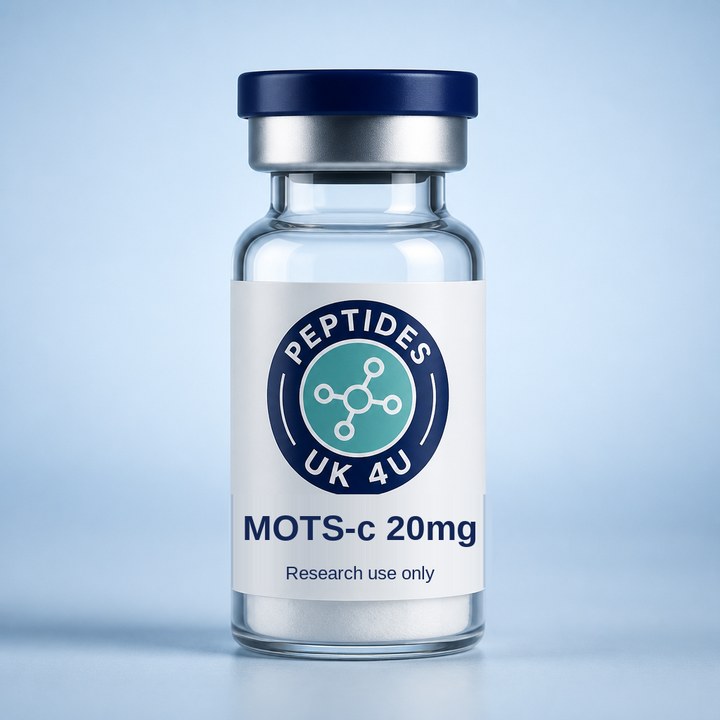
MOTS-c is a mitochondrial-derived peptide that functions as a metabolic regulator, influencing processes like insulin sensitivity and fat oxidation. This protocol outlines a gradual titration approach for subcutaneous administration, typically spanning 10 weeks, with doses ranging from 200 mcg to 1 mg daily. It's designed to support metabolic health and physical performance based on preclinical research.
- Functions as a metabolic regulator, primarily through AMPK activation.
- Preclinical studies indicate enhanced insulin sensitivity and fat oxidation.
- Gradual titration over 10 weeks, from 200 mcg up to 1,000 mcg daily.
- Reconstitute a 20 mg vial with 3.0 mL of bacteriostatic water.
- No human clinical trials have been completed for MOTS-c.
Reconstitution
Vial strength
20 mg
Bacteriostatic water
3 mL
Concentration
6.67 mg/mL
1 unit = 0.01 mL = 66.7 mcg
- 1Draw 3.0 mL of bacteriostatic water into a sterile syringe.
- 2Gently inject the water down the inside wall of the MOTS-c vial, avoiding foaming.
- 3Carefully swirl or roll the vial until the peptide is fully dissolved; do not shake vigorously.
- 4Label the vial with the reconstitution date and store it in the refrigerator at 2–8 °C (35.6–46.4 °F), protected from light.
- 5For optimal potency, use the reconstituted solution within 7 days.
Dosing schedule
| Phase | Dose | On a U-100 syringe |
|---|---|---|
| Weeks 1–2 | 200 mcg | 3 units (0.03 mL) |
| Weeks 3–4 | 400 mcg | 6 units (0.06 mL) |
| Weeks 5–6 | 600 mcg | 9 units (0.09 mL) |
| Weeks 7–8 | 800 mcg | 12 units (0.12 mL) |
| Weeks 9–10+ | 1,000 mcg | 15 units (0.15 mL) |
Protocol detail
| Start | Begin with 200 mcg daily for the first 2 weeks. |
|---|---|
| Titration | Increase the daily dose by approximately 200 mcg every 2 weeks (e.g., 400 mcg for Weeks 3–4, 600 mcg for Weeks 5–6, 800 mcg for Weeks 7–8). |
| Target | Potentially increase to 1,000 mcg (1.0 mg) daily by Weeks 9–10+ if the peptide is well tolerated. |
| Frequency | Administer once per day via subcutaneous injection. |
| Cycle Length | The cycle typically runs for 8–12 weeks, with an optional extension to 16 weeks. |
Overview at a glance
| Goal | Support metabolic homeostasis, insulin sensitivity, and age-related physical performance based on preclinical evidence. |
|---|---|
| Schedule | Daily subcutaneous injections for 8–12 weeks; extendable to 16 weeks. |
| Dose Range | 200–1,000 mcg daily with gradual titration over 10 weeks. |
| Reconstitution | 3.0 mL bacteriostatic water per 20 mg vial, resulting in ~6.67 mg/mL. |
| Storage | Lyophilized frozen at −20 °C; reconstituted refrigerated at 2–8 °C; avoid repeated freeze–thaw cycles. |
How it works
MOTS-c acts as a metabolic signal, helping cells manage energy, especially during stress or exercise. It primarily activates AMPK by affecting the folate cycle, which then enhances glucose uptake, fat oxidation, and mitochondrial function, while reducing fat storage. Beyond metabolism, MOTS-c can also move into the cell nucleus under stress, boosting genes that protect against oxidative damage. Its actions can be compared to certain benefits of exercise and metformin, making it relevant for research into metabolic disorders and aging.
Reported effects
- Improves insulin sensitivity and glucose metabolism (preclinical)
- Prevents obesity and reduces visceral fat (preclinical)
- Mitigates metabolic decline in post-menopausal models (preclinical)
- Enhances exercise capacity and counters age-related frailty (preclinical)
- Reduces liver fat and supports cardiac/cognitive function (preclinical)
- May promote osteoblast activity and modulate immune aging (preclinical)
Reported side effects
- No adverse effects reported in preclinical studies; human tolerability unknown.
Storage
Lyophilised (unmixed)
Store at -20 °C (-4 °F) or below in dry, dark conditions; include desiccant if available.
After reconstitution
Refrigerate at 2–8 °C (35.6–46.4 °F) and use within 7 days for best potency. Peptide degrades rapidly at room temperature.
Supplies
| Peptide vials | 20 mg MOTS-c vials: ~2 vials for 8 weeks, ~3 for 12 weeks, ~5 for 16 weeks. |
|---|---|
| Insulin Syringes (U-100) | Approximately 7 per week (1 per day). |
| Bacteriostatic Water | 10 mL bottles: ~6 mL for 8 weeks, ~9 mL for 12 weeks, ~15 mL for 16 weeks. |
| Alcohol Swabs | Approximately 14 per week (2 per day). |
Important notes
- Use a new sterile insulin syringe for each injection and dispose of it properly in a sharps container.
- Rotate injection sites to minimize irritation and prevent lipohypertrophy.
- Inject slowly and pause before removing the needle.
- Document daily doses and observations for consistency.
- Discontinue use and consult a healthcare professional if any concerning symptoms arise.
Frequently asked questions
What is the primary role of MOTS-c in the body?
MOTS-c acts as a metabolic regulator, influencing how cells use energy, particularly by activating AMPK. This leads to improved insulin sensitivity and increased fat oxidation.
Are there human clinical trials for MOTS-c?
As of now, no human clinical trials for MOTS-c itself have been completed. The documented benefits are primarily based on preclinical research in animal models or cell studies.
How long can reconstituted MOTS-c be stored?
After reconstitution, MOTS-c should be stored in the refrigerator at 2–8 °C (35.6–46.4 °F) and used within 7 days for optimal potency. It degrades quickly at room temperature.
What is the typical dose progression for MOTS-c?
The protocol suggests starting at 200 mcg daily for two weeks, gradually increasing the dose by about 200 mcg every two weeks until reaching a target of up to 1,000 mcg daily, if well tolerated, by weeks 9–10.
Educational reference only. These figures summarise how MOTS-c is commonly described in research literature and supplier documentation, including the MOTS-c listing at peptidesuk4u.co.uk. They are not a prescription, not medical advice, and not a recommendation to self-administer anything.
Related protocols
MOTS-c (10 mg Vial)
Metabolic regulator enhancing insulin sensitivity, fat oxidation, and exercise capacity.
MOTS-c (40 mg Vial)
Metabolic regulator enhancing insulin sensitivity and fat oxidation.
MOTS-c (5 mg Vial)
Metabolic regulator enhancing insulin sensitivity and combating age-related decline.
Tesamorelin (10 mg Vial)
GHRH analog stimulating GH for visceral fat reduction and metabolic health.