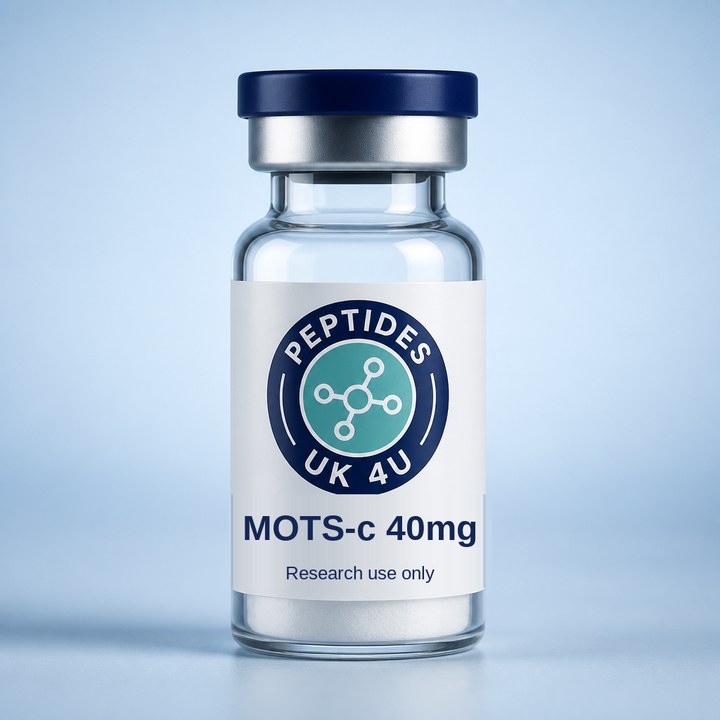
MOTS-c is a mitochondrial-derived peptide that functions as a metabolic regulator, primarily enhancing insulin sensitivity and promoting fat oxidation in preclinical studies. Its dosing typically involves a gradual increase from 200 mcg to 1 mg daily via subcutaneous injection over a 10-week period. This peptide is currently in the research stage, with no completed human clinical trials.
- Dosed daily via subcutaneous injection.
- Gradual titration over 10 weeks, from 200 mcg to 1 mg.
- Acts as a metabolic regulator by activating AMPK.
- Preclinical studies show benefits in insulin sensitivity and fat oxidation.
- No completed human clinical trials to date.
Reconstitution
Vial strength
40 mg
Bacteriostatic water
3 mL
Concentration
13.33 mg/mL
1 unit = 0.01 mL = 133.3 mcg
- 1Draw 3.0 mL of bacteriostatic water using a sterile syringe.
- 2Carefully inject the water down the inner wall of the vial, avoiding foaming.
- 3Gently swirl or roll the vial until the peptide is fully dissolved; do not shake vigorously.
- 4Label the reconstituted vial with the date and refrigerate it at 2–8 °C (35.6–46.4 °F), protected from light.
- 5For best potency, use the reconstituted solution within 7 days.
Dosing schedule
| Phase | Dose | On a U-100 syringe |
|---|---|---|
| Weeks 1-2 | 200 mcg (0.2 mg) | 1.5 units (0.015 mL) |
| Weeks 3-4 | 400 mcg (0.4 mg) | 3 units (0.03 mL) |
| Weeks 5-6 | 600 mcg (0.6 mg) | 4.5 units (0.045 mL) |
| Weeks 7-8 | 800 mcg (0.8 mg) | 6 units (0.06 mL) |
| Weeks 9-10+ | 1,000 mcg (1.0 mg) | 7.5 units (0.075 mL) |
Protocol detail
| Start | Begin with 200 mcg daily for the first 2 weeks. |
|---|---|
| Titration | Increase the dose by approximately 200 mcg every 2 weeks, reaching 400 mcg (Weeks 3–4), 600 mcg (Weeks 5–6), and 800 mcg (Weeks 7–8). |
| Target | If well tolerated, aim for up to 1,000 mcg (1.0 mg) daily by Weeks 9–10 and beyond. |
| Frequency | Administer once per day subcutaneously. |
| Cycle Length | Typically 8–12 weeks, with an option to extend to 16 weeks. |
| Timing | Administer at a consistent time each day, and remember to rotate injection sites. |
Overview at a glance
| Goal | Support metabolic homeostasis, insulin sensitivity, and age-related physical performance based on preclinical findings. |
|---|---|
| Schedule | Daily subcutaneous injections for 8–12 weeks, with an optional extension to 16 weeks. |
| Dose Range | 200–1,000 mcg daily, with a gradual titration over 10 weeks. |
| Reconstitution | Add 3.0 mL of bacteriostatic water to a 40 mg vial to achieve a concentration of approximately 13.33 mg/mL. |
| Storage | Lyophilized vials should be frozen at -20°C (-4°F). Reconstituted solution should be refrigerated at 2–8°C (35.6–46.4°F). Avoid repeated freezing and thawing. |
How it works
MOTS-c is a mitochondrial-derived peptide that functions as a metabolic 'stress signal,' optimizing energy use during challenging conditions like nutrient deprivation or exercise. Its primary mechanism involves activating AMPK by inhibiting the folate cycle, which leads to AICAR accumulation. This activation shifts cells into an energy-efficient state, boosting glucose uptake, fatty-acid oxidation, and mitochondrial respiration, while reducing fat storage and gluconeogenesis. MOTS-c also moves into the cell nucleus under stress, upregulating antioxidant and stress-response genes, enhancing cellular resilience. Its actions parallel those of exercise and metformin, making it a focus for research into metabolic disorders, obesity, and aging.
Reported effects
- Improved insulin sensitivity and glucose metabolism
- Prevention of diet-induced insulin resistance
- Reduction of body weight and visceral fat
- Enhanced energy expenditure
- Mitigation of post-menopausal metabolic decline
- Improved exercise capacity and physical performance
- Protection against age-related frailty
- Reduced liver fat accumulation
- Improved cardiac function
- Potential support for cognitive function
- Promotion of osteoblast activity and inhibition of osteoclast formation
- Modulation of immune aging
Reported side effects
- No adverse effects reported in preclinical studies
- Human tolerability is currently unknown
Storage
Lyophilised (unmixed)
Store at -20 °C (-4 °F) or below in dry, dark conditions; include desiccant if available.
After reconstitution
Refrigerate at 2–8 °C (35.6–46.4 °F); use within 7 days for optimal potency. Avoid repeated freeze-thaw cycles if aliquoting.
Supplies
| Peptide vials (MOTS-c, 40 mg each) | Approximately 1 vial for 8 weeks, 2 vials for 12 weeks, or 3 vials for 16 weeks. |
|---|---|
| Insulin Syringes (U-100) | 56 syringes for 8 weeks, 84 syringes for 12 weeks, or 112 syringes for 16 weeks (1 per day). |
| Bacteriostatic Water (10 mL bottles) | One 10 mL bottle is sufficient for up to 3 vials of peptide (for 16 weeks). |
| Alcohol Swabs | Two swabs per day (one for the vial, one for the injection site). Approximately 2-3 boxes of 100-count swabs for cycles up to 16 weeks. |
Important notes
- Always use a new, sterile insulin syringe for each injection and dispose of it in a sharps container.
- Rotate injection sites (abdomen, thighs, upper arms) to prevent local irritation and lipohypertrophy.
- Inject slowly and steadily; wait a few seconds before removing the needle.
- Maintain a daily log of dose, injection site, and any observations for consistency.
- Discontinue use and seek medical advice if any concerning symptoms arise.
Frequently asked questions
What is the primary role of MOTS-c in the body?
MOTS-c functions as a crucial metabolic regulator, primarily by activating AMPK. This action improves insulin sensitivity, promotes the oxidation of fats, and can enhance exercise performance, effectively optimizing the body's energy usage.
Are there any human clinical trials for MOTS-c?
As of now, there have been no completed human clinical trials for MOTS-c. The current understanding of its effects and mechanisms comes primarily from preclinical studies conducted in animal models and cell cultures.
How should I store MOTS-c before and after reconstitution?
Lyophilized (powder) MOTS-c should be stored frozen at -20 °C (-4 °F) or below. After reconstitution with bacteriostatic water, the solution should be refrigerated at 2–8 °C (35.6–46.4 °F) and used within 7 days for maximum potency. Avoid exposing it to room temperature for extended periods.
Can I increase my MOTS-c dose faster than the recommended schedule?
The protocol recommends a gradual titration of the dose over 10 weeks to monitor for adverse reactions and allow the body to adapt. It is advised to follow the suggested schedule and increase the dose by approximately 200 mcg every two weeks, rather than a faster escalation.
Educational reference only. These figures summarise how MOTS-c is commonly described in research literature and supplier documentation, including the MOTS-c listing at peptidesuk4u.co.uk. They are not a prescription, not medical advice, and not a recommendation to self-administer anything.
Related protocols
MOTS-c (10 mg Vial)
Metabolic regulator enhancing insulin sensitivity, fat oxidation, and exercise capacity.
MOTS-c (20 mg Vial)
Metabolic regulator enhancing insulin sensitivity, fat oxidation, and exercise capacity.
MOTS-c (5 mg Vial)
Metabolic regulator enhancing insulin sensitivity and combating age-related decline.
5-Amino-1MQ (50 mg Vial)
NNMT inhibitor for metabolic support, fat metabolism, and NAD+ levels.