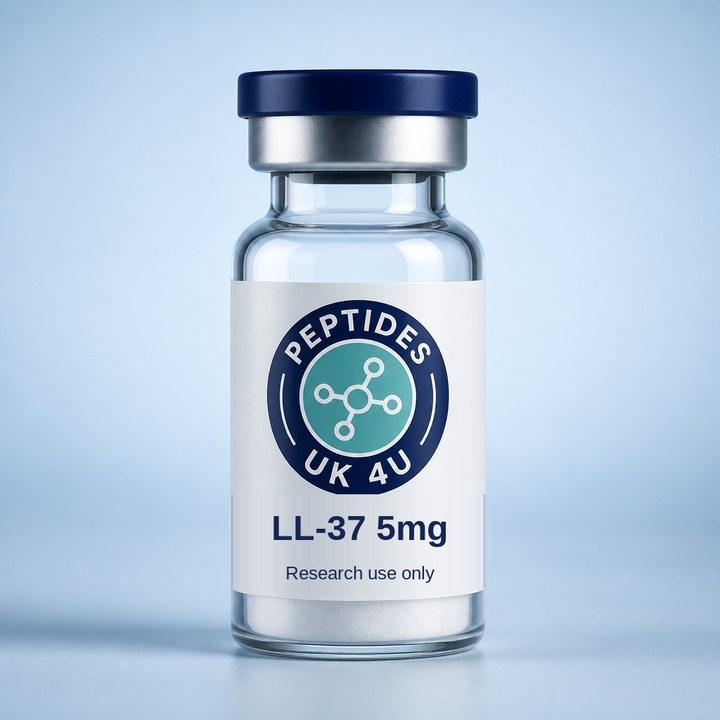
LL-37 is a human cathelicidin-derived antimicrobial peptide. It is administered via subcutaneous injection, with educational protocols suggesting a dose range of 50-400 mcg daily, often with a gradual increase over several weeks. Reconstitution typically involves adding 3.0 mL of bacteriostatic water to a 5 mg vial.
- Derived from human cathelicidin (hCAP18).
- Exhibits broad-spectrum antibacterial activity.
- Modulates immune responses.
- Typically dosed subcutaneously once daily.
- Gradual titration from 50 mcg up to 400 mcg daily is common.
Reconstitution
Vial strength
5 mg
Bacteriostatic water
3 mL
Concentration
1.67 mg/mL
1 unit = 0.01 mL = 16.7 mcg
- 1Draw 3.0 mL of bacteriostatic water using a sterile syringe.
- 2Slowly inject the water down the inner wall of the LL-37 vial, being careful to avoid creating foam.
- 3Gently swirl or roll the vial until the peptide completely dissolves; do not shake it.
- 4Label the reconstituted vial with the date and store it in the refrigerator.
Dosing schedule
| Phase | Dose | On a U-100 syringe |
|---|---|---|
| Week 1 | 50 µg | 3 units (0.03 mL) |
| Week 2 | 100 µg | 6 units (0.06 mL) |
| Week 3 | 150 µg | 9 units (0.09 mL) |
| Week 4 | 200 µg | 12 units (0.12 mL) |
| Week 5 | 250 µg | 15 units (0.15 mL) |
| Week 6 | 300 µg | 18 units (0.18 mL) |
| Week 7 | 350 µg | 21 units (0.21 mL) |
| Week 8 | 400 µg | 24 units (0.24 mL) |
Protocol detail
| Start | Initiate at 50-100 µg daily and increase the dose by approximately 50 µg each week, provided it is well-tolerated. |
|---|---|
| Target | Aim to reach a daily dose of 200-400 µg between Weeks 4 and 8. |
| Frequency | Administer once daily via subcutaneous injection. An optional schedule of 5 days on and 2 days off can be considered. |
| Cycle Length | Typically, an 8-12 week cycle is followed, with an option to extend to 16 weeks. |
Overview at a glance
| Goal | Support antimicrobial defense and promote healing processes. |
|---|---|
| Schedule | Daily subcutaneous injections for 8-12 weeks, extendable to 16 weeks. |
| Dose Range | 50-400 µg daily, achieved through gradual titration. |
| Reconstitution | 3.0 mL bacteriostatic water for a 5 mg vial, yielding approximately 1.67 mg/mL for precise unit measurements. |
| Storage | Lyophilized form is frozen; reconstituted form is refrigerated. Avoid repeated freeze-thaw cycles. |
How it works
LL-37 is an amphipathic, cationic alpha-helical peptide with a net positive charge, enabling it to bind and disrupt negatively charged microbial membranes, leading to direct antimicrobial effects. Beyond its direct killing mechanisms, LL-37 influences the immune system. For instance, in sepsis models, it stimulated neutrophils to release microvesicles containing antimicrobial proteins, reducing bacterial load. It can also neutralize bacterial lipopolysaccharides, decreasing inflammatory responses. These combined actions underscore LL-37’s role in combatting infections and aiding tissue repair.
Reported effects
- Effective broad-spectrum antimicrobial action
- Accelerated healing of chronic venous leg ulcers
- Improved granulation tissue formation in diabetic foot ulcers
- Reduces bacterial loads in experimental infection models
- Modulates host immune responses
Reported side effects
- Mild injection-site reactions (redness, itching) are possible
Storage
Lyophilised (unmixed)
Store at -20 °C (-4 °F) in dry, dark conditions; stable for approximately 24 months. Allow to reach room temperature before opening.
After reconstitution
Refrigerate at 2-8 °C (35.6-46.4 °F) for up to 4 weeks, protected from light. Can be frozen at -20 °C (-4 °F) for up to 6 months.
Supplies
| Peptide vials | For an 8-week protocol: 3 vials (5 mg each); 12 weeks: 5 vials; 16 weeks: 7 vials |
|---|---|
| Insulin Syringes (U-100) | Approximately 7 syringes per week. For an 8-week protocol: 56 syringes; 12 weeks: 84 syringes; 16 weeks: 112 syringes. Consider 30- or 50-unit syringes for doses ≤10 units. |
| Bacteriostatic Water (10 mL bottles) | Requires ~3.0 mL per vial for reconstitution. For an 8-week protocol: 1 x 10mL bottle; 12 weeks: 2 x 10mL bottles; 16 weeks: 3 x 10mL bottles |
| Alcohol Swabs | Two per day (one for vial, one for injection site). For an 8-week protocol: 112 swabs (recommend 2 x 100-count boxes); 12 weeks: 168 swabs (recommend 2 x 100-count boxes); 16 weeks: 224 swabs (recommend 3 x 100-count boxes). |
Important notes
- Always use a new, sterile insulin syringe for each injection and dispose of it in a sharps container.
- Rotate injection sites (e.g., abdomen, thighs, upper arms) to minimize local skin irritation.
- Inject slowly and steadily; wait a few seconds before removing the needle.
- Maintain a record of daily doses and injection site rotation for consistency and safety.
- For precision with smaller doses (≤10 units), consider using 30- or 50-unit insulin syringes.
Frequently asked questions
What is LL-37 mainly used for?
LL-37 is primarily utilized for its broad-spectrum antimicrobial properties, helping to fight infections and modulate the immune system. It also shows promise in supporting wound healing.
How frequently should LL-37 be injected?
LL-37 is typically injected once daily via subcutaneous administration. Some protocols might also suggest a schedule of 5 days on followed by 2 days off.
Can I store reconstituted LL-37 at room temperature?
No, reconstituted LL-37 should be stored in the refrigerator at 2-8 °C (35.6-46.4 °F) for up to 4 weeks, protected from light. For longer storage, it can be frozen at -20 °C (-4 °F) for up to 6 months.
What is the importance of rotating injection sites?
Rotating injection sites, such as the abdomen, thighs, and upper arms, helps to minimize localized irritation, discomfort, and potential tissue damage that could occur from repeated injections in the same spot.
Educational reference only. These figures summarise how LL-37 is commonly described in research literature and supplier documentation. They are not a prescription, not medical advice, and not a recommendation to self-administer anything.
Related protocols
KPV (10 mg Vial)
Potent anti-inflammatory peptide, fragment of α-MSH, without melanotropic effects.
BPC-157 + TB-500 (20 mg Blend)
Synergistic blend for enhanced tissue repair and healing.
5-Amino-1MQ (10 mg Vial)
Inhibitor of NNMT for metabolic support and fat metabolism.
5-Amino-1MQ (50 mg Vial)
NNMT inhibitor for metabolic support, fat metabolism, and NAD+ levels.