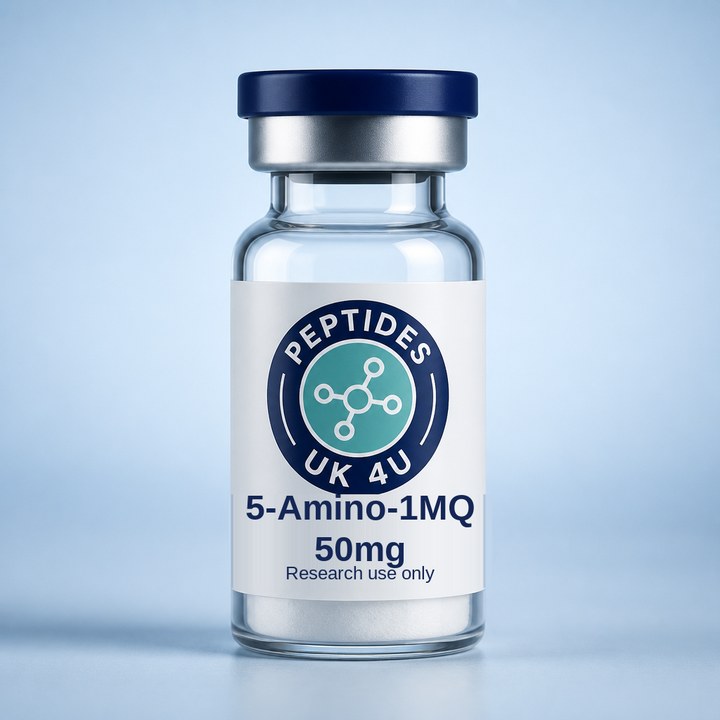
5-Amino-1MQ is a selective inhibitor of Nicotinamide N-methyltransferase (NNMT), an enzyme implicated in metabolic dysfunction. This peptide is studied for its potential to improve fat metabolism and increase NAD+ levels. Dosing typically ranges from 2.5mg to 5mg daily via subcutaneous injection.
- Selective NNMT inhibitor.
- Supports fat metabolism and NAD+ levels.
- Dosed subcutaneously at 2.5-5 mg daily.
- One 50 mg vial provides 10-20 days of material.
- Reconstitute with 4.0 mL bacteriostatic water.
Reconstitution
Vial strength
50 mg
Bacteriostatic water
4 mL
Concentration
12.5 mg/mL
1 unit = 0.01 mL = 0.125 mg (125 mcg)
- 1Remove the vial from freezer storage and allow it to reach room temperature for 15-20 minutes.
- 2Draw 4.0 mL of bacteriostatic water with a sterile syringe.
- 3Slowly inject the water down the inner wall of the vial, avoiding direct contact with the peptide powder to prevent foaming.
- 4Gently swirl or roll the vial until the powder is completely dissolved and the solution is clear; do not shake.
- 5Label the reconstituted vial with the date and refrigerate at 2-8 °C (35.6-46.4 °F), protected from light. Use within 2-4 weeks.
Dosing schedule
| Phase | Dose | On a U-100 syringe |
|---|---|---|
| Days 1-2 (Tolerance) | 2.5 mg once daily | 20 units (0.20 mL) |
| Days 3+ (Standard) | 5 mg once daily | 40 units (0.40 mL) |
| Alternative BID | 2.5 mg twice daily | 20 units (0.20 mL) x 2 |
Protocol detail
| Start | Begin with 2.5 mg once daily to assess individual tolerance. |
|---|---|
| Target | Increase to 5 mg once daily or opt for 2.5 mg twice daily (BID). |
| Frequency | Administer once or twice per day via subcutaneous injection. |
| Vial Duration | A single 50 mg vial typically lasts 10–20 days at recommended research doses. |
| Timing | Morning administration is generally preferred; twice-daily doses can be split between morning and evening. |
Overview at a glance
| Goal | To support metabolic efficiency by inhibiting NNMT, potentially enhancing fat oxidation and boosting NAD+ levels. |
|---|---|
| Schedule | Daily subcutaneous injections, with each 50 mg vial supplying 10-20 days of material. |
| Dose Range | 2.5–5 mg once or twice daily. |
| Reconstitution | Use 4.0 mL of bacteriostatic water per 50 mg vial to achieve a concentration of 12.5 mg/mL for precise measurements. |
| Storage | Lyophilized vials should be frozen at -20 °C (-4 °F); once reconstituted, refrigerate at 2-8 °C (35.6-46.4 °F). |
How it works
5-Amino-1MQ is a synthetic small molecule that acts as a selective inhibitor of Nicotinamide N-methyltransferase (NNMT). This enzyme is often overexpressed in adipose tissue in conditions of obesity and metabolic dysfunction, leading to the depletion of nicotinamide and reduced availability of NAD+. By blocking NNMT, 5-Amino-1MQ helps conserve nicotinamide, allowing for increased NAD+ synthesis. This action can then activate SIRT1 pathways, which are crucial for mitochondrial biogenesis and fat oxidation. Preclinical studies suggest that NNMT inhibition can mitigate diet-induced weight gain and improve metabolic health without altering food intake.
Reported effects
- May support reductions in fat mass.
- Helps preserve lean muscle mass.
- Associated with elevated NAD+ levels.
- Activates SIRT1 pathways.
- Potential for improved metabolic parameters.
Reported side effects
- Generally well tolerated.
- Mild headache.
- Transient jitteriness.
- Injection-site reactions.
- Long-term human safety data is not established.
Storage
Lyophilised (unmixed)
Store at -20 °C (-4 °F) in dry, dark conditions; stable up to 24 months.
After reconstitution
Refrigerate at 2-8 °C (35.6-46.4 °F); use within 2-4 weeks. Do not refreeze.
Supplies
| Peptide vials | 5-Amino-1MQ 50 mg vials (1 vial for 1-2 weeks, 2 vials for 4 weeks at 5mg/day) |
|---|---|
| Insulin Syringes | U-100 type (7 per week for once daily dosing, 14 per week for BID dosing) |
| Bacteriostatic Water | 10 mL bottles (4.0 mL needed per 50 mg vial) |
| Alcohol Swabs | One for vial stopper, one for injection site per administration (approx. 14 per week for once daily dosing) |
Important notes
- Always use a new, sterile insulin syringe for each administration and dispose of it properly in a sharps container.
- Rotate injection sites frequently (e.g., abdomen, thighs, upper arms) to prevent local irritation and lipohypertrophy.
- Inject slowly; a slight stinging sensation may be experienced due to the compound's quinolinium structure.
- Maintain a record of your daily doses and injection site rotation for consistency and accurate tracking.
- This product is for research use only and not for human consumption.
Frequently asked questions
What is the recommended reconstitution for a 50 mg vial of 5-Amino-1MQ?
For a 50 mg vial, you should add 4.0 mL of bacteriostatic water. This will yield a concentration of 12.5 mg/mL, making it easier to measure doses accurately using an insulin syringe.
How long will a 50 mg vial of 5-Amino-1MQ last?
At typical research doses of 2.5-5 mg per day, a single 50 mg vial will generally last between 10 to 20 days, depending on your daily dosing schedule (once or twice daily).
What is the primary mechanism of action for 5-Amino-1MQ?
5-Amino-1MQ works by selectively inhibiting the enzyme Nicotinamide N-methyltransferase (NNMT). This inhibition helps prevent the breakdown of nicotinamide, leading to increased NAD+ levels and activation of SIRT1 pathways, which are crucial for cellular metabolism and fat oxidation.
What are the common storage guidelines for 5-Amino-1MQ?
Lyophilized (powder) vials should be stored frozen at -20 °C (-4 °F). Once reconstituted with bacteriostatic water, the solution should be refrigerated at 2-8 °C (35.6-46.4 °F) and used within 2-4 weeks. Do not refreeze the reconstituted solution.
Educational reference only. These figures summarise how 5-Amino-1MQ is commonly described in research literature and supplier documentation. They are not a prescription, not medical advice, and not a recommendation to self-administer anything.
Related protocols
5-Amino-1MQ (10 mg Vial)
Inhibitor of NNMT for metabolic support and fat metabolism.
MOTS-c (40 mg Vial)
Metabolic regulator enhancing insulin sensitivity and fat oxidation.
HGH 191AA (10IU Vial)
Recombinant human growth hormone for body composition and metabolic health.
L-Carnitine (200 mg Vial)
Fuel fat metabolism, enhance energy, bypass gut issues.