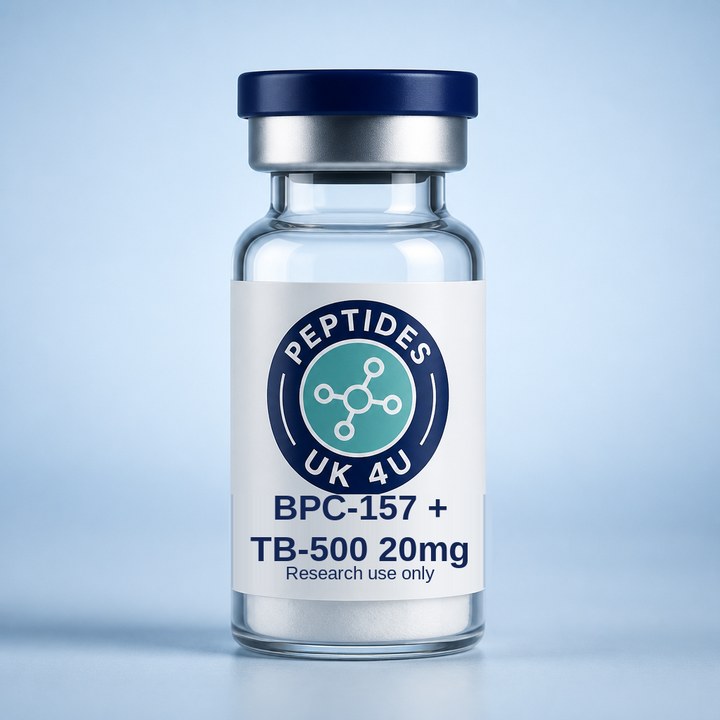
This blend combines BPC-157 and TB-500, two peptides known for their regenerative properties. It is typically administered via subcutaneous injection daily, with doses ranging from 250 mcg to 750 mcg of each peptide, for a total blend dose of 500 mcg to 1500 mcg. The protocol usually lasts 4-8 weeks.
- Combines BPC-157 (cytoprotective) and TB-500 (cell migration/angiogenesis).
- Dosed via subcutaneous injection once daily for 4-8 weeks.
- Reconstitute 20 mg vial with 3.0 mL bacteriostatic water for 6.67 mg/mL.
- Typical daily dose is 500-1000 mcg total blend, with an optional loading phase up to 1500 mcg.
- Rotate injection sites and use new sterile syringes for each dose.
Reconstitution
Vial strength
20 mg
Bacteriostatic water
3 mL
Concentration
6.67 mg/mL
1 unit = 0.01 mL = 66.7 mcg total blend (~33.3 mcg of each peptide)
- 1Draw 3.0 mL of bacteriostatic water using a sterile syringe.
- 2Inject the water slowly down the side of the vial, avoiding direct contact with the powder and preventing foaming.
- 3Gently swirl or roll the vial until the powder is fully dissolved; do not shake.
- 4Label the vial with the reconstitution date and refrigerate it at 2–8 °C (35.6–46.4 °F), shielding it from light.
Dosing schedule
| Phase | Dose | On a U-100 syringe |
|---|---|---|
| Weeks 1-2 | 500 mcg (0.5 mg) total blend | 7.5 units (0.075 mL) |
| Weeks 3-4 | 666 mcg (0.67 mg) total blend | 10 units (0.10 mL) |
| Weeks 5-8 | 1,000 mcg (1.0 mg) total blend | 15 units (0.15 mL) |
Protocol detail
| Start | Initiate with 500–666 mcg total blend daily (roughly 250–333 mcg of each peptide). |
|---|---|
| Target | Aim to reach 1,000 mcg total blend daily (about 500 mcg of each peptide) by Weeks 3–8. |
| Frequency | Administer once daily via subcutaneous injection. |
| Cycle Length | Continue for 4–8 weeks; optional cycling with a 6-week break between courses. |
| Optional Advanced Protocols | Some protocols incorporate a higher loading dose of 1,500 mcg total blend (~750 mcg each peptide) for the first 2–4 weeks, followed by a maintenance dose. |
Overview at a glance
| Goal | To support tissue repair, enhance wound healing, and aid musculoskeletal recovery in research settings. |
|---|---|
| Schedule | Daily subcutaneous injections over 4–8 weeks; some protocols suggest cycling with 3 months on and 6 weeks off. |
| Dose Range | 500–1,500 mcg total blend daily, which delivers approximately 250–750 mcg of each peptide. |
| Reconstitution | Add 3.0 mL to a 20 mg vial, resulting in approximately 6.67 mg/mL total concentration for precise unit measurements. |
| Storage | Lyophilized powder must be frozen; once reconstituted, refrigerate and use within 14 days. |
How it works
BPC-157 is a peptide derived from human gastric juice, known for its protective effects on various organ systems, promotion of new blood vessel formation, and interaction with growth factors critical for healing. TB-500, a naturally occurring peptide, regulates cell movement, reduces inflammation, and aids in wound repair and tissue regeneration. By combining these two, the blend is thought to offer complementary mechanisms that synergistically accelerate recovery of musculoskeletal and soft tissues. Both peptides enhance the body's natural repair processes, making this blend a subject of research for regenerative applications.
Reported effects
- Enhanced tissue repair
- Accelerated wound healing
- Reduced inflammation
- Improved gastrointestinal health (BPC-157)
- Support for musculoskeletal recovery
Reported side effects
- Mild injection-site reactions (redness, itching)
- Transient dizziness (rare)
- Nausea (rare)
- Limited long-term human safety data
Storage
Lyophilised (unmixed)
Store at -20 °C (-4 °F) in dry, dark conditions; minimize moisture exposure.
After reconstitution
Refrigerate at 2-8 °C (35.6-46.4 °F); use within 14 days and avoid freeze-thaw cycles. Allow to reach room temperature before opening.
Supplies
| Peptide vials (BPC-157 + TB-500 20 mg Blend) | 2 vials for 4 weeks (28 doses); 3 vials for 6 weeks (42 doses); 3-4 vials for 8 weeks (56 doses) with standard protocol. |
|---|---|
| Insulin Syringes (U-100) | 7 syringes per week (1 per day); 28 for 4 weeks, 42 for 6 weeks, 56 for 8 weeks. |
| Bacteriostatic Water (10 mL bottles) | 1 x 10 mL bottle for 4-6 weeks; 2 x 10 mL bottles for 8 weeks. |
| Alcohol Swabs | 14 swabs per week (2 per day); 1 x 100-count box for 4-6 weeks; 2 x 100-count boxes for 8 weeks. |
Important notes
- Always use a new sterile insulin syringe for each injection and dispose of it properly.
- Rotate injection sites (abdomen, thighs, upper arms) to minimize irritation and maintain consistent absorption.
- When targeting localized injuries, inject subcutaneously near (not directly into) the affected area.
- Maintain detailed records of daily doses and injection site rotation.
- Both BPC-157 and TB-500 are on WADA's list of prohibited substances for competitive sports.
Frequently asked questions
What is the typical dose range for BPC-157 + TB-500 blend?
The typical daily dose range for the BPC-157 + TB-500 blend is 500-1500 mcg total, depending on the phase of the protocol. This provides approximately 250-750 mcg of each individual peptide.
How do I reconstitute a 20 mg vial of BPC-157 + TB-500 blend?
To reconstitute, draw 3.0 mL of bacteriostatic water and inject it slowly down the side of the 20 mg vial. Gently swirl or roll the vial until the powder is completely dissolved. Do not shake.
How long can I use the BPC-157 + TB-500 blend after reconstitution?
Once reconstituted, the blend should be refrigerated at 2-8 °C (35.6-46.4 °F) and used within 14 days to maintain its stability and efficacy.
Can I inject the BPC-157 + TB-500 blend directly into an injury site?
While BPC-157 and TB-500 are often researched for localized effects, it is recommended to inject subcutaneously near (not directly into) the affected area when anatomically appropriate. Always rotate injection sites to prevent local irritation.
Educational reference only. These figures summarise how BPC-157 + TB-500 is commonly described in research literature and supplier documentation. They are not a prescription, not medical advice, and not a recommendation to self-administer anything.
Related protocols
BPC-157 + TB-500 (10 mg Blend)
Advanced blend for tissue repair, wound healing, and recovery.
KLOW (80 mg Blend)
Multi-peptide blend for enhanced healing, regeneration, and anti-inflammatory support.
Tri-Heal (45 mg Blend)
Advanced blend for tissue repair and inflammation modulation.
BPC-157 (10 mg Vial)
A synthetic peptide studied for tissue protection and accelerated healing.