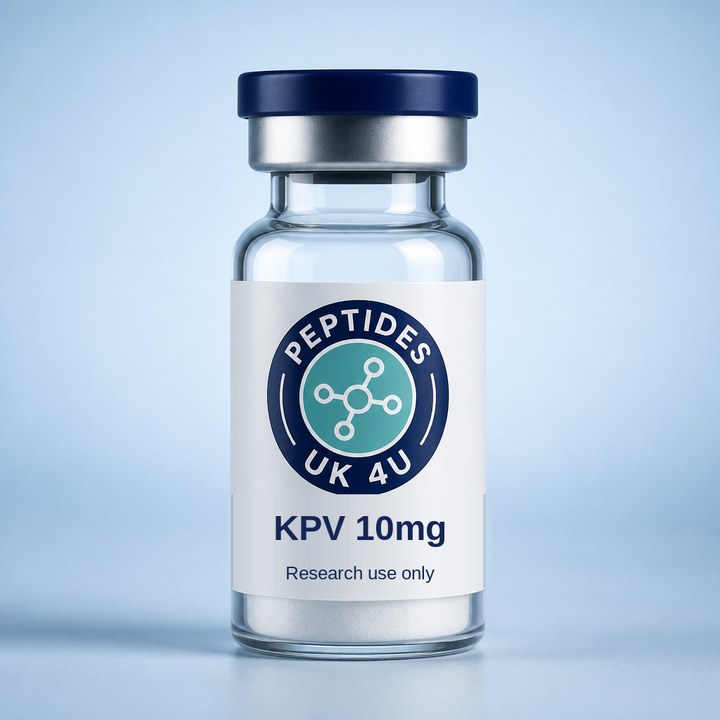
KPV is a potent anti-inflammatory peptide, a fragment of α-MSH, that reduces inflammatory cytokines without affecting pigmentation. It's typically dosed subcutaneously daily, often in short cycles, with concentrations easily adjusted for precise measurements using insulin syringes.
- Tripeptide fragment of α-MSH with potent anti-inflammatory properties.
- Reduces pro-inflammatory cytokines like TNF-α and IL-6.
- No melanotropic side effects observed.
- Administered via daily subcutaneous injections.
- Reconstituted vials stable for 30 days refrigerated.
Reconstitution
Vial strength
10 mg
Bacteriostatic water
3 mL
Concentration
3.33 mg/mL
1 unit = 0.01 mL = 33.33 mcg
- 1Draw 3.0 mL of bacteriostatic water using a sterile syringe.
- 2Slowly inject the water down the inner wall of the KPV vial, avoiding foaming.
- 3Gently swirl or roll the vial until the peptide fully dissolves (do not shake).
- 4Label the reconstituted vial with the date and refrigerate it at 2–8 °C (35.6–46.4 °F), protected from light.
Dosing schedule
| Phase | Dose | On a U-100 syringe |
|---|---|---|
| Week 1 | 200 mcg | 6 units (0.06 mL) |
| Week 2 | 300 mcg | 9 units (0.09 mL) |
| Week 3 | 400 mcg | 12 units (0.12 mL) |
| Weeks 4–8 | 500 mcg | 15 units (0.15 mL) |
Protocol detail
| Start | Begin with 200 mcg daily; increase the dose by approximately 100 mcg weekly as tolerated. |
|---|---|
| Target | Aim for a daily dose of 400–500 mcg by Weeks 4–8 to achieve maintenance anti-inflammatory effects. |
| Frequency | Inject once per day subcutaneously. |
| Cycle Length | An 8–12 week cycle is typical; extension to 16 weeks can be considered with observation. |
| Timing | Administer at a consistent time each day; consistently rotate injection sites. |
Overview at a glance
| Goal | Support reduction of systemic inflammation and modulate immune responses without affecting melanocytes. |
|---|---|
| Schedule | Daily subcutaneous injections for 8–12 weeks; optional extension to 16 weeks. |
| Dose Range | 200–500 mcg daily with gradual weekly increases. |
| Reconstitution | 3.0 mL bacteriostatic water per 10 mg vial, yielding approximately 3.33 mg/mL. |
| Storage | Lyophilized form stored frozen at -20 °C (-4 °F) or below; reconstituted solution refrigerated at 2–8 °C (35.6–46.4 °F). |
How it works
KPV is a short peptide sequence derived from α-melanocyte-stimulating hormone (α-MSH). It exhibits powerful anti-inflammatory effects by reducing key pro-inflammatory cytokines such as TNF-α, IL-6, and IL-1β, without triggering the pigment-producing effects of the full α-MSH molecule. KPV primarily works by inhibiting the NF-κB signaling pathway, which is central to inflammatory responses. Subcutaneous injection ensures effective systemic delivery, allowing for rapid absorption and sustained therapeutic benefits in conditions marked by inflammation.
Reported effects
- Reduces pro-inflammatory cytokines and modulates immune responses.
- Effective via subcutaneous injection for systemic delivery.
- May support tissue repair and wound healing.
- Generally well tolerated with minimal side effects.
- Does not cause skin pigmentation changes.
Reported side effects
- Mild injection-site reactions (redness, slight swelling) may occur.
- Systemic side effects are rarely reported.
Storage
Lyophilised (unmixed)
Store at -20 °C (-4 °F) or below in dry, dark conditions; protect from moisture and light.
After reconstitution
Refrigerate at 2–8 °C (35.6–46.4 °F) and use within 30 days; avoid freeze–thaw cycles.
Supplies
| Peptide vials (KPV, 10 mg each) | Approximately 3 vials for 8 weeks, 4 vials for 12 weeks, or 6 vials for 16 weeks. |
|---|---|
| Insulin Syringes (U-100) | 7 syringes per week (56 for 8 weeks, 84 for 12 weeks, 112 for 16 weeks). |
| Bacteriostatic Water (10 mL bottles) | 1-2 bottles depending on cycle length (approx. 3.0 mL per vial for reconstitution). |
| Alcohol Swabs | 14 swabs per week (2 per day), requiring 2-3 boxes for an 8-16 week cycle. |
Important notes
- Always use a new sterile insulin syringe for each injection and dispose of it properly in a sharps container.
- Rotate injection sites regularly (abdomen, thighs, upper arms) to prevent local irritation and lipohypertrophy.
- Inject slowly and allow a few seconds before withdrawing the needle to prevent solution backflow.
- Document daily doses, injection sites, and any observations for consistency and to track tolerability.
- If persistent injection-site reactions occur, review the protocol.
Frequently asked questions
What is KPV typically used for?
KPV is primarily researched for its potent anti-inflammatory effects. It's often studied in contexts of systemic inflammation, inflammatory bowel disease, and immune modulation, without the melanotropic (skin-darkening) side effects of its parent hormone.
How should I store KPV before and after reconstitution?
Lyophilized (powder) KPV should be stored frozen at -20 °C (-4 °F) or colder, in a dark, dry place. Once reconstituted with bacteriostatic water, it needs to be refrigerated at 2–8 °C (35.6–46.4 °F) and is typically stable for about 30 days. Avoid freezing reconstituted solutions.
Why is it important to rotate injection sites?
Rotating injection sites (e.g., abdomen, thighs, upper arms) is crucial to prevent localized irritation, discomfort, and a condition known as lipohypertrophy, which can impair absorption. Consistent rotation helps ensure better absorption and reduces tissue damage.
Can KPV affect my skin pigmentation?
No, KPV is a specific fragment of α-melanocyte-stimulating hormone (α-MSH) that retains the anti-inflammatory properties but does not possess the melanotropic (skin-darkening) effects of the full hormone. Studies indicate it does not influence skin pigmentation.
Educational reference only. These figures summarise how KPV is commonly described in research literature and supplier documentation, including the KPV listing at peptidesuk4u.co.uk. They are not a prescription, not medical advice, and not a recommendation to self-administer anything.
Related protocols
BPC-157 (10 mg Vial)
A synthetic peptide studied for tissue protection and accelerated healing.
BPC-157 (5 mg Vial)
A synthetic gastric peptide investigated for tissue repair and healing.
KLOW (80 mg Blend)
Multi-peptide blend for enhanced healing, regeneration, and anti-inflammatory support.
TB-500 + BPC-157 Stack (5 mg Vials)
Synergistic stack for enhanced tissue repair and regeneration.