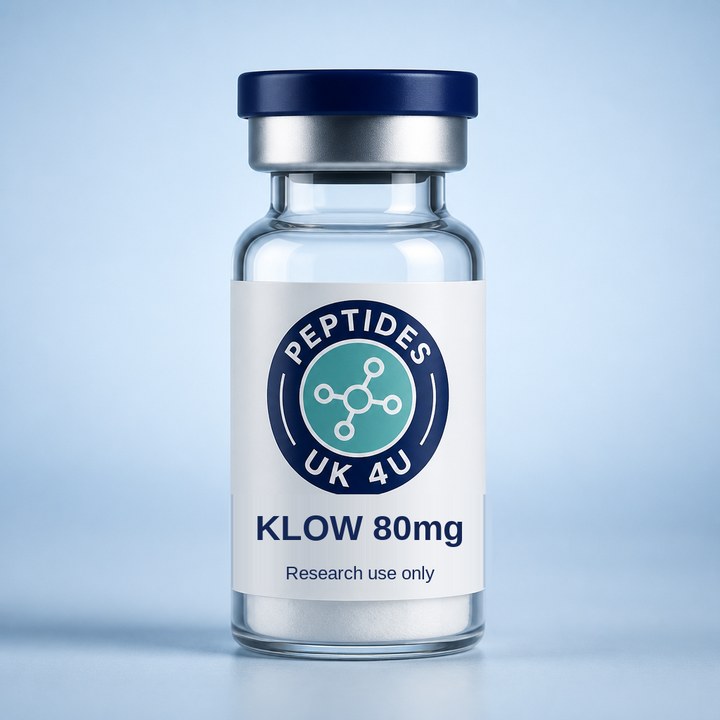
KLOW is a multi-peptide blend containing TB-500, BPC-157, KPV, and GHK-Cu, designed to support tissue repair and reduce inflammation. It is typically administered via subcutaneous injection in doses ranging from 250-750 mcg daily, with a titration schedule over several weeks. The blend comes as an 80 mg vial that needs reconstitution with bacteriostatic water.
- Comprehensive blend of TB-500, BPC-157, KPV, and GHK-Cu.
- Supports tissue repair, injury healing, and reduces inflammation.
- Dosed daily via subcutaneous injection.
- Gradual dose titration over several weeks is recommended.
- Reconstituted with 3.0 mL of bacteriostatic water for approximately 26.7 mg/mL.
Reconstitution
Vial strength
80 mg
Bacteriostatic water
3 mL
Concentration
26.67 mg/mL
1 unit = 0.01 mL = ~267 mcg total peptide
- 1Draw 3.0 mL of bacteriostatic water using a sterile syringe.
- 2Inject the water slowly down the interior wall of the KLOW vial, being careful to avoid creating foam.
- 3Gently swirl or roll the vial until the powder is completely dissolved; do not shake it vigorously.
- 4Label the reconstituted vial with the date and refrigerate it at 2–8 °C (35.6–46.4 °F), keeping it protected from light.
Dosing schedule
| Phase | Dose | On a U-100 syringe |
|---|---|---|
| Weeks 1–2 | 250 mcg (each TB-500, BPC-157, KPV) + 1.25 mg (GHK-Cu) | 7.5 units (0.075 mL) |
| Weeks 3–4 | 500 mcg (each TB-500, BPC-157, KPV) + 2.5 mg (GHK-Cu) | 15 units (0.15 mL) |
| Weeks 5–8 | 750 mcg (each TB-500, BPC-157, KPV) + 3.75 mg (GHK-Cu) | 22.5 units (0.225 mL) |
| Weeks 9–12 (Maintenance) | 500 mcg (each TB-500, BPC-157, KPV) + 2.5 mg (GHK-Cu) | 15 units (0.15 mL) |
Protocol detail
| Start | Begin with 7.5 units (0.075 mL) daily for an initial assessment period. |
|---|---|
| Increase | Gradually advance to 15 units by Week 3, then further to 22.5 units by Week 5, as tolerated. |
| Maintenance | For extended protocols, maintain a daily dose of 15 units. |
| Frequency | Administer once per day via subcutaneous injection. |
| Cycle Length | Typically 8–12 weeks, with an optional extension up to 16 weeks. |
| Timing | Can be administered at any consistent time of day; remember to rotate injection sites. |
Overview at a glance
| Goal | Support tissue repair, reduce inflammation, and promote regeneration through synergistic peptide action. |
|---|---|
| Schedule | Daily subcutaneous injections for 8–12 weeks; can be extended to 16 weeks if desired. |
| Dose Range | Gradual titration from lower to moderate daily doses, adjusted based on individual response. |
| Reconstitution | 3.0 mL of bacteriostatic water per 80 mg vial, resulting in approximately 26.7 mg/mL total concentration for precise unit measurements. |
| Storage | Store lyophilized vials frozen; once reconstituted, refrigerate and prevent repeated freeze–thaw cycles. |
How it works
KLOW combines four distinct peptides, each contributing to a synergistic effect for healing and regeneration. TB-500 facilitates wound healing and cell migration by influencing actin. BPC-157 supports the repair of tendons, ligaments, and muscles through enhanced angiogenesis and growth factors. KPV offers potent anti-inflammatory benefits by modulating NF-κB signaling. GHK-Cu stimulates collagen and elastin production, promoting overall tissue remodeling and wound repair. Together, these peptides aim to accelerate recovery and reduce inflammation across various bodily systems.
Reported effects
- Accelerated tissue repair and wound healing
- Reduced inflammation through multiple pathways
- Enhanced collagen and connective tissue synthesis
- Improved blood flow to healing areas
- Potential support for musculoskeletal recovery and joint health
Reported side effects
- Mild injection-site reactions (redness, irritation)
- Occasional lightheadedness due to vasodilatory effects
- Limited human clinical data for comprehensive safety profiles
Storage
Lyophilised (unmixed)
Freeze at -20 °C (-4 °F) in dry, dark conditions; minimize moisture exposure.
After reconstitution
Refrigerate at 2–8 °C (35.6–46.4 °F); use within 14–28 days and avoid freeze–thaw cycles.
Supplies
| Peptide vials (KLOW, 80 mg each) | 3 vials for 8 weeks, 4 vials for 12 weeks, 5 vials for 16 weeks |
|---|---|
| Insulin Syringes (U-100) | Minimum 7 per week; 56 for 8 weeks, 84 for 12 weeks, 112 for 16 weeks |
| Bacteriostatic Water (10 mL bottles) | 1 bottle for 8-12 weeks, 2 bottles for 16 weeks |
| Alcohol Swabs | Minimum 14 per week; recommend 2x 100-count boxes for 8-12 weeks, 3x 100-count boxes for 16 weeks |
Important notes
- Always use a new sterile insulin syringe for each injection and dispose of it in a sharps container.
- Rotate injection sites (abdomen, thighs, upper arms) to minimize local irritation and prevent lipohypertrophy.
- Inject slowly and allow a few seconds before withdrawing the needle.
- Maintain detailed records of daily doses and injection sites for consistent protocol adherence.
- This multi-peptide blend may offer broader regenerative support compared to single-peptide approaches.
Frequently asked questions
What is the primary purpose of the KLOW peptide blend?
KLOW is formulated to provide synergistic support for tissue regeneration, accelerate wound healing, and reduce inflammation through the combined actions of its four peptide components: TB-500, BPC-157, KPV, and GHK-Cu.
How should I store KLOW both before and after reconstitution?
Before reconstitution, store lyophilized KLOW vials frozen at -20 °C (-4 °F). After reconstituting with bacteriostatic water, the solution should be refrigerated at 2–8 °C (35.6–46.4 °F) and is typically stable for 14–28 days. Avoid freezing reconstituted peptide.
Is it important to follow the dose titration schedule for KLOW?
Yes, a gradual dose titration starting with lower doses and slowly increasing is recommended. This approach allows the body to adapt to the blend and helps assess individual tolerance and response, optimizing the protocol's effectiveness.
What are the common administration sites for KLOW injections?
KLOW is administered via subcutaneous injection. Preferred sites include the abdomen, thighs, and upper arms. It's crucial to rotate injection sites regularly to prevent localized irritation or potential tissue changes over time.
Educational reference only. These figures summarise how KLOW is commonly described in research literature and supplier documentation, including the KLOW listing at peptidesuk4u.co.uk. They are not a prescription, not medical advice, and not a recommendation to self-administer anything.
Related protocols
BPC-157 + TB-500 (10 mg Blend)
Advanced blend for tissue repair, wound healing, and recovery.
Tri-Heal (45 mg Blend)
Advanced blend for tissue repair and inflammation modulation.
BPC-157 (10 mg Vial)
A synthetic peptide studied for tissue protection and accelerated healing.
BPC-157 (5 mg Vial)
A synthetic gastric peptide investigated for tissue repair and healing.