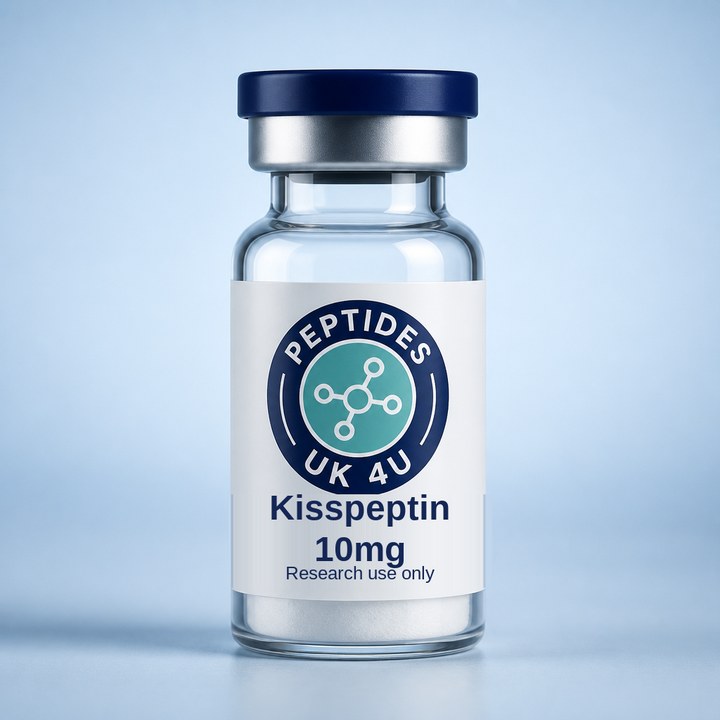
Kisspeptin is a significant neuroendocrine peptide that orchestrates reproductive functions by stimulating the release of gonadotropin-releasing hormone (GnRH). It is typically administered subcutaneously once daily, with dosages ranging from 100 to 200 mcg, often with a gradual increase over an 8-12 week cycle.
- Naturally occurring neuroendocrine peptide.
- Stimulates gonadotropin-releasing hormone (GnRH) secretion.
- Typically administered subcutaneously once daily.
- Dosing involves a gradual increase from 100 mcg to 200 mcg over several weeks.
- Integral for human reproduction and sex hormone regulation.
Reconstitution
Vial strength
10 mg
Bacteriostatic water
3 mL
Concentration
3.33 mg/mL
1 unit = 0.01 mL = 33.3 mcg
- 1Draw 3.0 mL of bacteriostatic water using a sterile syringe.
- 2Inject the water slowly down the interior wall of the vial, being careful to prevent foaming.
- 3Gently swirl or roll the vial until the peptide powder is fully dissolved, avoiding any vigorous shaking.
- 4Label the reconstituted vial with the date and refrigerate it at 2–8 °C (35.6–46.4 °F), protecting it from light.
Dosing schedule
| Phase | Dose | On a U-100 syringe |
|---|---|---|
| Weeks 1-2 | 100 mcg | 3 units (0.03 mL) |
| Weeks 3-8 (or 3-12) | 200 mcg | 6 units (0.06 mL) |
Protocol detail
| Start | Begin with 100 mcg daily for the initial one to two weeks to gauge individual sensitivity and response. |
|---|---|
| Titrate | If well-tolerated and required, increase the daily dose to 200 mcg. |
| Frequency | Administer once per day via subcutaneous injection. |
| Cycle Length | Continue for 8 to 12 weeks; avoid prolonged continuous use to prevent a decrease in effectiveness. |
| Timing | Inject at a consistent time each day and ensure rotation of injection sites. |
Overview at a glance
| Goal | To support the body’s natural reproductive hormone signaling by activating upstream GnRH pathways. |
|---|---|
| Schedule | Daily subcutaneous injections for a duration of 8 to 12 weeks. |
| Dose Range | 100-200 mcg daily, with a phased increase. |
| Reconstitution | 3.0 mL of bacteriostatic water per 10 mg vial, resulting in a concentration of approximately 3.33 mg/mL. |
| Storage | Lyophilized peptide should be frozen, and reconstituted peptide must be refrigerated; repeated freezing and thawing should be avoided. |
How it works
Kisspeptin acts as a crucial initiator in the reproductive hormone cascade. Once injected subcutaneously, it quickly binds to GPR54 receptors located on GnRH neurons within the hypothalamus, prompting an immediate surge of GnRH. This, in turn, stimulates the anterior pituitary gland to release luteinizing hormone (LH) and follicle-stimulating hormone (FSH). These hormones then target the gonads, enhancing the production of sex steroids and supporting the process of gametogenesis. Kisspeptin's mechanism relies entirely on GnRH; its effects on LH/FSH secretion are only possible if GnRH release is not blocked. This pathway effectively unlocks the body's natural GnRH reserves, leading to a more physiological pattern of hormone release compared to direct administration of GnRH or hCG.
Reported effects
- Physiological sex hormone stimulation
- Potential fertility restoration in cases of hypothalamic amenorrhea
- May serve as an IVF ovulation trigger with reduced OHSS risk
Reported side effects
- Occasional mild injection-site reactions (redness/itch)
Storage
Lyophilised (unmixed)
Store at -20 °C (-4 °F) in dry, dark conditions, ideally with desiccant.
After reconstitution
Refrigerate at 2-8 °C (35.6-46.4 °F) for up to approximately 4 weeks; avoid freeze-thaw cycles.
Supplies
| Peptide vials (Kisspeptin, 10 mg each) | 1 vial for 8 weeks, 2 for 12 weeks, 3 for 16 weeks |
|---|---|
| Insulin Syringes (U-100) | 56 for 8 weeks, 84 for 12 weeks, 112 for 16 weeks (7 per week) |
| Bacteriostatic Water (10 mL bottles) | 1 x 10 mL bottle for 8 or 12 weeks, up to 16 weeks based on total volume needed |
| Alcohol Swabs | 112 for 8 weeks (2 x 100-count boxes recommended), 168 for 12 weeks (2 x 100-count boxes), 224 for 16 weeks (3 x 100-count boxes) |
Important notes
- Always use new, sterile insulin syringes and dispose of them correctly in a sharps container.
- Rotate injection sites among the abdomen, thighs, and upper arms to minimize local irritation.
- Inject slowly and wait a few seconds before removing the needle to ensure proper absorption.
- Keep a record of daily doses and site rotations to maintain consistent administration.
- Discard bacteriostatic water 28 days after opening to prevent contamination.
Frequently asked questions
What is the primary function of Kisspeptin?
Kisspeptin is a neuroendocrine peptide that plays a crucial role in reproduction by stimulating the release of gonadotropin-releasing hormone (GnRH), which in turn triggers the secretion of LH and FSH, vital for sex hormone production and fertility.
How is Kisspeptin typically administered and dosed?
It is usually administered via subcutaneous injection once daily. A common protocol starts with 100 mcg daily for 1-2 weeks, potentially increasing to 200 mcg daily for the remainder of an 8-12 week cycle.
What is the correct way to reconstitute Kisspeptin?
For a 10 mg vial, you would add 3.0 mL of bacteriostatic water. Inject the water gently along the vial wall, then swirl or roll the vial until the powder dissolves completely, avoiding shaking, to achieve a concentration of approximately 3.33 mg/mL.
What are the potential benefits of using Kisspeptin?
Benefits may include physiological stimulation of sex hormones, potential restoration of fertility, and its use as an ovulation trigger in IVF protocols with potentially lower risk of ovarian hyperstimulation syndrome.
Educational reference only. These figures summarise how Kisspeptin is commonly described in research literature and supplier documentation. They are not a prescription, not medical advice, and not a recommendation to self-administer anything.
Related protocols
Gonadorelin (2 mg Vial)
Restores natural LH and FSH release for optimal hormone function.
HCG (5000 IU Vial)
Mimics LH to stimulate natural hormone production and preserve testicular function.
5-Amino-1MQ (10 mg Vial)
Inhibitor of NNMT for metabolic support and fat metabolism.
5-Amino-1MQ (50 mg Vial)
NNMT inhibitor for metabolic support, fat metabolism, and NAD+ levels.