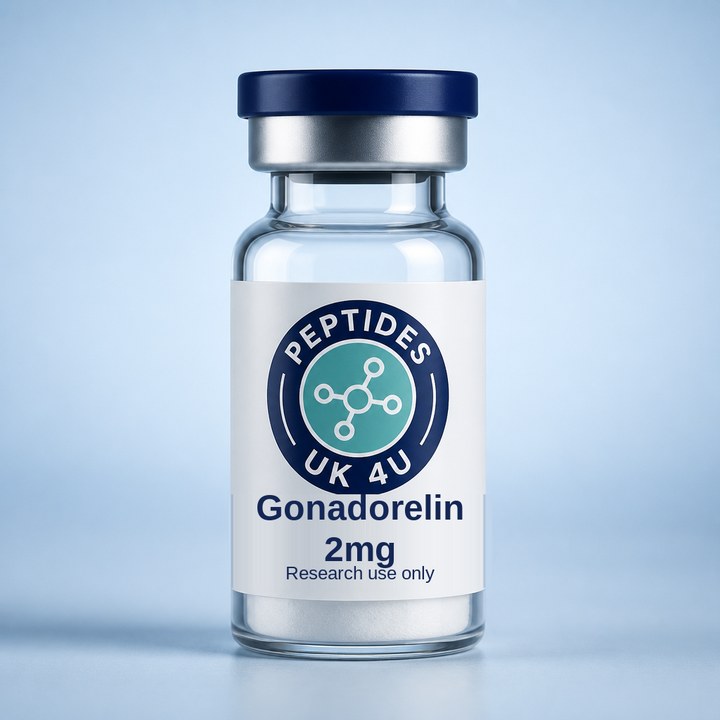
Gonadorelin is a synthetic form of Gonadotropin-Releasing Hormone (GnRH) that stimulates the pituitary gland to release LH and FSH, supporting natural hormone production. It is typically dosed via subcutaneous injection several times a week for 4-8 weeks to restore or maintain HPG axis function.
- Stimulates natural LH and FSH release.
- Supports testosterone production and ovarian function.
- Administered via subcutaneous injection.
- Reconstitute with 2.0 mL bacteriostatic water for 1 mg/mL concentration.
- Limit continuous daily dosing to 14 days to prevent desensitization.
Reconstitution
Vial strength
2 mg
Bacteriostatic water
2 mL
Concentration
1 mg/mL
1 unit = 0.01 mL = 10 mcg
- 1Draw 2.0 mL bacteriostatic water with a sterile syringe.
- 2Inject slowly down the vial wall; avoid foaming.
- 3Gently swirl/roll until dissolved (do not shake).
- 4Label concentration (1 mg/mL) and date; refrigerate at 2-8 °C (35.6-46.4 °F), protected from light.
Dosing schedule
| Phase | Dose | On a U-100 syringe |
|---|---|---|
| Weeks 1-2 (Initiation) | 50 mcg | 5 units (0.05 mL) |
| Weeks 3-4 (Titration) | 100 mcg | 10 units (0.10 mL) |
| Weeks 5-8 (Maintenance) | 100-150 mcg | 10-15 units (0.10-0.15 mL) |
Protocol detail
| Start | 50–100 mcg per injection; assess tolerance before increasing. |
|---|---|
| Target | 100–150 mcg per injection, 2–3 times weekly. |
| Frequency | Non-consecutive days (e.g., Mon/Wed/Fri) to mimic pulsatile GnRH release. |
| Cycle Length | 4–8 weeks; include off-periods to maintain pituitary sensitivity. |
| Timing | Morning injections preferred; rotate injection sites. |
Overview at a glance
| Goal | Stimulate endogenous LH and FSH release to support testosterone production and testicular function. |
|---|---|
| Schedule | Subcutaneous injections 2-3 times weekly for 4-8 weeks; limit daily dosing to ≤14 consecutive days. |
| Dose Range | 50-200 mcg per injection based on goals and response. |
| Reconstitution | 2.0 mL per 2 mg vial (1 mg/mL) for accurate unit measurements. |
| Storage | Lyophilized frozen; reconstituted refrigerated; avoid repeated freeze-thaw. |
How it works
Gonadorelin is a synthetic decapeptide that mimics natural gonadotropin-releasing hormone (GnRH). When administered in short, pulsatile doses, it binds to specific receptors in the pituitary gland, prompting the release of luteinizing hormone (LH) and follicle-stimulating hormone (FSH). LH in men stimulates testosterone production, while in women it triggers ovulation. FSH aids in sperm production and ovarian follicle development. This pulsatile dosing strategy is crucial, as continuous administration can lead to receptor desensitization, contrasting with its intended stimulatory effect.
Reported effects
- Supports endogenous testosterone production by stimulating LH release.
- May help maintain testicular volume and function.
- Promotes spermatogenesis and fertility in specific cases.
- Generally well tolerated.
Reported side effects
- Occasional mild injection-site reactions (redness, itching, swelling).
- Possible transient headache or flushing shortly after injection.
Storage
Lyophilised (unmixed)
Store at -20 °C (-4 °F) in dry, dark conditions; minimize moisture exposure.
After reconstitution
Refrigerate at 2–8 °C (35.6–46.4 °F); use within 4 weeks and avoid freeze–thaw.
Supplies
| Peptide vials | For 4-6 weeks (100 mcg x 3/wk) ≈ 1 vial; For 8 weeks (150 mcg x 3/wk) ≈ 2 vials |
|---|---|
| Insulin Syringes (U-100, 30- or 50-unit preferred) | Per week: 3 syringes. For 4 weeks: 12 syringes. For 6 weeks: 18 syringes. For 8 weeks: 24 syringes. |
| Bacteriostatic Water (10 mL bottles) | Use 2.0 mL per vial for reconstitution. 1 x 10 mL bottle is generally sufficient. |
| Alcohol Swabs | Per week: 6 swabs (2/injection × 3 injections). A 100-count box is recommended for an 8-week protocol. |
Important notes
- Use new sterile insulin syringes and dispose in a sharps container.
- Rotate injection sites (abdomen, thighs, upper arms) to reduce local irritation.
- Inject slowly; wait a few seconds before withdrawing the needle.
- Document each dose, date, and site rotation for consistency.
- Limit continuous daily dosing to ≤14 days to prevent receptor desensitization.
Frequently asked questions
What is the primary function of Gonadorelin?
Gonadorelin primarily functions to stimulate the pituitary gland to release Luteinizing Hormone (LH) and Follicle-Stimulating Hormone (FSH), which are crucial for natural testosterone production in men and ovarian function in women.
Why is it important to use Gonadorelin in a pulsatile manner rather than continuously?
Administering Gonadorelin in short, pulsatile doses mimics the body's natural release pattern of GnRH. Continuous administration can lead to desensitization of GnRH receptors in the pituitary, which can suppress rather than stimulate LH and FSH release.
How should I store Gonadorelin before and after mixing?
Lyophilized (unmixed) Gonadorelin should be stored frozen at -20 °C (-4 °F). Once reconstituted with bacteriostatic water, it should be refrigerated at 2-8 °C (35.6-46.4 °F) and used within 4 weeks. Avoid repeated freezing and thawing of the reconstituted solution.
What kind of syringe should I use for injection and why?
A U-100 insulin syringe, preferably in 30- or 50-unit sizes, is recommended. These syringes offer improved readability for the small volumes involved in Gonadorelin dosing, ensuring accurate measurement for each injection.
Educational reference only. These figures summarise how Gonadorelin is commonly described in research literature and supplier documentation. They are not a prescription, not medical advice, and not a recommendation to self-administer anything.
Related protocols
HCG (5000 IU Vial)
Mimics LH to stimulate natural hormone production and preserve testicular function.
Kisspeptin (10 mg Vial)
Master regulator of reproductive hormones, promoting natural fertility pathways.
5-Amino-1MQ (10 mg Vial)
Inhibitor of NNMT for metabolic support and fat metabolism.
5-Amino-1MQ (50 mg Vial)
NNMT inhibitor for metabolic support, fat metabolism, and NAD+ levels.