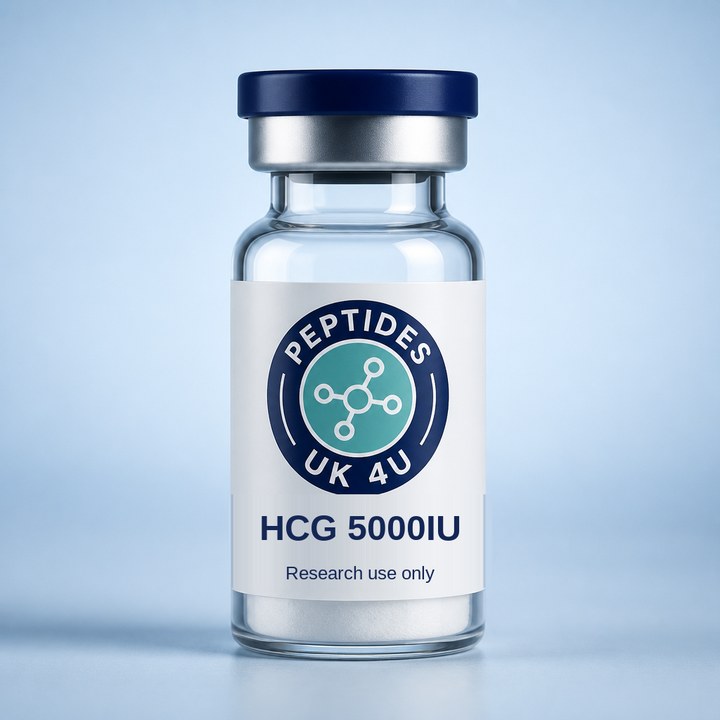
HCG is a hormone used to stimulate natural testosterone production in men or induce ovulation in women. It works by mimicking Luteinizing Hormone (LH) in the body. This protocol outlines a subcutaneous dosing approach, typically three times weekly, for maintaining testicular function during TRT or recovering natural hormone production after anabolic steroid use.
- Mimics Luteinizing Hormone (LH) in the body.
- Commonly used to maintain testicular size and function during TRT.
- Also used for post-cycle therapy (PCT) to restore natural testosterone production.
- Extended half-life of 36 hours supports less frequent dosing.
- Reconstituted solution is stable for up to 60 days when refrigerated.
Reconstitution
Vial strength
5000 mg
Bacteriostatic water
2 mL
Concentration
2500 mg/mL
1 unit = 0.01 mL = 25 IU on a U-100 insulin syringe
- 1Draw 2.0 mL of bacteriostatic water using a sterile syringe.
- 2Slowly inject the water down the inside wall of the HCG vial, avoiding vigorous shaking or foaming.
- 3Gently swirl or roll the vial until the powder completely dissolves into a clear solution.
- 4Label the vial with the reconstitution date and the concentration (2,500 IU/mL).
- 5Immediately place the reconstituted HCG vial back into the refrigerator at 2–8 °C (35.6–46.4 °F).
Dosing schedule
| Phase | Dose | On a U-100 syringe |
|---|---|---|
| Weeks 1-12 (Standard Protocol) | 500 IU | 20 units (0.20 mL) |
| Weeks 1-4 (High-Dose Recovery) | 1500 IU | 60 units (0.60 mL) |
| Weeks 5-8 (High-Dose Recovery) | 2000 IU | 80 units (0.80 mL) |
| Weeks 9-12 (High-Dose Recovery) | 1000 IU | 40 units (0.40 mL) |
Protocol detail
| Standard Maintenance | 500 IU subcutaneously on Monday, Wednesday, and Friday to maintain intratesticular testosterone levels during TRT. |
|---|---|
| High-Dose Recovery | 1,500–2,500 IU subcutaneously three times weekly for 3–6 months to re-establish spermatogenesis and testosterone production following anabolic steroid use or in cases of severe hypogonadotropic hypogonadism. Doses are typically reduced to maintenance levels after initial recovery. |
| Frequency Rationale | Because HCG has a 36-hour half-life, injecting three times per week is sufficient; daily injections are generally not necessary. |
| Cycle Length | Cycles typically last 8–12 weeks, though they may extend to 16 weeks or longer for individuals with severe suppression. |
| Injection Timing | Maintain consistent days and times for injections. Remember to rotate injection sites among the abdomen and thighs. |
Overview at a glance
| Goal | To maintain testicular function and fertility during testosterone replacement therapy (TRT) or to restore natural testosterone production after anabolic steroid cycles. |
|---|---|
| Schedule | Injections administered subcutaneously three times per week for approximately 8 to 16 weeks. |
| Dose Range | Standard maintenance doses are 500 IU per injection (1,500 IU weekly). For high-dose recovery, 1,500–2,500 IU per injection is used. |
| Reconstitution | Each 5000 IU vial is reconstituted with 2.0 mL of bacteriostatic water, yielding a concentration of 2,500 IU/mL for accurate measurement with insulin syringes. |
| Storage | Lyophilized and reconstituted vials must be refrigerated. The reconstituted solution remains stable for up to 60 days. |
How it works
Human Chorionic Gonadotropin (HCG) is a glycoprotein hormone that shares structural similarities with luteinizing hormone (LH). It stimulates the same LH receptors found in the Leydig cells of the testes, promoting the natural production of testosterone. Unlike the body's natural LH, which has a short half-life of around 30 minutes, HCG's half-life is extended to 36 hours, providing prolonged gonadal stimulation. This sustained action makes HCG effective for sustaining testicular function during exogenous testosterone therapy, which typically suppresses natural LH production. It also aids in restoring testicular function after prolonged anabolic steroid use or in cases of hypogonadotropic hypogonadism.
Reported effects
- Preserves fertility by maintaining intratesticular testosterone and spermatogenesis during TRT.
- Prevents or reverses testicular atrophy caused by exogenous testosterone use.
- Restores natural testosterone production in conditions like hypogonadotropic hypogonadism or post-cycle scenarios.
- Supports physiological downstream hormone production (e.g., pregnenolone, DHEA).
Reported side effects
- Potential for elevated estradiol levels due to stimulation of testicular aromatase.
- Mild reactions at the injection site such as redness, swelling, or discomfort.
- Possible acne or oily skin due to increased testosterone and estradiol.
- Occasional testicular discomfort or sensitivity as quiescent Leydig cells become active.
- Rare risk of gynecomastia if estradiol levels are significantly elevated without management.
Storage
Lyophilised (unmixed)
Refrigerate at 2–8 °C (35.6–46.4 °F); can be stored at room temperature but refrigeration preferred for long-term.
After reconstitution
Must be refrigerated at 2–8 °C (35.6–46.4 °F) and is stable for up to 60 days. Do NOT freeze.
Supplies
| Peptide vials | Depending on cycle length: 8 weeks (3 vials), 12 weeks (4 vials), 16 weeks (5 vials) of HCG 5000 IU. |
|---|---|
| Insulin Syringes (U-100) | 3 syringes weekly for injections; total 24 (8 weeks), 36 (12 weeks), or 48 (16 weeks). |
| Bacteriostatic Water (10 mL bottles) | 1 x 10 mL bottle for up to 5 vials of HCG. |
| Alcohol Swabs | 6 swabs weekly (2 per injection); recommend 1 x 100-count box for all cycle lengths. |
Important notes
- Always follow sterile techniques: use fresh, sterile insulin syringes and never reuse needles. Wipe vial stoppers and injection sites with alcohol.
- Rotate injection sites among the abdomen, outer thighs, and upper arms to prevent skin irritation and lipohypertrophy.
- Inject slowly and wait 5–10 seconds before withdrawing the needle to ensure proper dispersal of the solution.
- Consider monitoring testosterone and estradiol levels periodically, as HCG can increase estradiol conversion in some individuals.
- Keep detailed records of injection dates, doses, and sites for consistency throughout your protocol.
Frequently asked questions
What is the primary difference between HCG and natural LH?
HCG mimics LH by binding to the same receptors, but its key advantage is a much longer half-life (36 hours compared to LH's 30 minutes). This extended duration allows for less frequent dosing while providing sustained stimulation of testosterone production.
Can HCG be used during testosterone replacement therapy (TRT)?
Yes, HCG is often used in conjunction with TRT to maintain testicular function, preserve fertility, and prevent testicular atrophy, which can occur because exogenous testosterone suppresses natural LH production.
How long can reconstituted HCG be stored?
Once reconstituted with bacteriostatic water, HCG should be stored in the refrigerator at 2–8 °C (35.6–46.4 °F) and remains stable for up to 60 days. It should never be frozen, as freezing can denature the protein.
What are common side effects of HCG and how can they be managed?
Common side effects include potential increases in estradiol (which may require monitoring), injection site reactions, acne, or temporary testicular discomfort. Most side effects are mild and can often be managed through dose adjustments or, in some cases, with ancillary medications if estradiol elevation is significant.
Educational reference only. These figures summarise how HCG is commonly described in research literature and supplier documentation. They are not a prescription, not medical advice, and not a recommendation to self-administer anything.
Related protocols
Gonadorelin (2 mg Vial)
Restores natural LH and FSH release for optimal hormone function.
Kisspeptin (10 mg Vial)
Master regulator of reproductive hormones, promoting natural fertility pathways.
5-Amino-1MQ (10 mg Vial)
Inhibitor of NNMT for metabolic support and fat metabolism.
5-Amino-1MQ (50 mg Vial)
NNMT inhibitor for metabolic support, fat metabolism, and NAD+ levels.