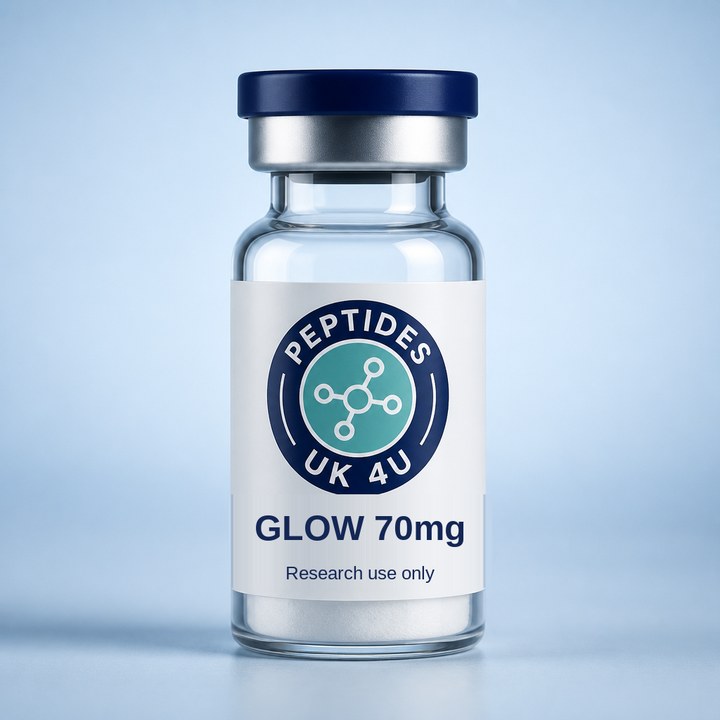
GLOW is a peptide blend containing GHK-Cu, BPC-157, and TB-500, formulated to support comprehensive tissue healing and regeneration. It is typically dosed via subcutaneous injections once daily for 4-week cycles.
- Combined blend for synergistic healing effects
- Typical dose is 2,330 mcg (10 units) daily
- Cycle length is 4 weeks, followed by a break
- Reconstitute with 3 mL bacteriostatic water
- Targets collagen synthesis, cell migration, and inflammation reduction
Reconstitution
Vial strength
70 mg
Bacteriostatic water
3 mL
Concentration
23.3 mg/mL
1 unit = 0.01 mL = 233 mcg
- 1Draw 3.0 mL of bacteriostatic water using a sterile syringe.
- 2Slowly inject the water down the inside wall of the GLOW peptide vial to minimize foaming.
- 3Gently swirl or roll the vial until the peptide powder is completely dissolved; avoid vigorous shaking.
- 4Label the reconstituted vial with the date and store it in the refrigerator at 2–8 °C (35.6–46.4 °F), protected from light.
- 5Use the solution within 4 weeks for optimal potency and safety.
Dosing schedule
| Phase | Dose | On a U-100 syringe |
|---|---|---|
| Weeks 1-4 | 2,330 mcg | 10 units (0.10 mL) |
Protocol detail
| Daily Dose | 2,330 mcg (10 units / 0.10 mL) maintained throughout the 4-week cycle. |
|---|---|
| Frequency | Once per day via subcutaneous injection, ideally at a consistent time. |
| Cycle Length | 4 weeks of daily dosing, followed by a 2–4 week break to evaluate progress and allow for receptor reset. |
| Volume | The per-injection volume of approximately 0.1 mL is well within comfortable limits for subcutaneous administration. |
| Syringe Recommendation | Use 0.3 mL (30-unit) insulin syringes for enhanced precision with low-volume measurements. |
Overview at a glance
| Goal | Support comprehensive tissue healing through combined effects of GHK-Cu, TB-500, and BPC-157, promoting collagen synthesis, cell migration, and anti-inflammatory responses. |
|---|---|
| Schedule | Daily subcutaneous injections for 4 weeks, followed by a 2–4 week rest period before considering another cycle. |
| Dose | 2,330 mcg (2.33 mg) total blend daily, providing approximately 1.7 mg GHK-Cu, 0.33 mg TB-500, and 0.33 mg BPC-157 per injection. |
| Reconstitution | Add 3.0 mL of bacteriostatic water per 70 mg vial for a concentration of 23.3 mg/mL. |
| Storage | Lyophilized vials should be frozen; reconstituted solutions must be refrigerated and used within 4 weeks. |
How it works
GLOW combines GHK-Cu, TB-500, and BPC-157, each working through distinct yet complementary mechanisms to foster healing. GHK-Cu modulates genes related to tissue growth, collagen synthesis, and reduces inflammation while promoting new blood vessel formation. TB-500 facilitates cell migration by influencing actin, accelerating angiogenesis and recruiting stem cells to repair damaged tissues. BPC-157 enhances growth factor signaling, improves microcirculation, and counteracts inflammatory mediators, supporting the survival and migration of repair cells. Together, these peptides create an optimal environment for regeneration, leading to faster wound closure, stronger tissue rebuilding, and reduced fibrosis.
Reported effects
- Accelerated wound healing (skin, tendons, muscles, gut)
- Anti-inflammatory effects and pain reduction
- Improved tissue quality and reduced scar formation
- Multi-tissue regenerative capabilities
- Generally well-tolerated with wide safety margins
Reported side effects
- Occasional mild injection-site reactions (redness, itching)
Storage
Lyophilised (unmixed)
Store at -20 °C (-4 °F) or colder for long-term stability. If a freezer isn't available, refrigeration (2-8 °C) is suitable for shorter periods. Store in a sealed container with desiccant to prevent moisture absorption.
After reconstitution
Refrigerate at 2-8 °C (35.6-46.4 °F). Do not freeze. Use within 4 weeks (28 days). Protect from light and discard if discolored, cloudy, or if precipitate forms.
Supplies
| Peptide vials (GLOW Blend, 70 mg each) | 1 vial for a 4-week protocol |
|---|---|
| Insulin Syringes (U-100, 0.3 mL / 30-unit for precision) | 28 syringes (1 per day for 4 weeks) |
| Bacteriostatic Water (10 mL bottles) | 1 x 10 mL bottle for reconstituting 1 vial |
| Alcohol Swabs | 56 swabs for a 4-week protocol (2 per day), recommend 1 x 100-count box |
Important notes
- Use a new sterile insulin syringe for each injection and dispose of it immediately in a sharps container.
- Rotate injection sites (abdomen, thighs, upper arms) systematically to minimize irritation.
- Inject slowly over several seconds and allow the needle to remain for a few seconds to ensure complete delivery.
- Maintain aseptic technique for all injections, cleaning vial stoppers and skin with separate alcohol swabs.
- Document daily dose, injection site, and any observations to track progress.
Frequently asked questions
What is GLOW and what does it do?
GLOW is a peptide blend containing GHK-Cu, BPC-157, and TB-500. It is designed to promote tissue healing, accelerate regeneration, reduce inflammation, and enhance anti-aging processes across various tissues in the body by leveraging the synergistic effects of its components.
How often should I inject GLOW and for how long?
GLOW is typically injected once daily via subcutaneous administration. A standard protocol involves daily injections for 4 weeks, followed by a 2-4 week rest period. This cycle can be repeated as needed after evaluation of progress.
How do I reconstitute a 70 mg vial of GLOW for dosing?
To reconstitute, use a sterile syringe to draw 3.0 mL of bacteriostatic water. Inject the water slowly down the side of the GLOW vial. Gently swirl or roll the vial until the powder is fully dissolved. This will create a concentration of 23.3 mg/mL, where 1 unit on a U-100 syringe equals approximately 233 mcg.
What are the common side effects of GLOW?
GLOW is generally well-tolerated. The most common minor side effects are mild injection-site reactions such as redness or itching. These are typically temporary and resolve quickly. Serious side effects are rare based on current research.
Educational reference only. These figures summarise how GLOW is commonly described in research literature and supplier documentation, including the GLOW listing at peptidesuk4u.co.uk. They are not a prescription, not medical advice, and not a recommendation to self-administer anything.
Related protocols
Tri-Heal (45 mg Blend)
Advanced blend for tissue repair and inflammation modulation.
BPC-157 + TB-500 (10 mg Blend)
Advanced blend for tissue repair, wound healing, and recovery.
KLOW (80 mg Blend)
Multi-peptide blend for enhanced healing, regeneration, and anti-inflammatory support.
GHK-Cu (50 mg Vial)
Naturally occurring copper peptide for tissue remodeling and skin repair.