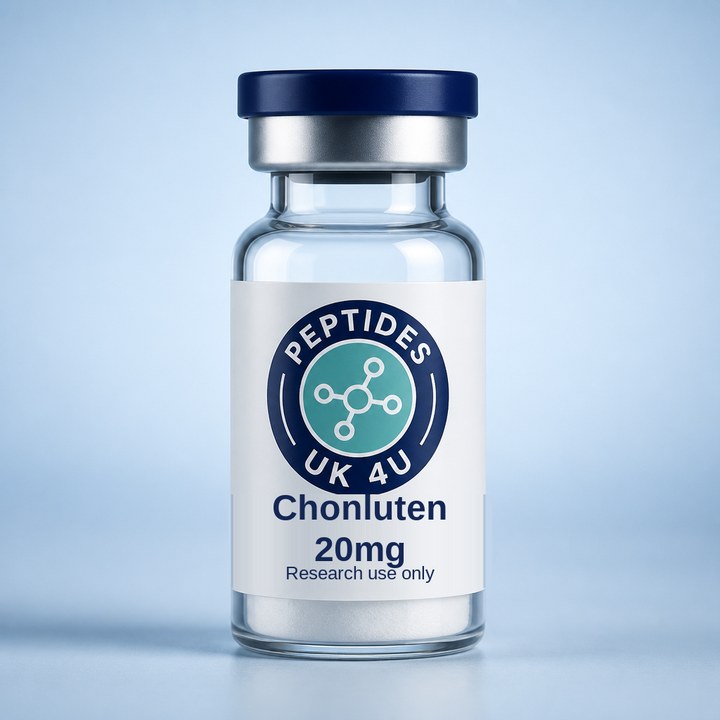
Chonluten is a short tripeptide investigated for its effects on lung tissue and inflammation. It is administered via subcutaneous injection, with educational protocols suggesting a daily dose between 250 mcg and 4 mg, gradually increasing over an 8-16 week cycle.
- A bioregulatory tripeptide (Glu-Asp-Gly).
- Targeted for bronchopulmonary tissue support.
- May modulate inflammatory pathways in cell models.
- Administered via subcutaneous injection due to poor oral stability.
- Gradual titration from 250 mcg up to 4 mg daily.
Reconstitution
Vial strength
20 mg
Bacteriostatic water
3 mL
Concentration
6.67 mg/mL
1 unit = 0.01 mL = 66.67 mcg
- 1Draw 3.0 mL of bacteriostatic water using a sterile syringe.
- 2Inject the water slowly down the inside wall of the Chonluten vial, avoiding direct contact with the powder and foaming.
- 3Gently swirl or roll the vial until the powder is completely dissolved. Do not shake.
- 4Label the reconstituted vial with the date and refrigerate it at 2–8 °C, protecting it from light.
Dosing schedule
| Phase | Dose | On a U-100 syringe |
|---|---|---|
| Weeks 1–2 | 250 mcg | 3.75 units (0.0375 mL) |
| Weeks 3–4 | 500 mcg | 7.5 units (0.075 mL) |
| Weeks 5–6 | 1,000 mcg | 15 units (0.15 mL) |
| Weeks 7–8 | 1,500 mcg | 22.5 units (0.225 mL) |
| Weeks 9–10 | 2,000 mcg | 30 units (0.30 mL) |
| Weeks 11–12 | 3,000 mcg | 45 units (0.45 mL) |
| Weeks 13–14 | 4,000 mcg | 60 units (0.60 mL) |
| Weeks 15–16 | 4,000 mcg | 60 units (0.60 mL) |
Protocol detail
| Start | Begin with 250 mcg daily. Gradually increase the dose by 250–500 mcg every 1–2 weeks, based on tolerance. |
|---|---|
| Target | Aim to reach up to 4,000 mcg daily by Weeks 13–16 of the protocol. |
| Frequency | Administer once per day via subcutaneous injection. |
| Cycle Length | The full protocol typically spans 8–16 weeks, though shorter durations of 8–12 weeks are also considered acceptable. |
| Timing | Injections can be given at any consistent time of day. Remember to rotate injection sites regularly. |
Overview at a glance
| Goal | Support bronchopulmonary tissue function and modulate inflammatory pathways. |
|---|---|
| Schedule | Daily subcutaneous injections for 8–16 weeks with gradual dose titration. |
| Dose Range | 250–4,000 mcg daily with incremental increases every 1–2 weeks. |
| Reconstitution | 3.0 mL bacteriostatic water per 20 mg vial, resulting in 6.67 mg/mL concentration for accurate unit measurements. |
| Storage | Lyophilized form refrigerated or frozen; reconstituted form refrigerated. Avoid repeated freeze-thaw cycles. |
How it works
Chonluten is a short bioregulatory peptide (Glu-Asp-Gly) from the Khavinson bioregulator peptide family, primarily investigated for its effects on lung tissues. Studies in monocyte/macrophage cell models suggest Chonluten may influence cell proliferation and inflammatory processes at low concentrations. Because short peptides like Chonluten are susceptible to enzymatic degradation and have limited absorption in the digestive system, subcutaneous injection is the preferred and most effective method of administration, bypassing oral bioavailability challenges and ensuring direct systemic delivery.
Reported effects
- May support bronchopulmonary tissue function.
- Suggested to modulate inflammatory pathways.
- Generally well-tolerated in preclinical studies.
Reported side effects
- Occasional mild injection-site reactions (e.g., redness, itching).
Storage
Lyophilised (unmixed)
Refrigerate at 4 °C short-term or freeze at -20 °C long-term (protected from moisture).
After reconstitution
Refrigerate at 2-8 °C; use within days to weeks; avoid freeze-thaw cycles.
Supplies
| Peptide vials | Estimate 3 vials for an 8-week cycle, 6 vials for 12 weeks, and 12 vials for 16 weeks (20 mg each). |
|---|---|
| Insulin Syringes (U-100) | Plan for 7 syringes per week (1 per day). This translates to 56 for 8 weeks, 84 for 12 weeks, and 112 for 16 weeks. |
| Bacteriostatic Water | Each 20 mg vial requires 3.0 mL. For reference: 1 x 10 mL bottle for 8 weeks, 2 x 10 mL bottles for 12 weeks, and 4 x 10 mL bottles for 16 weeks. |
| Alcohol Swabs | Allocate 2 swabs per day (one for vial, one for injection site). Recommend 2 x 100-count boxes for 8-12 weeks, and 3 x 100-count boxes for 16 weeks. |
Important notes
- Always use new, sterile insulin syringes and dispose of them safely in a sharps container.
- Rotate injection sites to prevent local irritation and issues like lipohypertrophy.
- Inject slowly and pause a few seconds before withdrawing the needle.
- Keep a record of daily doses and injection site rotation for consistency.
- For small doses (≤10 units), use 30- or 50-unit insulin syringes for better accuracy.
Frequently asked questions
What is Chonluten used for?
Chonluten is a peptide studied for its potential to support the function of bronchopulmonary tissues and to modulate inflammatory responses, based on research in cell models.
How is Chonluten typically administered?
Due to its poor oral stability, Chonluten is administered via subcutaneous injection. This method ensures that the peptide is delivered effectively.
Why is there such a wide dose range for Chonluten?
The protocol for Chonluten involves a gradual titration, starting at a lower dose (250 mcg) and slowly increasing it over several weeks to a higher dose (up to 4,000 mcg). This allows for monitoring tolerance and response.
What kind of storage does Chonluten require?
Lyophilized Chonluten should be refrigerated for short-term storage or frozen for long-term. Once reconstituted, it must be kept refrigerated and used within days to weeks, avoiding any freeze-thaw cycles.
Educational reference only. These figures summarise how Chonluten is commonly described in research literature and supplier documentation. They are not a prescription, not medical advice, and not a recommendation to self-administer anything.
Related protocols
Ara-290 (16 mg Vial)
Targets innate repair receptor for anti-inflammatory and tissue-protective effects.
BPC-157 (10 mg Vial)
A synthetic peptide studied for tissue protection and accelerated healing.
BPC-157 (5 mg Vial)
A synthetic gastric peptide investigated for tissue repair and healing.
KPV (10 mg Vial)
Potent anti-inflammatory peptide, fragment of α-MSH, without melanotropic effects.