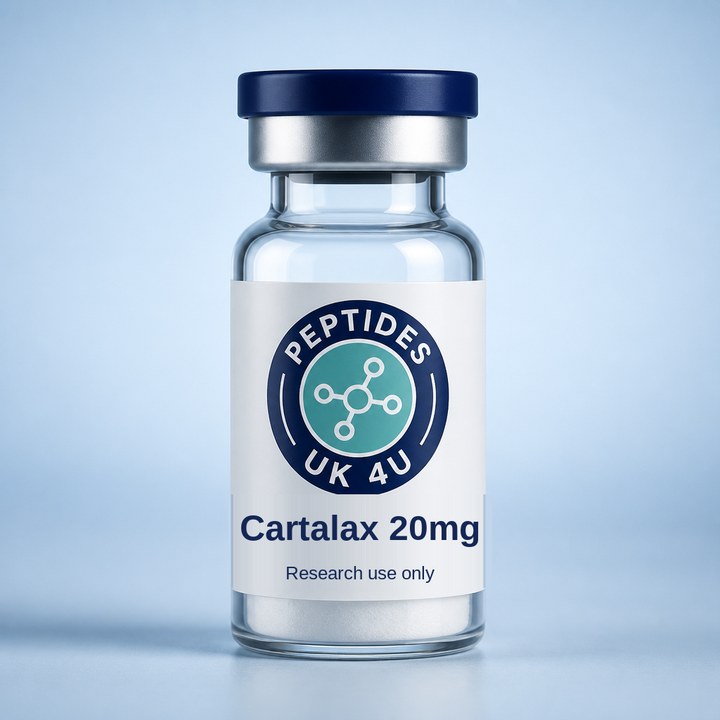
Cartalax is a synthetic tripeptide bioregulator designed to support connective tissue and fibroblast function. It is typically administered via subcutaneous injection daily, with doses gradually increasing over several weeks to a maximum of 5 mg.
- Synthetic tripeptide bioregulator (Ala-Glu-Asp)
- Reconstitute 20 mg vial with 3.0 mL bacteriostatic water for 6.67 mg/mL concentration
- Dose between 2 mg and 5 mg daily via subcutaneous injection
- Gradually increase dose over an 8-12 week cycle
- Primary goal is to support connective tissue homeostasis and fibroblast function
Reconstitution
Vial strength
20 mg
Bacteriostatic water
3 mL
Concentration
6.67 mg/mL
1 unit = 0.01 mL = 66.7 mcg
- 1Draw 3.0 mL of bacteriostatic water using a sterile syringe.
- 2Insert the needle through the stopper of the peptide vial, allowing the diluent to flow slowly down the side of the vial to prevent foaming.
- 3Gently swirl or roll the vial until the peptide is completely dissolved; do not shake.
- 4Label the reconstituted vial with the date and refrigerate it at 2–8 °C, ensuring it is protected from light.
Dosing schedule
| Phase | Dose | On a U-100 syringe |
|---|---|---|
| Weeks 1–2 | 2,000 mcg (2.0 mg) | 30 units (0.30 mL) |
| Weeks 3–4 | 3,000 mcg (3.0 mg) | 45 units (0.45 mL) |
| Weeks 5–8 | 4,000 mcg (4.0 mg) | 60 units (0.60 mL) |
| Weeks 9–12 | 5,000 mcg (5.0 mg) | 75 units (0.75 mL) |
Protocol detail
| Start | Begin with 2,000 mcg daily; increase the dose by approximately 1,000 mcg every two weeks as tolerated. |
|---|---|
| Target | Aim to reach 4,000–5,000 mcg daily by Weeks 5–12. |
| Frequency | Administer once per day via subcutaneous injection. |
| Cycle Length | Typically 8–12 weeks, with the option to extend to 16 weeks. |
| Timing | Inject at a consistent time each day and remember to rotate injection sites. |
Overview at a glance
| Goal | Support connective-tissue homeostasis and fibroblast function based on preclinical bioregulator research. |
|---|---|
| Schedule | Daily subcutaneous injections for 8–12 weeks, with an optional extension to 16 weeks. |
| Dose Range | 2,000–5,000 mcg daily with gradual titration. |
| Reconstitution | 3.0 mL per 20 mg vial (~6.67 mg/mL) for accurate unit measurements. |
| Storage | Lyophilized: refrigerate or freeze; reconstituted: refrigerate; avoid repeated freeze–thaw cycles. |
How it works
Cartalax, a Khavinson bioregulatory peptide (Ala-Glu-Asp), is believed to interact with DNA and regulate gene expression at very low concentrations. Its sequence is similar to a motif in type XI collagen, vital for cartilage. Preclinical studies show Cartalax can boost fibroblast proliferation, enhance SIRT-1/SIRT-6 expression, and lower pro-apoptotic signals like p53 and caspase-3. It also appears to inhibit MMP-9, an enzyme involved in degrading the extracellular matrix, collectively supporting tissue integrity and cellular health. This mechanism suggests a role in maintaining connective tissue.
Reported effects
- Supports fibroblast proliferation and reduces cellular senescence markers
- Modulates extracellular matrix homeostasis via MMP-9 inhibition
- May regulate collagen-related gene expression
Reported side effects
- Well tolerated in observational settings
- Occasional mild injection-site reactions (redness, itch)
Storage
Lyophilised (unmixed)
Store at 2–8 °C or freeze at −20 °C for long-term stability; protect from light and moisture.
After reconstitution
Refrigerate at 2–8 °C; avoid freeze–thaw cycles.
Supplies
| Peptide vials | Based on 20 mg each: 8 weeks ≈ 10 vials; 12 weeks ≈ 15 vials; 16 weeks ≈ 20 vials. |
|---|---|
| Insulin Syringes (U-100) | For 8 weeks: 56 syringes; 12 weeks: 84 syringes; 16 weeks: 112 syringes (1 per day). |
| Bacteriostatic Water (10 mL bottles) | 3.0 mL per vial for reconstitution. For 8 weeks: 3 x 10 mL bottles; 12 weeks: 5 x 10 mL bottles; 16 weeks: 6 x 10 mL bottles. |
| Alcohol Swabs | Two per day. For 8 weeks: recommend 2 x 100-count boxes; 12 weeks: recommend 2 x 100-count boxes; 16 weeks: recommend 3 x 100-count boxes. |
Important notes
- Use new sterile insulin syringes and dispose in a sharps container.
- Rotate injection sites (abdomen, thighs, upper arms) to reduce irritation.
- Inject slowly and pause before withdrawing the needle.
- Document daily dose and site rotation to ensure consistency.
Frequently asked questions
What is Cartalax and how does it work?
Cartalax is a synthetic tripeptide bioregulator (Ala-Glu-Asp) that modulates gene expression and supports connective tissue. It is believed to enhance fibroblast proliferation, reduce cellular aging markers, and maintain the extracellular matrix, contributing to tissue repair and health.
What is the recommended dosing schedule for Cartalax?
The suggested protocol involves daily subcutaneous injections, starting at 2,000 mcg for the first two weeks and gradually increasing up to 5,000 mcg by weeks 9-12. The cycle typically lasts 8-12 weeks, with an optional extension to 16 weeks.
How should Cartalax be reconstituted and stored?
A 20 mg vial should be reconstituted with 3.0 mL of bacteriostatic water, yielding a concentration of approximately 6.67 mg/mL. Lyophilized Cartalax should be refrigerated or frozen, while reconstituted peptide must be refrigerated and protected from light. Avoid freeze-thaw cycles for both forms.
Are there any side effects or important considerations when using Cartalax?
Cartalax is generally well tolerated, with mild injection site reactions like redness or itching being possible. It's crucial to use sterile syringes, rotate injection sites, and document doses. Keep in mind that extensive human clinical trial data for subcutaneous Cartalax are limited, and this protocol is based on preclinical studies.
Educational reference only. These figures summarise how Cartalax is commonly described in research literature and supplier documentation. They are not a prescription, not medical advice, and not a recommendation to self-administer anything.
Related protocols
BPC-157 (10 mg Vial)
A synthetic peptide studied for tissue protection and accelerated healing.
BPC-157 (5 mg Vial)
A synthetic gastric peptide investigated for tissue repair and healing.
GHK-Cu (100 mg Vial)
Copper peptide supporting collagen, tissue repair, and antioxidant benefits.
GHK-Cu (50 mg Vial)
Naturally occurring copper peptide for tissue remodeling and skin repair.