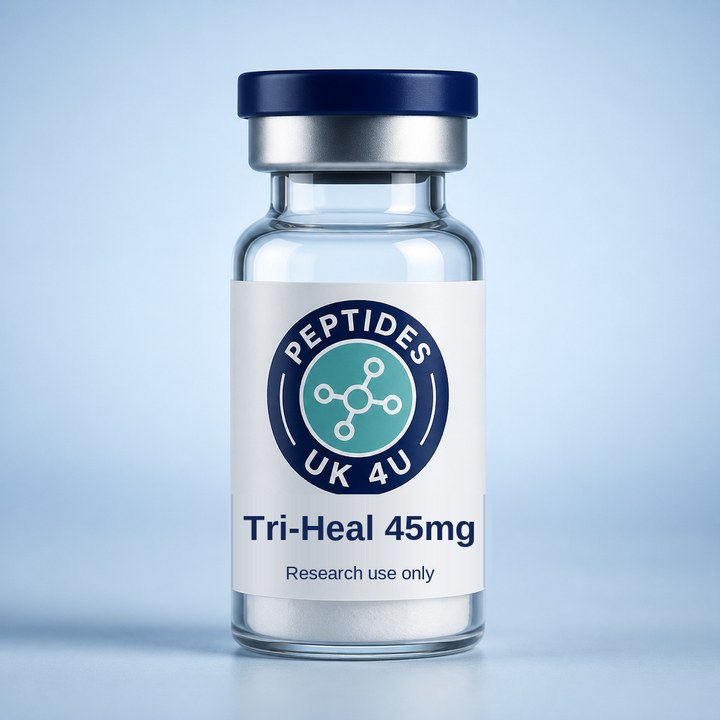
Tri-Heal is a peptide blend designed to support tissue repair, regeneration, and inflammation modulation. It combines TB-500, BPC-157, and KPV for synergistic effects. Doses typically range from 500 mcg to 2 mg once daily via subcutaneous injection, with gradual titration over several weeks.
- Contains TB-500 (25 mg), BPC-157 (10 mg), and KPV (10 mg).
- Dosed via subcutaneous injection once daily.
- Reconstituted with 3.0 mL bacteriostatic water for a 15 mg/mL concentration.
- Dosing typically starts at 500 mcg and titrates up.
- Cycle length can range from 8 to 16 weeks.
Reconstitution
Vial strength
45 mg
Bacteriostatic water
3 mL
Concentration
15 mg/mL
1 unit = 0.01 mL = 150 mcg on a U-100 syringe
- 1Draw 3.0 mL of bacteriostatic water with a sterile syringe.
- 2Inject the water slowly down the inside wall of the Tri-Heal vial, avoiding direct contact with the powder and foaming.
- 3Gently swirl or roll the vial until the powder completely dissolves; do not shake vigorously.
- 4Label the reconstituted vial with the date and concentration (15 mg/mL), then refrigerate it at 2–8 °C (35.6–46.4 °F), protected from light.
Dosing schedule
| Phase | Dose | On a U-100 syringe |
|---|---|---|
| Weeks 1-2 | 500 mcg | 3.3 units (0.033 mL) |
| Weeks 3-4 | 1000 mcg | 6.7 units (0.067 mL) |
| Weeks 5-6 | 1500 mcg | 10 units (0.10 mL) |
| Weeks 7-8 | 2000 mcg | 13.3 units (0.133 mL) |
| Weeks 9-10 | 2500 mcg | 16.7 units (0.167 mL) |
| Weeks 11-12 | 3000 mcg | 20 units (0.20 mL) |
| Weeks 13-14 | 3500 mcg | 23.3 units (0.233 mL) |
| Weeks 15-16 | 4000 mcg | 26.7 units (0.267 mL) |
Protocol detail
| Start | Begin with 500 mcg daily and increase the dose by 500 mcg every two weeks, based on tolerance. |
|---|---|
| Target | For a standard protocol, aim for 1500–2000 mcg daily by weeks 5–8; extended protocols may reach 3000–4000 mcg. |
| Frequency | Administer once per day via subcutaneous injection. |
| Cycle Length | Typically 8–12 weeks, with an option to extend to 16 weeks. |
| Timing | Inject at a consistent time each day and systematically rotate injection sites. |
Overview at a glance
| Goal | Support tissue healing, regeneration, and modulate inflammation through the combined action of peptides. |
|---|---|
| Schedule | Daily subcutaneous injections for 8–12 weeks, with an option to extend to 16 weeks. |
| Dose Range | 500–4000 mcg daily, with a strategy of gradual dose increase. |
| Reconstitution | 3.0 mL bacteriostatic water per 45 mg vial to achieve 15 mg/mL, for precise unit measurements. |
| Storage | Lyophilized form stored frozen; reconstituted solution stored refrigerated. Avoid repeated freeze-thaw cycles. |
How it works
Tri-Heal combines three distinct peptides—TB-500, BPC-157, and KPV—each contributing to a comprehensive healing response. TB-500 enhances cell migration, angiogenesis, and tissue repair while reducing inflammation. BPC-157 promotes accelerated healing of various tissues, including muscles and tendons, by stimulating growth factors and blood vessel formation. KPV, a potent anti-inflammatory agent, helps to mitigate inflammatory processes by modulating cytokine signaling. Together, these peptides create a synergistic effect, targeting wound repair, new blood vessel formation, and inflammation reduction through complementary biochemical pathways.
Reported effects
- Promotes cell proliferation and angiogenesis
- Accelerated tissue repair and wound healing
- Reduces inflammation and cytokine release
- Supports musculoskeletal healing (tendons, muscles)
- Enhances fibroblast activity and endothelial regeneration
Reported side effects
- Occasional mild injection-site reactions (redness, discomfort)
Storage
Lyophilised (unmixed)
Freeze at -20 °C (-4 °F) or colder, in dry, dark conditions.
After reconstitution
Refrigerate at 2–8 °C (35.6–46.4 °F); use within 4 weeks; avoid freeze–thaw cycles.
Supplies
| Peptide vials (Tri-Heal, 45 mg each) | 2 vials for an 8-week protocol, 4 vials for 12 weeks, 6 vials for 16 weeks. |
|---|---|
| Insulin Syringes (U-100) | Approximately 7 syringes per week (56 for 8 weeks, 84 for 12 weeks, 112 for 16 weeks). Consider 30-unit or 50-unit syringes for initial low doses. |
| Bacteriostatic Water (10 mL bottles) | 1 x 10 mL bottle for 8 weeks, 2 x 10 mL bottles for 12 or 16 weeks. |
| Alcohol Swabs | Approx. 14 swabs per week (2 per day), totaling 112 for 8 weeks, 168 for 12 weeks, and 224 for 16 weeks. |
Important notes
- Always use a new sterile insulin syringe for each injection.
- Dispose of all used syringes in an approved sharps container.
- Rotate injection sites regularly to prevent irritation and lipohypertrophy.
- Inject slowly and allow the needle to remain in place for a few seconds before withdrawing.
- For doses under 10 units, consider using 30-unit or 50-unit insulin syringes for better accuracy.
Frequently asked questions
What is the optimal way to store Tri-Heal?
Freeze the lyophilized powder at -20 °C or colder for long-term storage. Once reconstituted, refrigerate the solution at 2-8 °C and use it within 4 weeks. Avoid repeated freezing and thawing of the reconstituted peptide.
How crucial is it to rotate injection sites?
Rotating injection sites daily is very important to prevent local irritation, tissue damage, and the formation of hardened areas (lipohypertrophy). Good practice involves using different areas like the abdomen, thighs, and upper arms.
Why does the protocol suggest using smaller insulin syringes for lower doses?
For doses under 10 units, using 30-unit or 50-unit insulin syringes allows for greater precision and readability. This helps ensure that the specific, smaller dose is accurately measured and administered, especially during the initial phases of the protocol.
Can I mix Tri-Heal with other peptides to inject them together?
It is generally not recommended to mix this blend with other peptides in the same syringe unless specifically instructed by a healthcare professional or reliable source. Each peptide may have specific properties that could be affected by mixing, or it could complicate accurate dosing.
Educational reference only. These figures summarise how Tri-Heal is commonly described in research literature and supplier documentation. They are not a prescription, not medical advice, and not a recommendation to self-administer anything.
Related protocols
BPC-157 + TB-500 (10 mg Blend)
Advanced blend for tissue repair, wound healing, and recovery.
GLOW (70 mg Blend)
Advanced blend for tissue healing, regeneration, and anti-aging.
KLOW (80 mg Blend)
Multi-peptide blend for enhanced healing, regeneration, and anti-inflammatory support.
MGF (5 mg Vial)
Supports muscle repair and regeneration through localized growth factor signaling.