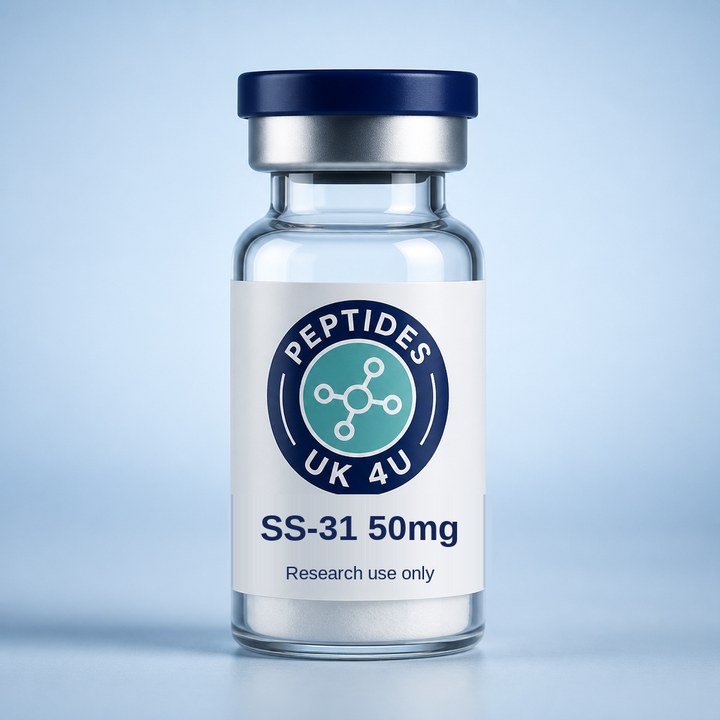
SS-31 is a mitochondrial-targeting peptide that helps stabilize the electron transport chain and reduce oxidative stress. It is administered via subcutaneous injection, with typical daily doses ranging from 5 mg to 10 mg for most protocols.
- Dosed subcutaneously once daily.
- Supports mitochondrial function and reduces oxidative stress.
- 50 mg vial reconstituted with 3.0 mL yields 16.67 mg/mL.
- Typical courses are 8-12 weeks.
- Injection site reactions are common but usually mild.
Reconstitution
Vial strength
50 mg
Bacteriostatic water
3 mL
Concentration
16.67 mg/mL
1 unit = 0.01 mL = 167 mcg
- 1Draw 3.0 mL of bacteriostatic water using a sterile syringe.
- 2Inject the water slowly down the inside wall of the SS-31 vial, avoiding vigorous shaking.
- 3Gently swirl or roll the vial until the powder is fully dissolved and the solution is clear.
- 4Label the reconstituted vial with the date and refrigerate at 2-8 °C, protected from light. Use within 4 weeks.
Dosing schedule
| Phase | Dose | On a U-100 syringe |
|---|---|---|
| Weeks 1-2 | 5 mg | 30 units (0.30 mL) |
| Weeks 3-8 | 10 mg | 60 units (0.60 mL) |
Protocol detail
| Start | Begin with 5 mg daily for Weeks 1-2 to evaluate individual tolerance. |
|---|---|
| Standard Target | Increase to 10 mg daily by Week 3, which is a common dose in clinical trials. |
| Advanced Target | For severe conditions and under medical oversight, doses of 15-20 mg daily may be used from Week 5 onward. |
| Frequency | Inject once per day subcutaneously, maintaining a consistent time. |
| Cycle Length | The cycle typically lasts 8-12 weeks; data for use beyond 12 weeks is limited. |
| Timing | Any consistent time of day is suitable; remember to rotate injection sites regularly. |
Overview at a glance
| Goal | Support mitochondrial function, enhance ATP production, and reduce oxidative stress in tissues. |
|---|---|
| Schedule | Daily subcutaneous injections for 8-12 weeks. |
| Dose Range | 5-10 mg daily (standard); 15-20 mg daily (advanced, under supervision). |
| Reconstitution | 3.0 mL per 50 mg vial (~16.67 mg/mL) for convenient dosing. |
| Storage | Lyophilized frozen at -20 °C; reconstituted refrigerated at 2-8 °C, use within 4 weeks. |
How it works
SS-31 (elamipretide) is a cell-permeable tetrapeptide that specifically targets and accumulates within the inner mitochondrial membrane. Here, it binds to cardiolipin, a crucial phospholipid for organizing electron transport chain components and maintaining mitochondrial structure. By stabilizing these cardiolipin-protein interactions, SS-31 effectively optimizes electron transport efficiency, reducing the production of harmful reactive oxygen species and enhancing ATP synthesis in metabolically active tissues. Preclinical studies show it protects against mitochondrial dysfunction across various disease models, including heart failure and neurodegeneration. In human trials, it has a favorable safety profile and has shown significant improvements in muscle strength and exercise capacity in Barth syndrome, leading to its accelerated FDA approval for this specific condition.
Reported effects
- Stabilizes mitochondrial membranes and optimizes electron transport chain function.
- Enhances ATP production and reduces pathological reactive oxygen species.
- Improves muscle strength and exercise capacity in Barth syndrome patients.
- Protective effects in preclinical models of heart failure, neurodegeneration, and muscle atrophy.
- Does not significantly alter blood pressure, heart rate, or standard lab parameters.
Reported side effects
- Injection-site reactions (redness, itching, discomfort) are common and usually mild.
- Approximately 80% of patients experienced mild injection-site reactions in trials.
- No dose-limiting toxicities or serious adverse events directly attributed to SS-31.
- Long-term safety data beyond 12 weeks is limited.
Storage
Lyophilised (unmixed)
Store at -20 °C (-4 °F) in original sealed vial, dry and protected from light. Stable for months.
After reconstitution
Refrigerate at 2-8 °C (35.6-46.4 °F) and use within 4 weeks. Avoid freeze-thaw.
Supplies
| Peptide vials (SS-31, 50 mg each) | For an 8-week standard protocol (5-10 mg/day), approximately 10 vials; for 12 weeks, 16 vials. Advanced 12-week protocols may require 21 vials. |
|---|---|
| Insulin Syringes (U-100, 1 mL capacity) | 7 syringes per week (1 per day) for standard dosing (e.g., 56 for 8 weeks, 84 for 12 weeks). Advanced protocols with split 20 mg doses may require 2 syringes per day. |
| Bacteriostatic Water (30 mL bottles) | 3.0 mL per vial for reconstitution. For 10 vials (8 weeks), 1 x 30 mL bottle. |
| Alcohol Swabs | Two swabs per day - one for the vial, one for the injection site. Recommend 2 x 100-count boxes for 8-12 weeks. |
Important notes
- Use a new sterile insulin syringe for each injection and dispose of it in a sharps container.
- Rotate injection sites regularly (abdomen, thighs, upper arms) to prevent irritation.
- Inject slowly over several seconds and wait briefly before withdrawing the needle.
- Mild injection-site reactions are common and typically resolve within hours.
- Document daily dose, injection site, and any reactions for consistency.
Frequently asked questions
What is the primary function of SS-31?
SS-31 is a peptide designed to improve mitochondrial function by stabilizing cardiolipin in the inner mitochondrial membrane, which helps optimize the electron transport chain, reduce oxidative stress, and enhance ATP production.
How long can I use SS-31 in a cycle?
Most educational protocols suggest a cycle length of 8-12 weeks. Clinical trial data beyond 12 weeks is limited, so extended use should be carefully monitored and discussed with a qualified healthcare professional.
What should I do if I experience an injection site reaction?
Mild injection-site reactions like redness, itching, or discomfort are common and usually resolve within a few hours. Ensure you are rotating injection sites regularly and using proper sterile technique. If reactions are severe or persistent, consult a healthcare provider.
Can SS-31 be used for conditions other than Barth syndrome?
While SS-31 is FDA-approved only for Barth syndrome (under the brand name Forzinity), its use for other conditions remains investigational. This guide is for educational purposes only and not medical advice. Always consult with healthcare professionals before starting any peptide protocol for non-approved uses.
Educational reference only. These figures summarise how SS-31 is commonly described in research literature and supplier documentation, including the SS-31 listing at peptidesuk4u.co.uk. They are not a prescription, not medical advice, and not a recommendation to self-administer anything.
Related protocols
SS-31 (10 mg Vial)
Mitochondria-targeting peptide for energy production and oxidative stress reduction.
SS-31 (30 mg Vial)
Mitochondrial-targeted peptide enhancing energy production and reducing oxidative stress.
5-Amino-1MQ (50 mg Vial)
NNMT inhibitor for metabolic support, fat metabolism, and NAD+ levels.
MOTS-c (40 mg Vial)
Metabolic regulator enhancing insulin sensitivity and fat oxidation.