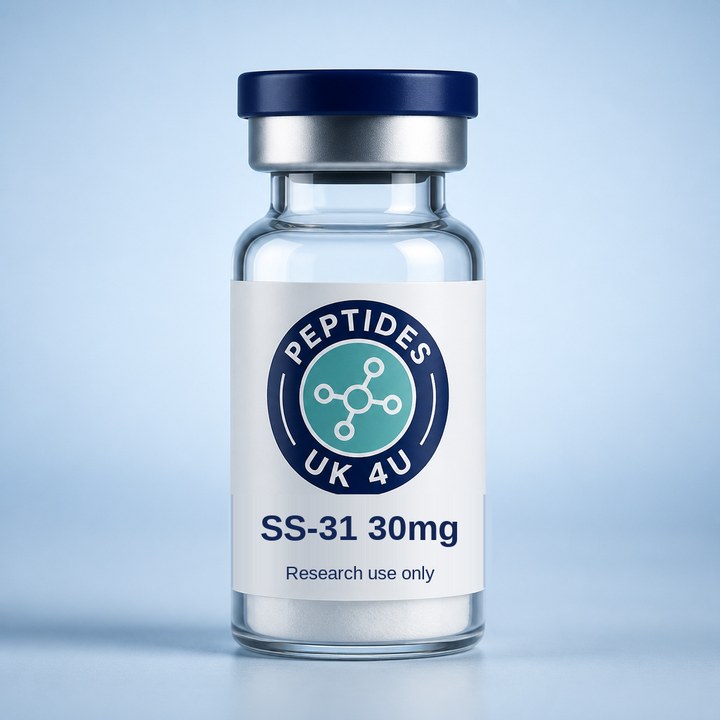
SS-31 is a tetrapeptide that targets mitochondria, specifically binding to cardiolipin to stabilize the electron transport chain, reduce oxidative stress, and boost ATP synthesis. It is dosed via subcutaneous injection, typically 5-10 mg daily depending on the protocol and desired intensity.
- FDA-approved for Barth syndrome (Forzinity).
- Targets mitochondria to improve ATP production and reduce oxidative stress.
- A 30 mg vial reconstituted with 3.0 mL yields 10 mg/mL.
- Standard dosing ranges from 5-10 mg daily.
- Split injections are needed for doses above 10 mg.
Reconstitution
Vial strength
30 mg
Bacteriostatic water
3 mL
Concentration
10 mg/mL
1 unit = 0.01 mL = 100 mcg
- 1Draw 3.0 mL of bacteriostatic water using a sterile syringe.
- 2Slowly inject the water down the inside wall of the SS-31 vial, avoiding direct impact on the peptide powder.
- 3Do not shake the vial vigorously; gently swirl or roll the vial until the powder is fully dissolved and the solution is clear.
- 4Label the vial with the reconstitution date and store it in the refrigerator at 2-8 °C (35.6-46.4 °F), protected from light. Use within 4 weeks.
Dosing schedule
| Phase | Dose | On a U-100 syringe |
|---|---|---|
| Weeks 1-2 (Standard/Advanced) | 5 mg (5000 mcg) | 50 units (0.50 mL) |
| Weeks 3-8 (Standard) | 10 mg (10,000 mcg) | 100 units (1.0 mL) |
| Weeks 3-4 (Advanced) | 10 mg (10,000 mcg) | 100 units (1.0 mL) |
| Weeks 5-8 (Advanced) | 15 mg (15,000 mcg) | Split: 2 x 75 units (0.75 mL each) |
| Optional Weeks 9-12 (Advanced) | 20 mg (20,000 mcg) | Split: 2 x 100 units (1.0 mL each) |
Protocol detail
| Start | 5 mg daily for Weeks 1-2 to assess individual tolerance. |
|---|---|
| Standard Target | 10 mg daily by Week 3 (most common clinical trial dose). |
| Advanced Target | 15-20 mg daily for Weeks 5+ (only for severe conditions under medical oversight). |
| Frequency | Once per day (subcutaneous injection); maintain consistent timing. |
| Cycle Length | 8-12 weeks; limited data exists beyond 12 weeks. |
| Timing | Any consistent time; rotate injection sites to prevent tissue irritation. |
Overview at a glance
| Goal | Support mitochondrial function, enhance ATP production, and reduce oxidative stress in tissues with high metabolic demand. |
|---|---|
| Schedule | Daily subcutaneous injections for 8-12 weeks. |
| Dose Range | 5-10 mg daily (standard); 15-20 mg daily (advanced, under supervision). |
| Reconstitution | 3.0 mL per 30 mg vial (~10 mg/mL) for convenient single-syringe administration. |
| Storage | Lyophilized frozen at -20 °C (-4 °F); reconstituted refrigerated at 2-8 °C (35.6-46.4 °F); use within 4 weeks. |
How it works
SS-31, also known as elamipretide, is a permeable tetrapeptide that targets mitochondria. It accumulates in the inner mitochondrial membrane where it binds to cardiolipin, a crucial phospholipid for organizing electron transport chain supercomplexes and maintaining mitochondrial structure. By stabilizing cardiolipin interactions, SS-31 optimizes electron transport, reduces harmful reactive oxygen species production, and improves ATP synthesis in metabolically active tissues. Preclinical studies show its protective effects across various disease models, and it received FDA accelerated approval in 2025 for Barth syndrome.
Reported effects
- Stabilizes mitochondrial membranes and optimizes electron transport chain function.
- Enhances ATP production and reduces pathological reactive oxygen species.
- Improves muscle strength and exercise capacity in Barth syndrome patients.
- Shows protective effects in preclinical models of heart failure, neurodegeneration, and muscle atrophy.
- Does not significantly alter blood pressure or heart rate in clinical trials.
Reported side effects
- Injection-site reactions (most common): mild-to-moderate redness, itching, or transient discomfort.
- No dose-limiting toxicities or serious adverse events directly attributed to SS-31 in published trials.
- Long-term safety data beyond 12 weeks is limited.
Storage
Lyophilised (unmixed)
Store lyophilized at -20 °C (-4 °F) in original sealed vial, protected from light. Stable for months.
After reconstitution
Refrigerate at 2-8 °C (35.6-46.4 °F) immediately after mixing; use within 4 weeks for optimal stability. Avoid freeze-thaw cycles.
Supplies
| Peptide vials | 17 vials for 8 weeks (standard), 26 vials for 12 weeks (standard), 35 vials for 12 weeks (advanced). |
|---|---|
| Insulin Syringes (U-100, 1 mL) | 7 syringes per week (standard); 56 syringes for 8 weeks; 84 syringes for 12 weeks. Advanced protocols may require 2 syringes per day. |
| Bacteriostatic Water | 2 x 30 mL bottles for 8 weeks (17 vials); 3 x 30 mL bottles for 12 weeks (26 vials); 4 x 30 mL bottles for 12 weeks (35 vials, advanced). |
| Alcohol Swabs | 14 per week (2/day); 112 for 8 weeks (2 x 100-count boxes); 168 for 12 weeks (2 x 100-count boxes). |
Important notes
- Use a new sterile insulin syringe for each injection and dispose of it in a sharps container immediately.
- Rotate injection sites (abdomen, thighs, upper arms) to reduce local irritation.
- Inject slowly over several seconds and wait briefly before withdrawing the needle to prevent leakage.
- For doses requiring split injections (>=15 mg), space injections at least 2 inches apart.
- This content is for educational purposes only and not medical advice.
Frequently asked questions
What is the primary function of SS-31?
SS-31's primary function is to support mitochondrial health by stabilizing mitochondrial membranes, optimizing the electron transport chain, reducing oxidative stress, and enhancing ATP production.
How should I reconstitute and store SS-31?
To reconstitute, add 3.0 mL of bacteriostatic water to a 30 mg vial, gently swirling until dissolved. Store the lyophilized peptide at -20 °C and the reconstituted solution refrigerated at 2-8 °C, using it within 4 weeks.
What is the typical dose range for SS-31?
Standard daily doses range from 5-10 mg, administered once daily via subcutaneous injection. Advanced protocols, under medical supervision, may go up to 15-20 mg daily, requiring split injections.
Are there any specific side effects or important considerations for SS-31?
The most common side effects are mild injection-site reactions like redness or itching. It's important to use sterile syringes, rotate injection sites, inject slowly, and space out split injections. Long-term safety data beyond 12 weeks is limited.
Educational reference only. These figures summarise how SS-31 is commonly described in research literature and supplier documentation, including the SS-31 listing at peptidesuk4u.co.uk. They are not a prescription, not medical advice, and not a recommendation to self-administer anything.
Related protocols
SS-31 (10 mg Vial)
Mitochondria-targeting peptide for energy production and oxidative stress reduction.
SS-31 (50 mg Vial)
Mitochondria-targeting peptide for cellular energy and oxidative stress.
Pinealon (20 mg Vial)
Neuroprotective tripeptide supporting cognitive function and neuronal resilience.
5-Amino-1MQ (50 mg Vial)
NNMT inhibitor for metabolic support, fat metabolism, and NAD+ levels.