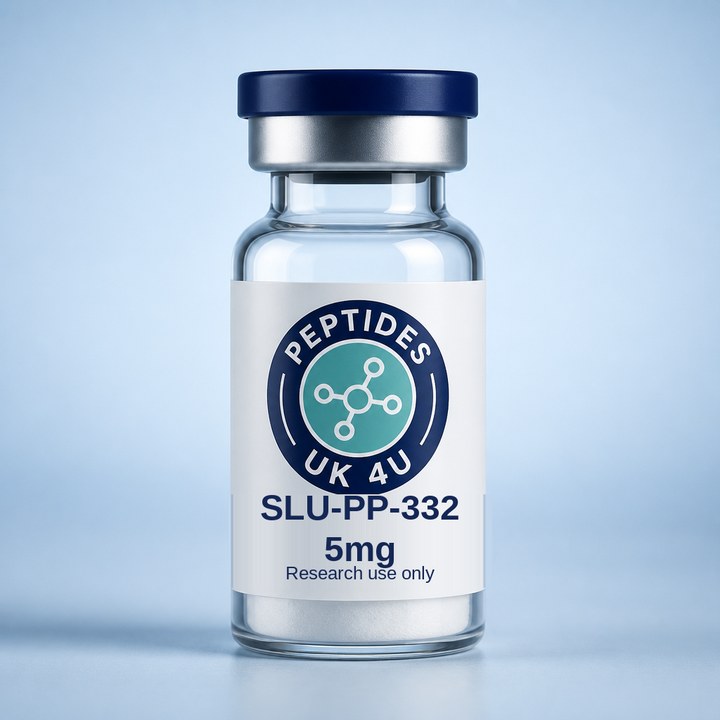
SLU-PP-332 is a research compound that acts as a pan-agonist for estrogen-related receptors (ERRα/β/γ). It has been studied exclusively in murine models for its effects on metabolism, endurance, and cardiovascular health. Dosing for research protocols typically involves twice-daily intraperitoneal injections.
- Research compound with no human data.
- Pan-ERR agonist activating an aerobic-exercise gene program.
- Dosed intraperitoneally in murine studies.
- Enhances mitochondrial function and improves endurance in mice.
- Reconstitute 5mg vial with 3.0 mL bacteriostatic water for ~1.67 mg/mL.
Reconstitution
Vial strength
5 mg
Bacteriostatic water
3 mL
Concentration
1.67 mg/mL
1 unit = 0.01 mL = 16.7 mcg
- 1Draw 3.0 mL bacteriostatic water with a sterile syringe.
- 2Inject slowly down the vial wall, avoiding foaming.
- 3Gently swirl or roll the vial until the substance is fully dissolved; do not shake.
- 4Label the reconstituted vial and refrigerate at 2–8 °C (35.6–46.4 °F), protected from light.
Dosing schedule
| Phase | Dose | On a U-100 syringe |
|---|---|---|
| Weeks 1–2 | 1250 mcg daily (625 mcg twice daily) | 37.5 units per injection (0.375 mL) |
| Weeks 3–8 | 2500 mcg daily (1250 mcg twice daily) | 75 units per injection (0.75 mL) |
Protocol detail
| Initial Phase (Weeks 1–2) | 1250 mcg daily, administered as 625 mcg per injection, twice daily. |
|---|---|
| Maintenance Phase (Weeks 3–8) | 2500 mcg daily, administered as 1250 mcg per injection, twice daily. |
| Frequency | Administered twice per day in murine studies. |
| Route | Intraperitoneal, as examined in preclinical models. |
| Timing | Maintain consistent intervals between the morning and evening administrations. |
Overview at a glance
| Evidence Status | Preclinical only—no human trials exist. |
|---|---|
| Mechanism | Pan-ERR agonist; activates aerobic-exercise gene program and enhances mitochondrial function. |
| Published Route | Intraperitoneal administration in mice (25–50 mg/kg twice daily). |
| Cycle Length | Typically 8 weeks in published murine studies. |
| Reconstitution | 3.0 mL per 5 mg vial for a concentration of ~1.67 mg/mL. |
| Storage | Lyophilized form stored frozen; reconstituted form refrigerated. |
How it works
SLU-PP-332 functions as a synthetic small-molecule pan-agonist for estrogen-related receptors (ERRα, ERRβ, and ERRγ), showing particular strength at ERRα. Murine studies indicate that acute administration stimulates an aerobic-exercise transcriptional program, boosting mitochondrial respiration and fatty-acid oxidation in skeletal muscle. This leads to improved endurance capacity and better cardiometabolic markers. The compound essentially acts as an 'exercise mimetic' by engaging metabolic pathways typically activated during physical activity, but without the mechanical stress involved. Importantly, all current evidence is derived from preclinical research; no human trials have been conducted to date.
Reported effects
- Activates aerobic-exercise gene program (murine)
- Enhances mitochondrial function (murine)
- Improves endurance capacity (murine)
- Boosts fatty-acid oxidation (murine)
- Ameliorates heart failure in preclinical models (murine)
- Reverses mitochondrial dysfunction in aging kidney models (murine)
Reported side effects
- No human safety data available
- Unknown long-term effects (murine)
Storage
Lyophilised (unmixed)
Store at −20 °C (−4 °F) in dry, dark conditions; minimize moisture exposure.
After reconstitution
Refrigerate at 2–8 °C (35.6–46.4 °F); avoid freeze–thaw cycles; protect from light.
Supplies
| Peptide vials (SLU-PP-332, 5 mg each) | Approximately 25 vials for 8 weeks, 39 for 12 weeks, or 53 for 16 weeks of murine-equivalent protocol. |
|---|---|
| Insulin Syringes (U-100) | 14 syringes per week, totaling 112 for 8 weeks, 168 for 12 weeks, or 224 for 16 weeks. |
| Bacteriostatic Water (10 mL bottles) | Around 8 bottles for 8 weeks, 12 bottles for 12 weeks, or 16 bottles for 16 weeks assuming 3.0 mL per vial. |
| Alcohol Swabs | Approximately 28 swabs per week, recommending 3 to 5 boxes of 100-count swabs depending on protocol length. |
Important notes
- SLU-PP-332 has not been tested in human subjects; all evidence comes from murine models.
- Always use a new sterile syringe for each administration and dispose of it properly.
- Rotate injection sites to minimize local irritation for any administered compounds.
- Thoroughly document administration times, doses, and any observed changes.
- This compound is strictly for research purposes and not for human consumption.
Frequently asked questions
Is SLU-PP-332 safe for human use?
No, SLU-PP-332 is a preclinical research compound, and there are currently no human safety or efficacy data available. All information is based on murine studies.
How should SLU-PP-332 be reconstituted?
For a 5 mg vial, reconstitute with 3.0 mL of bacteriostatic water. Inject the water slowly along the vial wall, then gently swirl or roll the vial until the peptide fully dissolves. Do not shake.
What is the typical dose range for SLU-PP-332 in murine studies?
Murine studies typically use a daily dose equivalent to 1.25 mg to 2.5 mg, administered in two divided doses via intraperitoneal injection.
What are the primary effects of SLU-PP-332 observed in preclinical research?
In murine models, SLU-PP-332 has been observed to activate an aerobic-exercise gene program, enhance mitochondrial function, improve endurance capacity, and show benefits in cardiometabolic phenotypes.
Educational reference only. These figures summarise how SLU-PP-332 is commonly described in research literature and supplier documentation. They are not a prescription, not medical advice, and not a recommendation to self-administer anything.
Related protocols
5-Amino-1MQ (10 mg Vial)
Inhibitor of NNMT for metabolic support and fat metabolism.
5-Amino-1MQ (50 mg Vial)
NNMT inhibitor for metabolic support, fat metabolism, and NAD+ levels.
AICAR (50 mg Vial)
Mimicking exercise at a cellular level for endurance and metabolic benefits.
HGH 191AA (10IU Vial)
Recombinant human growth hormone for body composition and metabolic health.