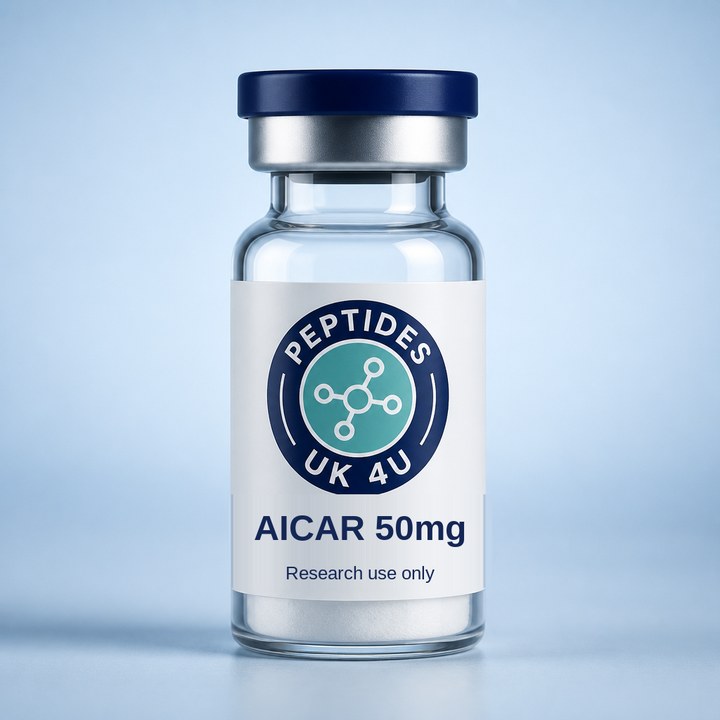
AICAR is a research compound that activates AMP-activated protein kinase (AMPK), mimicking the effects of exercise on a cellular level. It is typically administered via subcutaneous injection in doses ranging from 1 mg to 3 mg daily for research protocols, with some advanced protocols exploring doses up to 5 mg.
- Activates AMPK to mimic exercise-like metabolic effects.
- Dosage typically ranges from 1,000-3,000 mcg daily, with advanced protocols up to 5,000 mcg.
- Reconstitute 50 mg vial with 3.0 mL of bacteriostatic water for a 16.7 mg/mL concentration.
- Prohibited in sports by WADA due to its metabolic modulator properties.
- Requires daily subcutaneous injections and consistent site rotation.
Reconstitution
Vial strength
50 mg
Bacteriostatic water
3 mL
Concentration
16.7 mg/mL
1 unit = 0.01 mL = 167 mcg
- 1Draw 3.0 mL of bacteriostatic water using a sterile syringe.
- 2Carefully inject the water down the inner wall of the AICAR vial to prevent foaming.
- 3Gently swirl or roll the vial until the powder completely dissolves; do not shake.
- 4Label the reconstituted vial with the date and store it in the refrigerator at 2–8 °C (35.6–46.4 °F), protected from light.
Dosing schedule
| Phase | Dose | On a U-100 syringe |
|---|---|---|
| Weeks 1-2 | 1,000 mcg (1 mg) | 6 units (0.06 mL) |
| Weeks 3-4 | 2,000 mcg (2 mg) | 12 units (0.12 mL) |
| Weeks 5-8 | 3,000 mcg (3 mg) | 18 units (0.18 mL) |
Protocol detail
| Initiation | Begin with 1,000 mcg daily, gradually increasing the dose by 1,000 mcg every two weeks if well-tolerated. |
|---|---|
| Conservative Target | Aim for a daily dose of 2,000–3,000 mcg between Weeks 3 and 8 of the protocol. |
| Advanced Protocols | Doses up to 5,000 mcg daily may be used if explicitly supported by specific research literature. |
| Frequency | Administer once per day via subcutaneous injection to maintain consistent AMPK activation. |
| Timing | Inject at a consistent time each day, ensuring daily rotation of injection sites. |
Overview at a glance
| Research Goal | To activate AMPK pathways, thereby mimicking the metabolic effects of exercise. |
|---|---|
| Schedule | Once-daily subcutaneous injections for an 8–12 week duration, as per research protocols. |
| Dose Range | Conservative initiation at 1,000 mcg daily, progressing to 3,000 mcg, and up to 5,000 mcg in advanced protocols. |
| Reconstitution | Mixing a 50 mg vial with 3.0 mL of bacteriostatic water to achieve a concentration of approximately 16.7 mg/mL for accurate dosing. |
| Storage | Lyophilized form stored frozen at -20 °C (-4 °F); reconstituted solution refrigerated at 2–8 °C (35.6–46.4 °F) for up to 4 weeks. |
How it works
AICAR functions as an AMPK agonist, effectively simulating a state of low cellular energy. Upon administration, AICAR enters cells, including skeletal muscle, where it's converted into ZMP (AICAR monophosphate). ZMP directly activates AMP-activated protein kinase (AMPK), which is crucial for regulating cellular energy. This activation boosts glucose uptake and fatty-acid oxidation in muscles, and promotes the creation of new mitochondria, enhancing the cell's energy capabilities. This metabolic adjustment "fools" cells into reacting as if they are undergoing exercise or fasting, thereby promoting pathways that improve energy metabolism and endurance without physical exertion.
Reported effects
- Enhanced exercise endurance (observed in preclinical studies)
- Improved metabolic function (increased mitochondrial enzymes, fatty-acid oxidation)
- Greater skeletal muscle glucose uptake
- Potential for improved insulin sensitivity
- Therapeutic potential for diabetic neuropathy and metabolic syndrome (animal models)
Reported side effects
- Generally well-tolerated
- Possible mild injection-site reactions (redness, irritation)
Storage
Lyophilised (unmixed)
Freeze at -20 °C (-4 °F) in dry, dark conditions; stable up to 24 months. Avoid freeze-thaw cycles.
After reconstitution
Refrigerate at 2–8 °C (35.6–46.4 °F) for up to 4 weeks; avoid freeze–thaw cycles.
Supplies
| Peptide vials | Approximately 3 vials for an 8-week gradual dosing protocol; around 8 vials for a 12-week advanced protocol. |
|---|---|
| Insulin Syringes | U-100 syringes, or 30/50-unit syringes for enhanced precision, with 7 needed per week. |
| Bacteriostatic Water | Require 3.0 mL per vial for reconstitution; one 10 mL bottle is sufficient for 3 vials. |
| Alcohol Swabs | Two swabs per day (one for vial, one for injection site), totaling about 14 per week. |
Important notes
- AICAR is for research use only and not for human consumption.
- Prohibited by the World Anti-Doping Agency (WADA) in competitive sports.
- Use new, sterile insulin syringes for each injection and dispose of them in a sharps container.
- Rotate injection sites regularly to reduce local irritation.
- Document daily dose, administration time, and site rotation meticulously for consistency.
Frequently asked questions
What is the primary function of AICAR?
AICAR primarily functions as an AMPK agonist, which means it activates the AMP-activated protein kinase pathway. This activation mimics the metabolic effects typically seen during exercise, leading to improved endurance and metabolic health at a cellular level.
Why is AICAR prohibited in sports?
AICAR is prohibited by the World Anti-Doping Agency (WADA) because it is classified as a metabolic modulator. Its ability to enhance endurance and improve metabolic function gives athletes an unfair advantage, leading to its ban in competitive sports.
How should I store AICAR, both before and after reconstitution?
Lyophilized (powder) AICAR vials should be stored frozen at -20 °C (-4 °F) in a dark, dry place for up to 24 months. Once reconstituted with bacteriostatic water, it should be refrigerated at 2–8 °C (35.6–46.4 °F) and is stable for approximately 4 weeks. Always avoid freeze-thaw cycles.
How do I calculate the correct dose of AICAR using an insulin syringe?
After reconstituting a 50 mg vial with 3.0 mL of bacteriostatic water, the concentration will be approximately 16.7 mg/mL. On a U-100 insulin syringe, 1 unit (0.01 mL) will deliver roughly 167 mcg of AICAR. For example, a 1,000 mcg dose would equate to about 6 units (0.06 mL).
Educational reference only. These figures summarise how AICAR is commonly described in research literature and supplier documentation. They are not a prescription, not medical advice, and not a recommendation to self-administer anything.
Related protocols
AOD-9604 (10 mg Vial)
Targets fat loss, prevents new fat storage, and supports metabolic health.
AOD-9604 (5 mg Vial)
Targets fat loss, prevents new fat storage, and supports metabolic health.
Cagrilintide (10 mg Vial)
Weekly injection for weight management by enhancing satiety.
Cagrilintide (5 mg Vial)
Long-acting amylin analog for satiety and weight management.