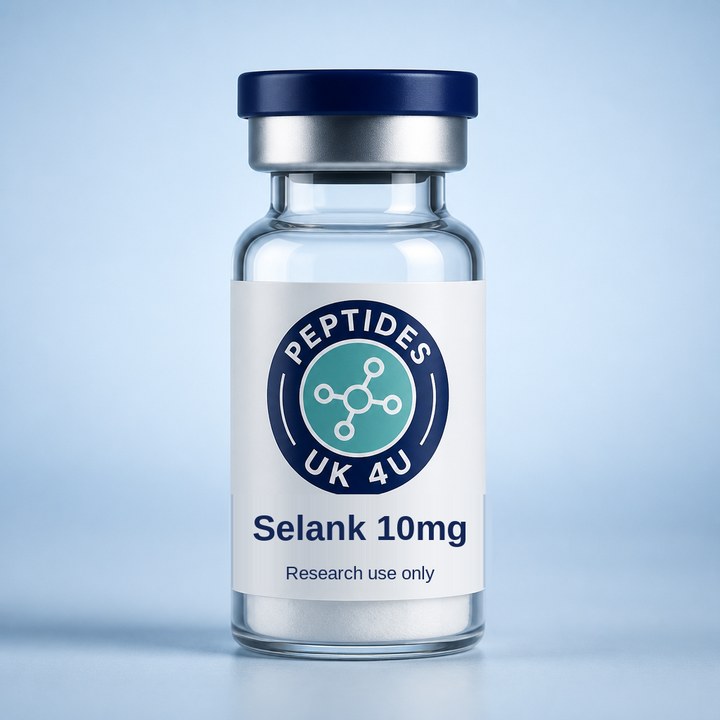
Selank is a synthetic heptapeptide derived from the natural tuftsin sequence, primarily studied for its anxiolytic and neuroprotective properties. It is typically administered intranasally. This guide details reconstitution calculations for 10 mg vials to prepare solutions for nasal spray delivery, aiming for concentrations of 100 or 200 mcg per spray.
- Synthetic heptapeptide based on tuftsin.
- Primarily studied for anxiolytic effects.
- Administered intranasally via spray or drops.
- Calculation methods for 3.0 mL and 10 mL final volumes.
- Pump output verification is crucial for accurate dosing.
Reconstitution
Vial strength
10 mg
Bacteriostatic water
3 mL
Concentration
3.33 mg/mL
1 unit = 0.01 mL = 33.3 mcg (U-100 syringe)
- 1Confirm vial, sterile vehicle, actuator bottle, and pump output.
- 2Add 3.0 mL of compatible sterile vehicle to the Selank 10 mg vial using aseptic technique.
- 3Gently swirl the vial until the peptide fully dissolves; do not shake.
- 4Transfer the entire 3.0 mL solution from the vial into a sterile 3.0 mL or 10 mL nasal actuator bottle.
- 5Add additional vehicle to precisely reach a final measured volume of 3.0 mL or 10.0 mL.
- 6Secure the pump, label the bottle with all relevant details (peptide amount, final volume, concentration, pump output, and preparation date).
- 7Prime the pump according to the actuator's instructions and log the priming sprays.
Dosing schedule
| Phase | Dose | On a U-100 syringe |
|---|---|---|
| General Research | 100-200 mcg | 6 units (0.06 mL) |
| Anxiety Study (Zozulia et al., 2008) | 2.7 mg daily | 81.1 units (0.81 mL) |
| GAD Study (Syunyakov et al., 2012) | 2,700 mcg daily | 21 units (0.21 mL) |
Protocol detail
| 3.0 mL Option (200 mcg/spray) | 1-2 sprays per administration, adjusted as needed for target dose (e.g., 1.5 theoretical sprays for 300 mcg, 4.5 theoretical sprays for 900 mcg) |
|---|---|
| 10 mL Option (100 mcg/spray) | 2-3 sprays per administration, adjusted as needed for target dose (e.g., 3 sprays for 300 mcg, 9 sprays for 900 mcg) |
Overview at a glance
| Human research route | Intranasal drops or solution |
|---|---|
| Peptide amount per vial | 10,000 mcg total |
| 3.0 mL option concentration | 2,000 mcg/mL and 200 mcg per verified 0.10 mL spray |
| 10 mL option concentration | 1,000 mcg/mL and 100 mcg per verified 0.10 mL spray |
| Final-volume rule | Bring transferred solution to an exact measured final volume |
How it works
Selank is a synthetic heptapeptide that mimics the natural immune peptide tuftsin. Research indicates it interacts with specific brain targets, influencing the metabolism of endogenous regulatory peptides like leu-enkephalin, and modulating neurophysiological activity. These mechanisms contribute to its observed anxiolytic, cognitive-enhancing, and neuroprotective effects. As an intranasally administered peptide, it bypasses the digestive system, allowing for direct absorption via the nasal mucosa into the bloodstream and central nervous system, which is crucial for its neuroactive properties and therapeutic potential in conditions like anxiety disorders.
Reported effects
- Anxiety reduction
- Improved mood
- Cognitive enhancement
- Neuroprotective effects
- Anti-asthenic properties
Reported side effects
- Unpleasant taste sensations
- Possible allergic reactions
Storage
Lyophilised (unmixed)
Protected from light, not more than 10°C, and not frozen.
After reconstitution
Up to 15 days at not more than 25°C for registered products; custom preparations require specific stability controls.
Supplies
| Peptide vials | One Selank 10 mg research vial with purity documentation per prepared bottle. |
|---|---|
| Sterile research vehicle | Sterile 0.9% sodium chloride or another validated sterile nasal vehicle. |
| Nasal actuator bottle | One 3.0 mL or 10 mL sterile bottle for single-user research. |
| Metered pump | Compatible actuator verified at 0.10 mL per complete spray. |
| Calibrated transfer tools | Sterile syringes or pipettes for precise volume measurement. |
| Sterile transfer needle | Needed if the peptide vial has a rubber septum. |
| Clean handling supplies | Alcohol pads, clean gloves, disinfected work surface. |
| Label and research log | For recording peptide details, preparation, and usage. |
| Storage materials | Light-protective, temperature-controlled storage. |
| Sharps container | For safe disposal of needles. |
Important notes
- Accurate measurement of final volume is critical; bottle capacity alone is insufficient.
- Verify the exact output of your actuator pump (e.g., 0.10 mL per stroke).
- Proper priming and re-priming of the pump are essential for consistent dosage.
- Maintain consistent bottle orientation and complete strokes during administration.
- Understand that 'nominal sprays' are theoretical; priming and residual volume reduce usable sprays.
- Calculate total peptide requirement before starting multi-day protocols.
- Custom preparations require specific laboratory handling and stability plans.
Frequently asked questions
What is the key difference between the 3.0 mL and 10 mL final volume options for Selank?
The 3.0 mL option results in a higher concentration (2,000 mcg/mL) and delivers 200 mcg per 0.10 mL spray, providing 50 nominal sprays per vial. The 10 mL option, with a lower concentration (1,000 mcg/mL), delivers 100 mcg per 0.10 mL spray, offering 100 nominal sprays. The choice depends on the desired concentration and frequency of administration.
Why is it important to verify the nasal spray actuator's output?
Nasal spray actuators can vary significantly in the volume they dispense per spray (e.g., 0.025 mL to 0.20 mL). Verifying the specific pump's output (e.g., 0.10 mL) is crucial for accurate dosing, as the calculations for mcg per spray directly depend on this volume. Without verification, the actual dose delivered could be substantially different from the intended amount.
Can I use Selank orally instead of intranasally?
Primary human research studies for Selank have almost exclusively utilized the intranasal route (drops or solution). While alternative routes might be explored in other contexts, the documented efficacy and safety profiles are based on intranasal administration, which facilitates direct absorption and avoids degradation in the digestive system.
What should I do if my nasal spray bottle doesn't have mL markings?
If your nasal spray bottle lacks precise mL markings, you must use calibrated transfer tools like syringes or pipettes to measure the final volume accurately. Relying solely on the bottle's capacity can lead to significant dosing errors because the actual liquid volume may differ from the stated capacity or perceived fill line.
Educational reference only. These figures summarise how Selank is commonly described in research literature and supplier documentation, including the Selank listing at peptidesuk4u.co.uk. They are not a prescription, not medical advice, and not a recommendation to self-administer anything.
Related protocols
Selank (5 mg Vial)
Anxiolytic heptapeptide for mood, stress, and cognitive support.
Cerebrolysin (60 mg Vial)
Porcine-derived peptide supporting brain health and neuronal function.
Adamax (10 mg Vial)
Advanced nootropic for enhanced cognition, neuroprotection, and neuroplasticity.
Ara-290 (16 mg Vial)
Targets innate repair receptor for anti-inflammatory and tissue-protective effects.