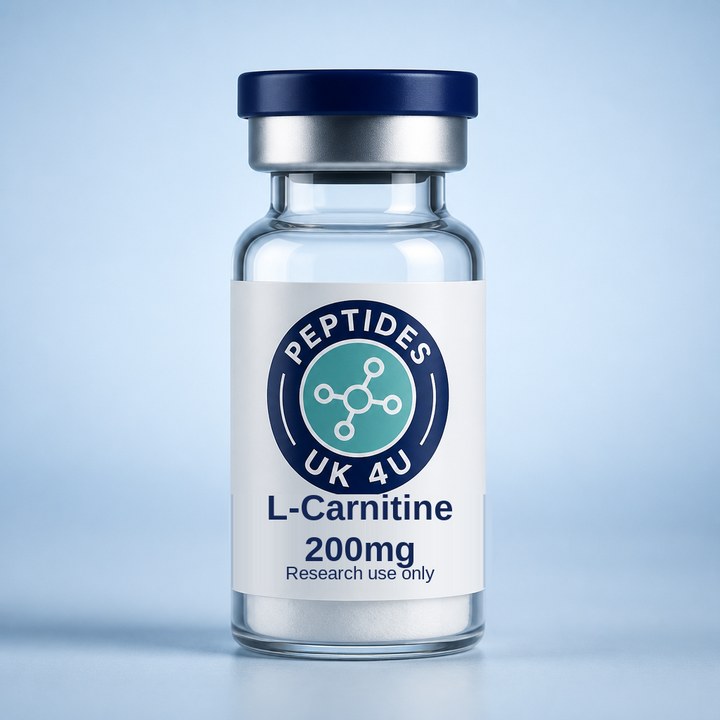
L-Carnitine is an amino acid derivative crucial for transporting fatty acids into mitochondria for energy production. It is typically dosed subcutaneously at 50-100 mg daily to ensure high bioavailability and avoid adverse gut metabolism. This protocol describes how to reconstitute and administer L-Carnitine for optimal research use.
- 50-100 mg daily subcutaneous dose.
- Reconstitute 200 mg vial with 2.0 mL bacteriostatic water for 100 mg/mL.
- 1 unit on a U-100 syringe equals 1 mg.
- Bypasses gut metabolism to avoid TMAO production.
- Refrigerate reconstituted solution, use within 2-4 weeks.
Reconstitution
Vial strength
200 mg
Bacteriostatic water
2 mL
Concentration
100 mg/mL
1 unit = 0.01 mL = 1 mg
- 1Draw 2.0 mL of bacteriostatic water (0.9% benzyl alcohol) using a sterile syringe.
- 2Inject the water slowly down the side of the vial to prevent foaming; avoid directly streaming it onto the powder.
- 3Gently swirl or roll the vial until all the powder is completely dissolved. Do not shake vigorously.
- 4Label the vial with the reconstitution date and store it in the refrigerator at 2–8 °C (35.6–46.4 °F), protected from light.
Dosing schedule
| Phase | Dose | On a U-100 syringe |
|---|---|---|
| Weeks 1-2 | 50 mg | 50 units (0.50 mL) |
| Weeks 3-8 | 100 mg | 100 units (1.0 mL) |
| Weeks 9-12 | 100 mg | 100 units (1.0 mL) |
Protocol detail
| Start | Initiate with 50 mg daily for the first 1-2 weeks to evaluate tolerance and monitor for any local injection-site responses. |
|---|---|
| Maintenance | Increase the dose to 100 mg daily starting from Week 3 and continue onward. This serves as a common maintenance dose for most research applications. |
| Advanced | For more intensive experimental protocols, doses can be increased up to 200 mg daily, provided research findings clearly support this level. |
| Frequency | Inject once per day subcutaneously. Consistency in timing is key, with morning or pre-exercise injection often preferred. |
| Cycle Length | The typical duration is 8–12 weeks, with an optional extension to 16 weeks under continued observation. |
| Site Rotation | Systematically rotate injection sites among areas like the abdomen, thighs, and upper arms to prevent tissue irritation and promote absorption. |
Overview at a glance
| Goal | Support mitochondrial fatty acid oxidation and energy metabolism while avoiding TMAO production associated with oral dosing. |
|---|---|
| Schedule | Daily subcutaneous injections for 8–12 weeks (optionally extend to 16 weeks). |
| Dose Range | 50–100 mg daily with gradual titration; advanced protocols may use up to 200 mg daily. |
| Reconstitution | 2.0 mL per 200 mg vial (100 mg/mL) for precise 1:1 unit-to-milligram measurement. |
| Storage | Lyophilized formula frozen; reconstituted solution refrigerated. Avoid repeated freeze–thaw cycles. |
How it works
L-Carnitine is an amino acid derivative synthesized from lysine and methionine, playing a vital role in energy metabolism. It facilitates the transport of long-chain fatty acids into mitochondria, enabling their oxidation to produce ATP. This process is particularly important for energy generation from fat stores during sustained exercise or calorie restriction. Unlike oral administration, which has low bioavailability and can lead to the formation of TMAO—a metabolite linked to cardiovascular risk—subcutaneous injection of L-Carnitine ensures 100% bioavailability, bypassing gut bacterial metabolism. This method optimizes its delivery to cells, allowing it to efficiently enhance fat oxidation and energy production without the potential negative side effects associated with oral dosing.
Reported effects
- Enhanced mitochondrial fatty acid oxidation and ATP production.
- Modest weight loss and BMI reduction (with oral, may be enhanced SC).
- Improved exercise capacity and reduced fatigue.
- Avoids TMAO production and associated cardiovascular risk.
- Supports energy levels, particularly in carnitine-deficient states.
Reported side effects
- Mild, transient redness, swelling, or irritation at injection sites.
- Gastrointestinal effects (nausea, diarrhea) are minimized with subcutaneous route.
- Fishy body odor is minimized with subcutaneous route.
Storage
Lyophilised (unmixed)
Store at -20 °C (-4 °F) or below, in dry, dark conditions. Minimize moisture exposure and keep vial tightly sealed. Stable for months to years.
After reconstitution
Refrigerate at 2–8 °C (35.6–46.4 °F) immediately after mixing. Do not freeze reconstituted solution. Use within 2-4 weeks. Allow to reach room temperature before use.
Supplies
| Peptide vials | L-Carnitine (200 mg each): 28 vials for 8 weeks, 42 vials for 12 weeks, 56 vials for 16 weeks. |
|---|---|
| Insulin Syringes | U-100, 1 mL capacity: 56 for 8 weeks, 84 for 12 weeks, 112 for 16 weeks. |
| Bacteriostatic Water | 10 mL bottles: 6 for 8 weeks, 9 for 12 weeks, 12 for 16 weeks. |
| Alcohol Swabs | 2 boxes of 100-count for 8 or 12 weeks, 3 boxes for 16 weeks. |
| Sharps Container | For safe disposal of used needles and syringes. |
Important notes
- Use new, sterile insulin syringes for each injection.
- Rotate injection sites regularly to prevent irritation and lipohypertrophy.
- Inject slowly to minimize discomfort and prevent leakage.
- Allow refrigerated solution to warm to room temperature before injection.
- Maintain a log of doses, injection sites, and observations.
- Dispose of used needles safely in a sharps container.
Frequently asked questions
Why is subcutaneous L-Carnitine preferred over oral supplements?
Subcutaneous administration provides 100% bioavailability, meaning all the L-Carnitine is absorbed and utilized. Oral L-Carnitine has poor absorption and can be metabolized by gut bacteria into TMAO, a compound associated with increased cardiovascular risk. Injecting bypasses these issues.
How does L-Carnitine help with fat loss and energy?
L-Carnitine is crucial for transporting long-chain fatty acids into the mitochondria, where they are burned for energy. By enhancing this process, it can improve fat oxidation and ATP production, which supports weight management and boosts energy levels, especially during exercise or caloric restriction.
What is the typical cycle length for L-Carnitine, and can I extend it?
The typical cycle length for L-Carnitine is 8-12 weeks. If you are experiencing positive results and monitor your body's response, it can optionally be extended up to 16 weeks. Always observe for any adverse reactions throughout the cycle.
Can I reuse syringes or needles?
No, it is critical to use a new, sterile insulin syringe for each injection. Reusing needles or syringes can lead to infections, contamination, and dulling of the needle, which causes more discomfort. Always dispose of used sharps safely in an approved container.
Educational reference only. These figures summarise how L-Carnitine is commonly described in research literature and supplier documentation. They are not a prescription, not medical advice, and not a recommendation to self-administer anything.
Related protocols
5-Amino-1MQ (10 mg Vial)
Inhibitor of NNMT for metabolic support and fat metabolism.
5-Amino-1MQ (50 mg Vial)
NNMT inhibitor for metabolic support, fat metabolism, and NAD+ levels.
HGH 191AA (10IU Vial)
Recombinant human growth hormone for body composition and metabolic health.
MOTS-c (40 mg Vial)
Metabolic regulator enhancing insulin sensitivity and fat oxidation.