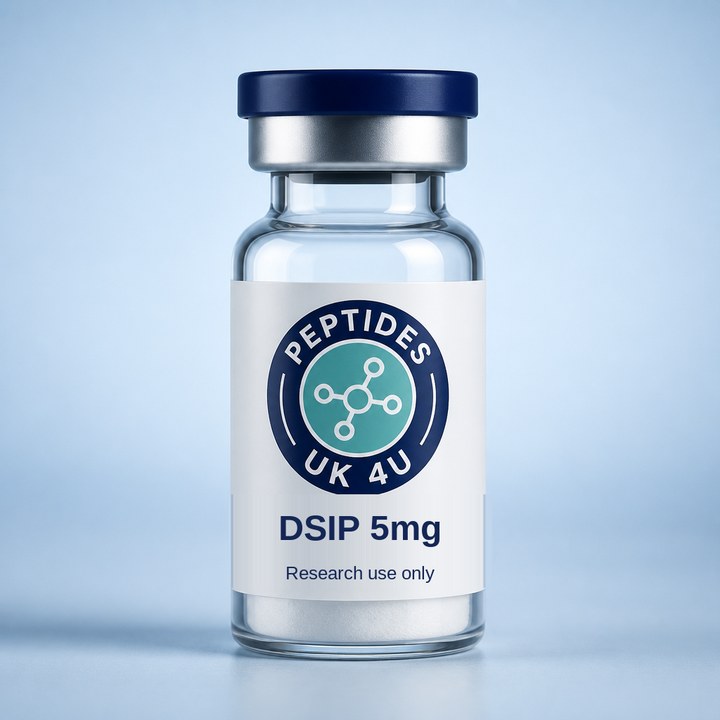
DSIP, or Delta Sleep-Inducing Peptide, is a naturally occurring peptide being studied for its effects on sleep patterns and stress management. Research protocols typically involve daily subcutaneous injections of 100-300 mcg, usually administered before bedtime to support healthy sleep architecture and stress modulation.
- Typically dosed at 100-300 mcg daily
- Administered via subcutaneous injection before bedtime
- Reconstitute 5mg vial with 3.0 mL bacteriostatic water
- May support deeper, more restorative sleep
- Well-tolerated in studies, with occasional mild injection site reactions
Reconstitution
Vial strength
5 mg
Bacteriostatic water
3 mL
Concentration
1.67 mg/mL
1 unit = 0.01 mL = 16.7 mcg
- 1Draw 3.0 mL of bacteriostatic water using a sterile syringe.
- 2Inject the water slowly down the inside wall of the DSIP vial, taking care to avoid creating foam.
- 3Gently swirl or roll the vial until the peptide powder completely dissolves (do not shake).
- 4Label the reconstituted vial with the date and store it in the refrigerator at 2-8°C (35.6-46.4°F), protected from light.
Dosing schedule
| Phase | Dose | On a U-100 syringe |
|---|---|---|
| Week 1 | 100 mcg | 6 units (0.06 mL) |
| Week 2 | 150 mcg | 9 units (0.09 mL) |
| Week 3 | 200 mcg | 12 units (0.12 mL) |
| Weeks 4-8 | 250-300 mcg | 15-18 units (0.15-0.18 mL) |
Protocol detail
| Start | Begin with 100 mcg daily; increase the dose by approximately 50 mcg every 1-2 weeks as tolerated. |
|---|---|
| Target | Aim for a daily dose of 250–300 mcg by Weeks 4–8. |
| Frequency | Administer once per day via subcutaneous injection, ideally before bedtime. |
| Cycle Length | Follow a 4–8 week cycle, with an optional extension to 12 weeks, considering periodic breaks. |
Overview at a glance
| Goal | Support healthy sleep architecture and stress modulation over time. |
|---|---|
| Schedule | Daily subcutaneous injections for 4–8 weeks (extend to 12 weeks if desired). |
| Dose Range | 100–300 mcg daily with gradual titration; advanced up to 500 mcg. |
| Reconstitution | 3.0 mL bacteriostatic water per 5 mg vial (~1.67 mg/mL) for accurate unit measurements. |
| Storage | Lyophilized frozen; reconstituted refrigerated; avoid repeated freeze–thaw cycles. |
How it works
DSIP is a naturally occurring nonapeptide first identified in rabbit brain tissue in 1977. Studies indicate it may influence sleep by modulating GABAergic transmission and interacting with opioid receptor systems, potentially increasing delta-wave (slow-wave) sleep duration without altering REM sleep significantly. Beyond sleep, DSIP has shown stress-protective and adaptogenic qualities in various models, possibly by modulating the hypothalamic-pituitary-adrenal axis. This suggests a role in both sleep regulation and stress response.
Reported effects
- May promote deeper, more restorative slow-wave sleep
- Could improve subjective sleep quality
- Potential for stress-protective and anxiolytic-like effects
- Studies suggest no pharmacological tolerance development
Reported side effects
- Generally well tolerated in human studies
- Occasional mild injection-site reactions may occur
- Limited long-term safety data; periodic breaks are recommended
Storage
Lyophilised (unmixed)
Store at -20°C (-4°F) in dry, dark conditions; minimize moisture exposure.
After reconstitution
Refrigerate at 2-8°C (35.6-46.4°F); use within ~4 weeks and avoid freeze-thaw cycles.
Supplies
| Peptide vials (DSIP, 5 mg each) | Plan for 2-3 vials for an 8-week cycle at an average of 200 mcg/day, or 3-4 vials for 12 weeks at the same average. |
|---|---|
| Insulin Syringes (U-100) | You will need 7 syringes per week (1 per day), totaling 56 for an 8-week cycle or 84 for 12 weeks. |
| Bacteriostatic Water (10 mL bottles) | Use approximately 3.0 mL per vial for reconstitution. For 3 vials, 1x10 mL bottle is sufficient; for 5-6 vials, 2x10 mL bottles are recommended. |
| Alcohol Swabs | You will need two per day (one for the vial, one for the injection site), totaling 112 for an 8-week cycle or 168 for 12 weeks. Recommend 2x100-count boxes. |
Important notes
- Always use new, sterile insulin syringes and dispose of them in a sharps container.
- Rotate injection sites (abdomen, thighs, upper arms) to minimize local irritation.
- Inject slowly and wait a few seconds before withdrawing the needle.
- Document your daily dose and injection site rotation for consistency.
- Some research suggests DSIP effects may persist for multiple nights after dosing.
Frequently asked questions
What is the primary benefit of DSIP?
DSIP is primarily studied for its potential to support healthy sleep architecture by promoting deeper, slow-wave sleep and for its adaptogenic properties that may help with stress modulation.
How should I store DSIP once it's mixed?
After reconstitution, DSIP should be stored in the refrigerator at 2-8°C (35.6-46.4°F). It's best to use it within approximately 4 weeks and avoid any freeze-thaw cycles.
Can I increase my DSIP dose beyond 300 mcg daily?
While some advanced protocols suggest doses up to 500 mcg, formal human studies have mainly examined doses up to 300 mcg daily. Any increase beyond this range is typically based on anecdotal experience, and it's always recommended to use the minimum effective dose.
How do I ensure accurate dosing with an insulin syringe?
To ensure accurate dosing, reconstitute a 5 mg vial with 3.0 mL of bacteriostatic water, which yields a concentration of 1.67 mg/mL. This means 1 unit (0.01 mL) on a U-100 insulin syringe will deliver approximately 16.7 mcg of DSIP.
Educational reference only. These figures summarise how DSIP is commonly described in research literature and supplier documentation, including the DSIP listing at peptidesuk4u.co.uk. They are not a prescription, not medical advice, and not a recommendation to self-administer anything.
Related protocols
DSIP (10 mg Vial)
Promotes deep, restorative sleep and modulates stress response.
DSIP (15 mg Vial)
Promotes deep, restorative sleep and modulates stress response.
BPC-157 (5 mg Vial)
A synthetic gastric peptide investigated for tissue repair and healing.
Cerebrolysin (60 mg Vial)
Porcine-derived peptide supporting brain health and neuronal function.