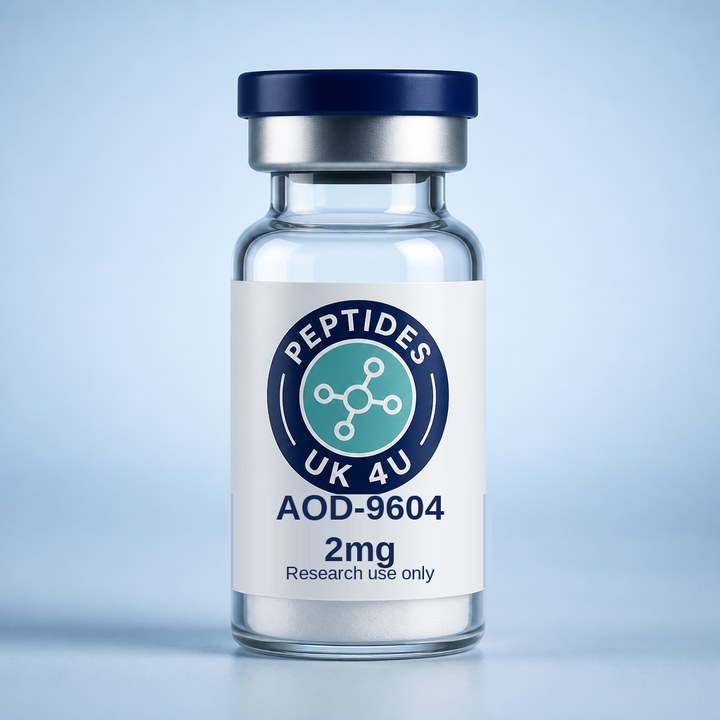
AOD-9604 is a synthetic fragment of human growth hormone designed to promote fat breakdown and prevent fat storage. It works without affecting IGF-1 levels or insulin sensitivity, offering a well-tolerated option for metabolic support. Dosing protocols typically involve daily subcutaneous injections.
- Synthetic fragment of human growth hormone (TYR-hGH 177-191).
- Promotes fat breakdown and inhibits fat storage.
- Does not elevate IGF-1 levels or cause insulin resistance.
- Well-tolerated with a placebo-like safety profile in studies.
- Typically administered once daily via subcutaneous injection.
Reconstitution
Vial strength
2 mg
Bacteriostatic water
3 mL
Concentration
0.667 mg/mL
1 unit = 0.01 mL = 6.67 mcg
- 1Draw 3.0 mL of bacteriostatic water using a sterile syringe.
- 2Carefully inject the water down the inner wall of the peptide vial to avoid foaming.
- 3Gently swirl or roll the vial until the peptide completely dissolves; do not shake vigorously.
- 4Label the vial with the reconstitution date and store it in the refrigerator at 2-8 °C (35.6-46.4 °F), protected from light.
Dosing schedule
| Phase | Dose | On a U-100 syringe |
|---|---|---|
| Weeks 1-4 | 300 mcg | 45 units (0.45 mL) |
| Weeks 5-12 | 500 mcg | 75 units (0.75 mL) |
Protocol detail
| Start | Begin with 300 mcg daily for the first 4 weeks. |
|---|---|
| Target | Increase to 500 mcg daily from Week 5 and maintain this dose through the end of the cycle (8-12, or up to 16 weeks). |
| Frequency | One injection per day (subcutaneous). |
| Cycle Length | Typical duration is 8-12 weeks, with an optional extension to 16 weeks. |
| Timing | Commonly administered in the morning while fasted. Remember to rotate injection sites. |
Overview at a glance
| Goal | Support reduction of fat mass and enhance fat oxidation. |
|---|---|
| Schedule | Daily subcutaneous injections for 8-12 weeks, with an option to extend to 16 weeks. |
| Dose Range | 300-500 mcg daily, with gradual titration. |
| Reconstitution | 3.0 mL bacteriostatic water per 2 mg vial (~0.667 mg/mL concentration). |
| Storage | Lyophilized vials frozen; reconstituted solution refrigerated. Avoid repeated freeze-thaw. |
How it works
AOD-9604 is a modified fragment of human growth hormone, specifically its C-terminal domain, that retains the ability to mobilize fat without promoting general growth effects. It targets adipose tissue, stimulating the breakdown of stored fat (lipolysis) and preventing the formation of new fat (lipogenesis) within adipocytes. This peptide also upregulates β3-adrenergic receptors in fat tissue, which are often suppressed in obese individuals, thereby enhancing fat-burning pathways. Crucially, unlike full-length hGH, AOD-9604 does not significantly elevate IGF-1 levels or negatively impact glucose tolerance, contributing to its favorable safety profile in clinical studies.
Reported effects
- Reduced fat mass and increased fat oxidation.
- Preferential loss of abdominal fat.
- Does not raise IGF-1 levels significantly.
- Placebo-like safety profile in human studies.
- Potential for cartilage repair and bone health (preclinical).
Reported side effects
- Generally well tolerated.
- Occasional mild injection-site reactions (e.g., redness, itching).
Storage
Lyophilised (unmixed)
Freeze at -20 °C (-4 °F) in dry, dark conditions; stable for 1+ year. Allow to reach room temperature before opening.
After reconstitution
Refrigerate at 2-8 °C (35.6-46.4 °F), protected from light. Use within 3-4 weeks. Avoid freeze-thaw cycles.
Supplies
| Peptide vials | Approximately 12 vials for an 8-week cycle, 19 for 12 weeks, or 26 for 16 weeks (2 mg each). |
|---|---|
| Insulin Syringes (U-100) | Minimum 7 per week; 56 for 8 weeks, 84 for 12 weeks, or 112 for 16 weeks. |
| Bacteriostatic Water (10 mL bottles) | Sufficient to reconstitute 3.0 mL per vial. For example, 4 bottles for 8 weeks or 6 bottles for 12 weeks. |
| Alcohol Swabs | Two per day (one for vial, one for injection site); recommend 2x 100-count boxes for 8-12 weeks. |
Important notes
- Always use sterile, new U-100 insulin syringes (29-31 gauge) and dispose of them in a sharps container.
- Rotate injection sites (abdomen, thighs, upper arms) to prevent local irritation and lipohypertrophy.
- Inject slowly and allow a few seconds before withdrawing the needle to ensure proper absorption.
- Each 2 mg vial can last approximately 4 days at 500 mcg/day or 6-7 days at 300 mcg/day.
Frequently asked questions
How does AOD-9604 differ from full-length human growth hormone (hGH)?
AOD-9604 is a specific fragment of hGH that targets fat metabolism (lipolysis and lipogenesis) without the growth-promoting effects of full hGH. This means it doesn't elevate IGF-1 levels or negatively impact glucose tolerance, making its safety profile distinct.
Can AOD-9604 be used as a standalone solution for weight loss?
While AOD-9604 supports fat reduction, it is most effective when combined with a hypocaloric, protein-rich diet and regular exercise. It should be viewed as an aid to a comprehensive weight management strategy, not a magic bullet.
What is the best way to time the daily injection?
It is commonly suggested to inject AOD-9604 in the morning on an empty stomach. Always remember to rotate your injection sites to prevent potential skin irritation.
How crucial is the accuracy of reconstitution and dosing?
Accurate reconstitution with the recommended amount of bacteriostatic water ensures the correct concentration. Precise dosing with U-100 insulin syringes is important for consistency and to achieve the intended therapeutic effects. Small variations can lead to significant differences in delivered dosage.
Educational reference only. These figures summarise how AOD-9604 is commonly described in research literature and supplier documentation, including the AOD-9604 listing at peptidesuk4u.co.uk. They are not a prescription, not medical advice, and not a recommendation to self-administer anything.
Related protocols
AOD-9604 (10 mg Vial)
Targets fat loss, prevents new fat storage, and supports metabolic health.
AOD-9604 (5 mg Vial)
Targets fat loss, prevents new fat storage, and supports metabolic health.
Adipotide (10 mg Vial)
Targets fat cell blood supply for research into weight loss.
5-Amino-1MQ (10 mg Vial)
Inhibitor of NNMT for metabolic support and fat metabolism.