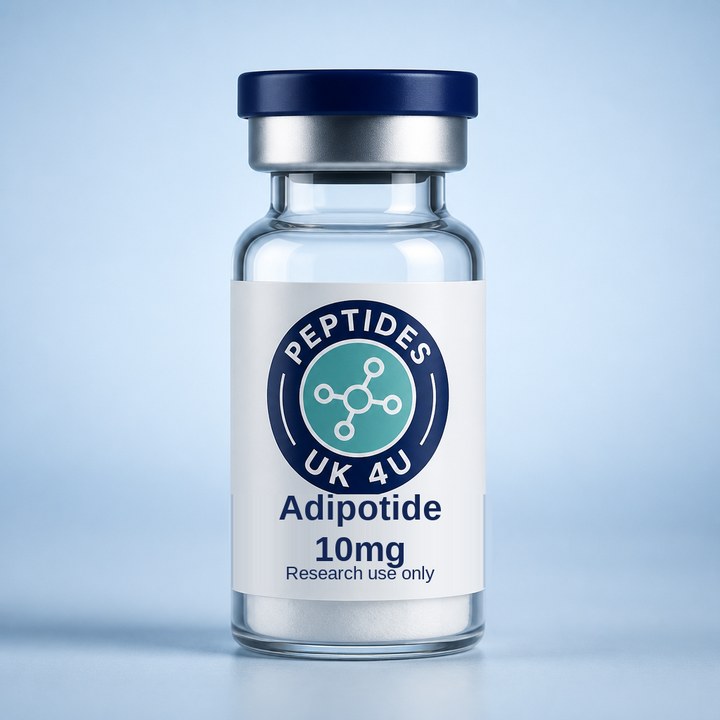
Adipotide is a synthetic peptidomimetic designed to reduce fat mass by targeting the blood supply to white adipose tissue. This educational protocol outlines a conservative, gradually escalating daily subcutaneous injection regimen for research purposes only, as clinical development was discontinued due to safety concerns.
- Targets blood vessels in white adipose tissue.
- Clinical development discontinued due to safety concerns.
- Preclinical studies showed significant weight loss.
- Administered via once-daily subcutaneous injection.
- Not for human consumption; research use only.
Reconstitution
Vial strength
10 mg
Bacteriostatic water
3 mL
Concentration
3.33 mg/mL
1 unit = 0.01 mL = 33.33 mcg
- 1Draw 3.0 mL of bacteriostatic water using a sterile syringe.
- 2Inject the water slowly down the inside wall of the Adipotide vial, avoiding direct contact with the powder to prevent foaming.
- 3Gently swirl or roll the vial until the peptide fully dissolves; do not shake.
- 4Label the reconstituted vial with the date and refrigerate it at 2–8 °C (35.6–46.4 °F), protected from light.
Dosing schedule
| Phase | Dose | On a U-100 syringe |
|---|---|---|
| Weeks 1–2 | 250 mcg | 7.5 units (0.08 mL) |
| Weeks 3–4 | 500 mcg | 15 units (0.15 mL) |
| Weeks 5–6 | 750 mcg | 22.5 units (0.23 mL) |
| Weeks 7–8 | 1000 mcg (1.0 mg) | 30 units (0.30 mL) |
Protocol detail
| Start | Begin with 250 mcg daily for the first two weeks. Increase the daily dose by 250 mcg every two weeks, if tolerated. |
|---|---|
| Target | Gradually increase the daily dose up to 1000 mcg (1.0 mg) by Weeks 7–8, only if previous doses are well-tolerated. |
| Frequency | Administer once per day via subcutaneous injection. |
| Cycle Length | Typically 4–8 weeks; extending beyond this period should be done with extreme caution due to preclinical observations of side effects. |
| Timing | Maintain a consistent injection time each day and systematically rotate injection sites. |
Overview at a glance
| Goal | Targeted reduction of fat mass by disrupting adipose tissue's vascular supply. |
|---|---|
| Schedule | Daily subcutaneous injections for 4–8 weeks, due to limited human data and safety concerns. |
| Dose Range | 250–1000 mcg daily, with dose increased gradually every two weeks. |
| Reconstitution | 3.0 mL of bacteriostatic water per 10 mg vial, resulting in a concentration of approximately 3.33 mg/mL for accurate unit measurements. |
| Storage | Lyophilized powder stored frozen; reconstituted solution stored refrigerated. Avoid repeated freeze–thaw cycles. |
How it works
Adipotide is a peptidomimetic that specifically targets prohibitin-1 on the endothelial cells of blood vessels supplying white adipose tissue. Upon binding, it delivers a pro-apoptotic sequence, leading to the destruction of these vessels. This action cuts off the blood supply to fat cells, causing them to undergo apoptosis and be metabolized. Preclinical studies in obese rodents and primates demonstrated notable reductions in body weight. However, clinical development in humans was halted after a Phase 1 trial due to identified safety concerns, including reversible renal toxicity at higher doses, rendering Adipotide solely for research use.
Reported effects
- Significant targeted fat mass reduction observed in preclinical studies.
- Mechanism specifically targets adipose tissue vasculature.
- Potential for improved insulin resistance in preclinical models.
Reported side effects
- Clinical development discontinued due to safety concerns (e.g., reversible kidney toxicity).
- Possible mild injection-site reactions (redness, swelling).
- Limited human data means long-term safety profile is unknown.
Storage
Lyophilised (unmixed)
Store at -20 °C (-4 °F) in dry, dark conditions; minimize moisture exposure.
After reconstitution
Refrigerate at 2–8 °C (35.6–46.4 °F); avoid freeze–thaw cycles. Allow vials to reach room temperature before opening.
Supplies
| Peptide vials | For an 8-week protocol, approximately 4 x 10 mg Adipotide vials are needed. |
|---|---|
| Insulin Syringes (U-100) | Approximately 56 syringes for an 8-week protocol (one per day). |
| Bacteriostatic Water | About 12 mL for 4 vials (e.g., 2 x 10 mL bottles) over 8 weeks. |
| Alcohol Swabs | Approximately 112 swabs for an 8-week protocol (two per day). |
Important notes
- This protocol is for educational and research purposes only and is not medical advice.
- Adipotide is not for human consumption; clinical development was discontinued due to safety concerns.
- Always use sterile insulin syringes and dispose of them in a sharps container.
- Rotate injection sites to minimize local irritation and document doses.
- Consider monitoring kidney function if extending treatment due to preclinical findings.
Frequently asked questions
Why was Adipotide's clinical development discontinued?
Adipotide's clinical development was halted after a Phase 1 trial due to safety concerns, including dose-dependent, reversible kidney toxicity observed in both preclinical and human studies.
Is Adipotide safe for human use?
No, Adipotide is not considered safe for human consumption or therapeutic use. Its development was discontinued due to safety concerns, and it is currently only intended for research purposes.
What is the primary mechanism of action for Adipotide?
Adipotide works by targeting and destroying the blood vessels that supply white adipose tissue. By cutting off the blood flow, it induces apoptosis (programmed cell death) in fat cells, leading to a reduction in fat mass.
How should I store Adipotide after reconstituting it?
After reconstitution, Adipotide should be stored in the refrigerator at 2–8 °C (35.6–46.4 °F). It should be protected from light, and repeated freeze-thaw cycles must be avoided to maintain its stability and efficacy.
Educational reference only. These figures summarise how Adipotide is commonly described in research literature and supplier documentation. They are not a prescription, not medical advice, and not a recommendation to self-administer anything.
Related protocols
AOD-9604 (2 mg Vial)
Targets fat loss without affecting growth or insulin resistance.
5-Amino-1MQ (10 mg Vial)
Inhibitor of NNMT for metabolic support and fat metabolism.
5-Amino-1MQ (50 mg Vial)
NNMT inhibitor for metabolic support, fat metabolism, and NAD+ levels.
AOD-9604 (10 mg Vial)
Targets fat loss, prevents new fat storage, and supports metabolic health.