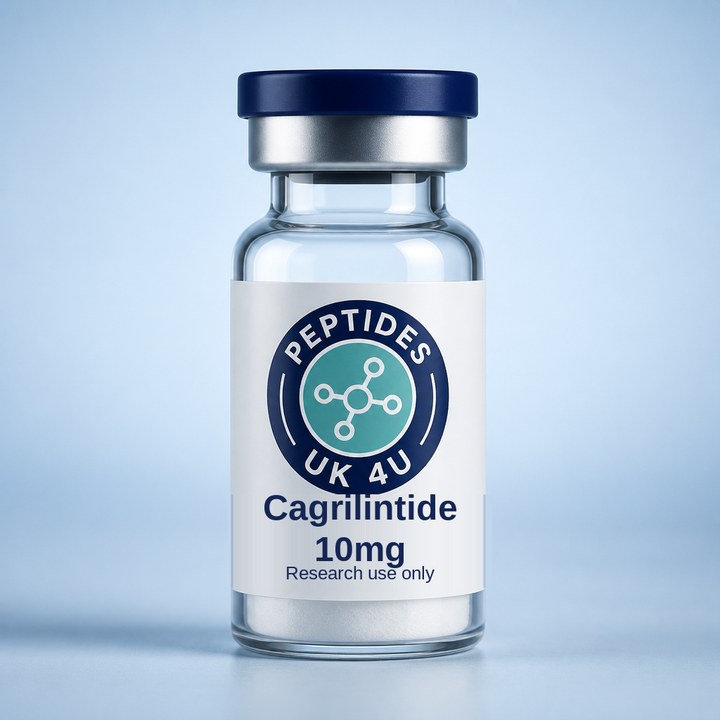
Cagrilintide is a long-acting synthetic analog of the pancreatic hormone amylin, administered via subcutaneous injection once weekly. It is designed to promote satiety, slow gastric emptying, and reduce food intake, leading to weight management benefits. Dosing typically starts low and gradually increases over several weeks.
- Long-acting amylin analog.
- Administered once weekly subcutaneously.
- Promotes satiety and slows gastric emptying.
- Designed for gradual dose escalation.
- Primary side effects are gastrointestinal.
Reconstitution
Vial strength
10 mg
Bacteriostatic water
3 mL
Concentration
3.33 mg/mL
1 unit = 0.01 mL = 33.3 mcg
- 1Draw 3.0 mL of bacteriostatic water using a sterile syringe.
- 2Inject the water slowly down the inside wall of the peptide vial, avoiding foaming or vigorous agitation.
- 3Gently swirl or roll the vial until the powder is completely dissolved; do not shake.
- 4Label the reconstituted vial with the date and concentration, then refrigerate at 2-8 °C (35.6-46.4 °F) and protect from light.
- 5Use the reconstituted solution within 30 days; discard if any cloudiness or particulate matter is observed.
Dosing schedule
| Phase | Dose | On a U-100 syringe |
|---|---|---|
| Weeks 1-2 | 0.6 mg | 18 units (0.18 mL) |
| Weeks 3-4 | 1.2 mg | 36 units (0.36 mL) |
| Weeks 5-6 | 2.4 mg | 72 units (0.72 mL) |
| Weeks 7-16 (Maintenance) | 4.5 mg | 135 units (1.35 mL) |
Protocol detail
| Start | Begin with 0.6 mg weekly for the initial 2 weeks to assess personal tolerability. |
|---|---|
| Escalate | Increase the dose by doubling it every 2 weeks (progressing from 0.6 mg, to 1.2 mg, to 2.4 mg, and finally to 4.5 mg) as long as it is well-tolerated. |
| Target | Aim to reach a maintenance dose of 4.5 mg weekly by Weeks 7–8 and continue at this level. |
| Frequency | Inject once per week subcutaneously, ensuring it's on the same day each week. |
| Timing | Choose any consistent time for injection and remember to rotate the injection sites. |
Overview at a glance
| Goal | To support satiety, reduce food intake, and aid in weight management over time. |
|---|---|
| Schedule | Weekly subcutaneous injections for 12–16 weeks (or longer based on individual needs). |
| Dose Range | 0.6–4.5 mg weekly with a gradual titration every 2 weeks. |
| Reconstitution | Mix 3.0 mL of bacteriostatic water with a 10 mg vial, resulting in approximately 3.33 mg/mL for convenient volume measurements. |
| Storage | Store lyophilized peptide frozen; keep reconstituted solution refrigerated and avoid repeated freeze-thaw cycles. |
How it works
Cagrilintide acts as an analogue of amylin, a hormone naturally co-secreted with insulin. It targets central amylin receptors, particularly in brain regions that regulate appetite and food intake. This action leads to increased feelings of fullness, slowed stomach emptying, and suppressed post-meal glucagon release. Its modified structure gives it a prolonged half-life, allowing for convenient once-weekly dosing. By modulating these pathways, cagrilintide helps to reduce overall energy consumption and support weight management.
Reported effects
- Significant body weight reduction.
- Enhanced satiety and reduced food intake.
- Potential for greater weight loss when combined with semaglutide.
- Dose-dependent efficacy for more pronounced effects.
Reported side effects
- Nausea
- Vomiting
- Diarrhea
- Constipation
- Injection-site reactions (mild)
Storage
Lyophilised (unmixed)
Store frozen at -20 °C (-4 °F) in dry, dark conditions; minimize moisture exposure.
After reconstitution
Refrigerate at 2-8 °C (35.6-46.4 °F); use within 30 days and avoid freeze-thaw cycles.
Supplies
| Peptide vials | 2 vials for 8 weeks, 4 vials for 12 weeks, 6 vials for 16 weeks (10 mg each) |
|---|---|
| Syringes | U-100 insulin syringes for doses ≤72 units (Weeks 1-6); 3 mL syringes with 25-27G needles for doses >100 units (Weeks 7+); 1 syringe per week. |
| Bacteriostatic Water | 1 x 10 mL bottle for 8-12 weeks; 2 x 10 mL bottles for 16 weeks (3.0 mL per vial). |
| Alcohol Swabs | 2 per week (one for vial, one for injection site); recommended 1 x 100-count box for 16-week protocol. |
Important notes
- Always use a new, sterile syringe for each injection and dispose of it in a sharps container.
- Rotate injection sites weekly (abdomen, thighs, upper arms) to minimize local skin irritation.
- Gradual dose increases are crucial for managing potential gastrointestinal side effects.
- Keep a record of your weekly dose, injection site, and any adverse reactions.
- For doses exceeding 1.0 mL, use a 3 mL syringe with an appropriate subcutaneous needle instead of a U-100 insulin syringe.
Frequently asked questions
How often should I inject Cagrilintide?
Cagrilintide is designed for once-weekly subcutaneous injection on a consistent day. Ensure you rotate injection sites each week.
What should I do if I experience side effects like nausea?
Nausea and other GI side effects are common, especially during dose escalation. The gradual titration schedule helps minimize these. If symptoms are severe or persistent, consult a healthcare professional. Ensuring proper hydration and electrolyte balance can also help.
Can I combine Cagrilintide with other medications for weight loss?
Research has shown positive results when Cagrilintide is combined with semaglutide (CagriSema) for enhanced weight loss. However, always consult with a qualified medical professional before combining any medications or peptides to ensure safety and efficacy specific to your health status.
Why do I need different syringe sizes for different weeks?
Early doses are small volumes, accurately measured by U-100 insulin syringes. As the dose increases to the maintenance level (4.5 mg), the volume (1.35 mL) exceeds the capacity of a standard insulin syringe, requiring a larger 3 mL syringe for accurate administration.
Educational reference only. These figures summarise how Cagrilintide is commonly described in research literature and supplier documentation, including the Cagrilintide listing at peptidesuk4u.co.uk. They are not a prescription, not medical advice, and not a recommendation to self-administer anything.
Related protocols
Cagrilintide (5 mg Vial)
Long-acting amylin analog for satiety and weight management.
Mazdutide (10 mg Vial)
Dual GLP-1/glucagon agonist for weight loss and metabolic improvement.
Mazdutide (5 mg Vial)
Dual GLP-1/glucagon agonist for weight management and metabolic health.
Retatrutide (10 mg Vial)
Triple-agonist peptide for significant weight loss and metabolic health.