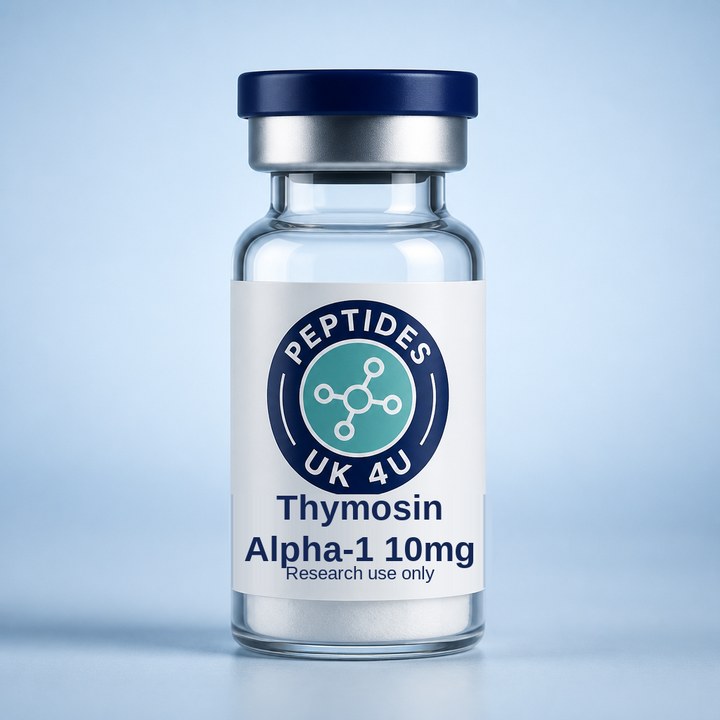
Thymosin Alpha-1 is a peptide that supports immune function, often used in protocols ranging from 300 to 500 mcg daily. It is administered via subcutaneous injection after reconstitution, and an 8-week cycle is common.
- A naturally occurring peptide that supports immune responses.
- Dosed subcutaneously, typically once daily, for 8-12 weeks.
- Commonly used to enhance immune function in various conditions.
- Has shown an excellent safety profile in studies.
- Reconstitute with 3 mL of bacteriostatic water per 10 mg vial.
Reconstitution
Vial strength
10 mg
Bacteriostatic water
3 mL
Concentration
3.33 mg/mL
1 unit = 0.01 mL = 33.3 mcg
- 1Draw 3.0 mL of bacteriostatic water using a sterile syringe.
- 2Slowly inject the water down the inside wall of the peptide vial to avoid foaming.
- 3Gently swirl or roll the vial until the peptide powder completely dissolves; do not shake.
- 4Label the vial with the reconstitution date and store it in a refrigerator at 2–8 °C, protected from light.
Dosing schedule
| Phase | Dose | On a U-100 syringe |
|---|---|---|
| Week 1 | 300 mcg | 9 units (0.09 mL) |
| Weeks 2-8 | 500 mcg | 15 units (0.15 mL) |
Protocol detail
| Start | Begin with 300 mcg daily for the first week to assess individual tolerance. |
|---|---|
| Target | Increase to 500 mcg daily starting from the second week until the end of the cycle. |
| Frequency | Administer once per day via subcutaneous injection. |
| Cycle Length | Typically 8–12 weeks, with a potential extension up to 16 weeks based on need. |
| Timing | Administer at a consistent time each day, and remember to rotate injection sites. |
Overview at a glance
| Goal | To modulate the immune system and strengthen host defense mechanisms. |
|---|---|
| Schedule | Daily subcutaneous injections for 8–12 weeks, with an option to extend to 16 weeks. |
| Dose Range | 300–500 mcg daily, with an initial gradual titration. |
| Reconstitution | 3.0 mL of bacteriostatic water per 10 mg vial, resulting in approximately 3.33 mg/mL for precise unit measurements. |
| Storage | Lyophilized form can be refrigerated or frozen; reconstituted solution must be refrigerated and used within 7 days. |
How it works
Thymosin Alpha-1 is a peptide naturally found in the thymus gland that plays a crucial role in regulating immune responses. It functions by supporting the maturation and differentiation of T-cells, enhancing the activity of dendritic cells, and promoting the release of important immune signaling molecules like interferon-alpha and interleukin-2. This action helps to fortify the body's defenses against various pathogens and can be particularly beneficial for individuals with compromised immune systems. Studies have shown its effectiveness in improving immune responses in chronic infections and reducing mortality in severe cases of illness.
Reported effects
- Enhances T-cell function and overall immune competence
- Supports host defense mechanisms
- Excellent safety profile, even at higher doses
- May reduce mortality in specific critical illnesses
Reported side effects
- Mild injection site irritation (redness or discomfort)
Storage
Lyophilised (unmixed)
Refrigerate at 2–8 °C or freeze at −20 °C; minimize moisture exposure.
After reconstitution
Refrigerate at 2–8 °C and use within 7 days. Avoid freezing.
Supplies
| Peptide vials (Thymosin Alpha-1, 10 mg each) | For 8 weeks: 3 vials; for 12 weeks: 5 vials; for 16 weeks: 6 vials |
|---|---|
| Insulin Syringes (U-100) | For 8 weeks: 56 syringes; for 12 weeks: 84 syringes; for 16 weeks: 112 syringes |
| Bacteriostatic Water (10 mL bottles) | For 8 weeks: 1 bottle; for 12 weeks: 2 bottles; for 16 weeks: 2 bottles |
| Alcohol Swabs | For 8 weeks: 200-count box; for 12 weeks: 200-count box; for 16 weeks: 300-count box |
Important notes
- Always use new, sterile insulin syringes and dispose of them in a sharps container.
- Rotate injection sites (e.g., abdomen, thighs, upper arms) to minimize irritation.
- Inject slowly and wait a few seconds before removing the needle.
- Document daily doses and injection sites for consistency.
- Do not use the solution if it appears cloudy or discolored.
Frequently asked questions
How long can I use Thymosin Alpha-1 for?
Typical protocols range from 8 to 12 weeks, with some individuals extending treatment up to 16 weeks. Always consult with a healthcare professional to determine the appropriate duration for your needs.
What should I do if I miss a dose?
If you miss a dose, simply resume your regular dosing schedule the next day. Do not double your dose to make up for the missed one. Consistency is key for optimal results.
Can I mix Thymosin Alpha-1 with other peptides?
It's generally recommended to administer peptides separately unless specifically advised otherwise by a qualified practitioner. Mixing peptides can alter their stability or effectiveness. If you have questions about combining therapies, seek expert advice.
How should I store my Thymosin Alpha-1 after reconstitution?
Once reconstituted with bacteriostatic water, store Thymosin Alpha-1 in the refrigerator at 2–8 °C (35.6–46.4 °F) and use it within 7 days. Do not freeze the reconstituted solution.
Educational reference only. These figures summarise how Thymosin Alpha-1 is commonly described in research literature and supplier documentation. They are not a prescription, not medical advice, and not a recommendation to self-administer anything.
Related protocols
Thymosin Alpha-1 (5 mg Vial)
Immune-modulating peptide supporting T-cell function and host defense.
Glutathione (1500 mg Vial)
Master antioxidant supporting detoxification, cellular health, and immune function.
Glutathione (600 mg Vial)
Master antioxidant supporting detoxification, cellular health, and immune function.
Vilon (20 mg Vial)
Immunoregulatory dipeptide supporting immune markers and thymic function.