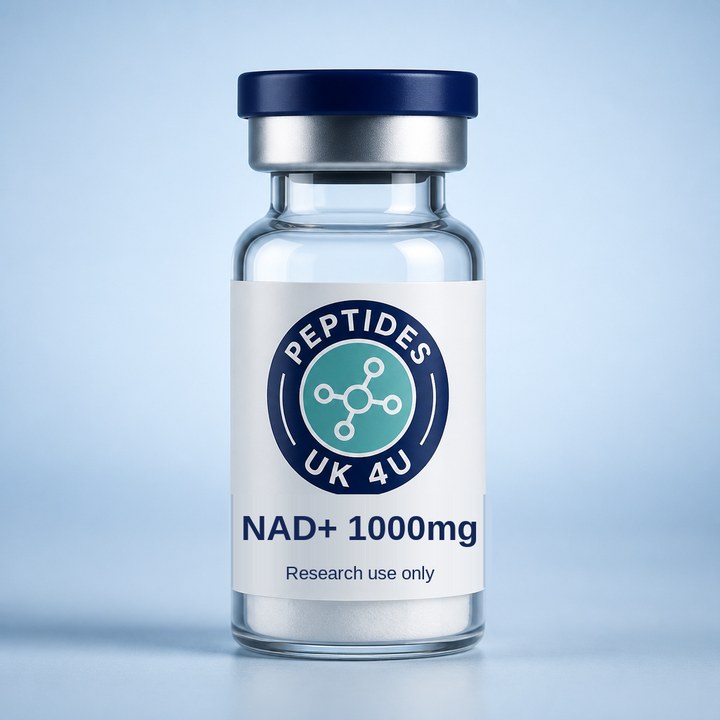
NAD+ is a vital coenzyme supporting cellular energy, DNA repair, and mitochondrial health. This protocol outlines a subcutaneous dosing strategy, starting with a low dose and gradually increasing it to improve tolerance and effectiveness, administered daily for several weeks.
- Critical coenzyme for cellular metabolism and repair.
- Administered subcutaneously with a gradual dose titration.
- Reconstitute 1000 mg vial with 3.0 mL bacteriostatic water for 333.3 mg/mL.
- Daily doses range from 50 mg to 100 mg, starting low to assess tolerance.
- Store reconstituted solution refrigerated for up to 14 days, protected from light.
Reconstitution
Vial strength
1000 mg
Bacteriostatic water
3 mL
Concentration
333.3 mg/mL
1 unit = 0.01 mL = 3.33 mg
- 1Allow the lyophilized vial to reach room temperature.
- 2Draw 3.0 mL of bacteriostatic water using a sterile syringe.
- 3Inject the water slowly down the side of the vial, avoiding direct contact with the powder.
- 4Gently swirl or roll the vial until the powder is fully dissolved; do not shake.
- 5Ensure the solution is clear and colorless; discard if any discoloration or particles are present.
- 6Label the vial with the reconstitution date and store it in the refrigerator (2-8 °C), protected from light.
- 7Use the reconstituted solution within 14 days.
Dosing schedule
| Phase | Dose | On a U-100 syringe |
|---|---|---|
| Week 1 | 50 mg | 15 units (0.15 mL) |
| Week 2 | 75 mg | 22.5 units (0.225 mL) |
| Weeks 3-16 | 100 mg | 30 units (0.30 mL) |
Protocol detail
| Start | 50 mg daily for Week 1 to assess individual tolerance. |
|---|---|
| Escalation | Increase to 75 mg daily in Week 2, then to 100 mg daily by Week 3 if well-tolerated. |
| Maintenance | Continue at 100 mg daily for Weeks 3–16, adjusting as needed based on individual response. |
| Frequency | Once per day, via subcutaneous injection. |
| Timing | Maintain a consistent daily injection time; morning administration is often preferred. |
| Site Rotation | Systematically rotate injection sites (abdomen, thighs, upper arms) to prevent tissue issues. |
Overview at a glance
| Goal | Support cellular energy metabolism, DNA repair pathways, and mitochondrial function. |
|---|---|
| Schedule | Daily subcutaneous injections for 8–16 weeks with gradual dose titration. |
| Dose Range | 50–100 mg daily; begin at 50 mg and increase by ~25 mg weekly as tolerated. |
| Reconstitution | 3.0 mL per 1000 mg vial yields 333.3 mg/mL. |
| Storage | Lyophilized: frozen at −20 °C; Reconstituted: refrigerated at 2–8 °C for up to 14 days, protected from light. |
How it works
NAD+ is a crucial coenzyme involved in fundamental cellular processes like energy production, DNA repair, and mitochondrial heath. Cellular NAD+ levels tend to decrease with age and stress, which can negatively impact mitochondrial function and overall cellular resilience. While high-dose intravenous NAD+ has been explored in clinical settings, subcutaneous injections of lower doses offer a practical method for ongoing support. This protocol uses daily subcutaneous administration and a gradual dose increase to optimize tolerance and individual responses, helping to replenish NAD+ pools and support cellular vitality.
Reported effects
- Supports cellular energy production and mitochondrial function.
- May aid DNA repair pathways.
- Potential for cognitive support and metabolic health.
- Reported to reduce cravings and improve mood in some studies (high IV doses).
Reported side effects
- Insomnia, anxiety, or fatigue if doses are escalated too quickly.
- Mild injection-site reactions (redness, itching, soreness).
- Transient headache or flushing (dose-dependent).
- High doses may lead to metabolic byproduct accumulation.
Storage
Lyophilised (unmixed)
Store at -20 °C (-4 °F) or colder, in a dry, dark environment. Avoid moisture.
After reconstitution
Refrigerate at 2-8 °C (35.6-46.4 °F) for up to 14 days, protected from light. Do not freeze-thaw.
Supplies
| Peptide vials (NAD+, 1000 mg each) | 6 vials for 8 weeks; 8 vials for 12 weeks; 11 vials for 16 weeks |
|---|---|
| Insulin Syringes (U-100, 1 mL) | 56 syringes for 8 weeks; 84 syringes for 12 weeks; 112 syringes for 16 weeks |
| Bacteriostatic Water (10 mL bottles) | 2 bottles for 8 weeks; 3 bottles for 12 weeks; 4 bottles for 16 weeks |
| Alcohol Swabs | 2 packs (100-count) for 8 weeks; 2 packs for 12 weeks; 3 packs for 16 weeks |
Important notes
- Always use new, sterile insulin syringes and dispose of them properly.
- Rotate injection sites regularly to minimize soreness and prevent tissue changes.
- Clean both the vial stopper and injection site with alcohol swabs and allow to air-dry.
- Inject slowly over 5-10 seconds to reduce irritation.
- Keep a log of daily doses, injection sites, and any observed effects.
- If persistent redness or lumps occur, apply hydrocortisone cream and change sites.
Frequently asked questions
Why is a gradual titration recommended for NAD+ dosing?
Gradual titration, starting at a lower dose like 50 mg, helps the body adjust to NAD+ and minimizes potential side effects such as insomnia, anxiety, or fatigue. It allows you to find the optimal dose that is both effective and well-tolerated.
What should I do if I experience an injection site reaction?
Mild reactions like redness or soreness at the injection site are common. Ensure you are rotating injection sites regularly. If a persistent lump or redness develops, you can apply an over-the-counter hydrocortisone cream and use an alternative injection site until it resolves.
How long can I store reconstituted NAD+?
Once reconstituted with bacteriostatic water, NAD+ should be stored in the refrigerator between 2-8 °C (35.6-46.4 °F) and protected from light. It remains stable for approximately 14 days under these conditions. Always check for clarity before use.
Can NAD+ therapy be combined with lifestyle changes for better results?
Yes, combining NAD+ therapy with positive lifestyle factors can enhance outcomes. A balanced diet rich in NAD+ precursors, regular exercise, adequate sleep (7-9 hours), and stress management techniques like meditation can all contribute to optimizing cellular NAD+ levels and overall cellular health.
Educational reference only. These figures summarise how NAD+ is commonly described in research literature and supplier documentation, including the NAD+ listing at peptidesuk4u.co.uk. They are not a prescription, not medical advice, and not a recommendation to self-administer anything.
Related protocols
NAD+ (500 mg Vial)
Fuel cellular energy, enhance DNA repair, support mitochondrial health.
SS-31 (10 mg Vial)
Mitochondria-targeting peptide for energy production and oxidative stress reduction.
5-Amino-1MQ (50 mg Vial)
NNMT inhibitor for metabolic support, fat metabolism, and NAD+ levels.
CJC-1295 DAC (2 mg Vial)
Long-acting GHRH analog for sustained growth hormone release.