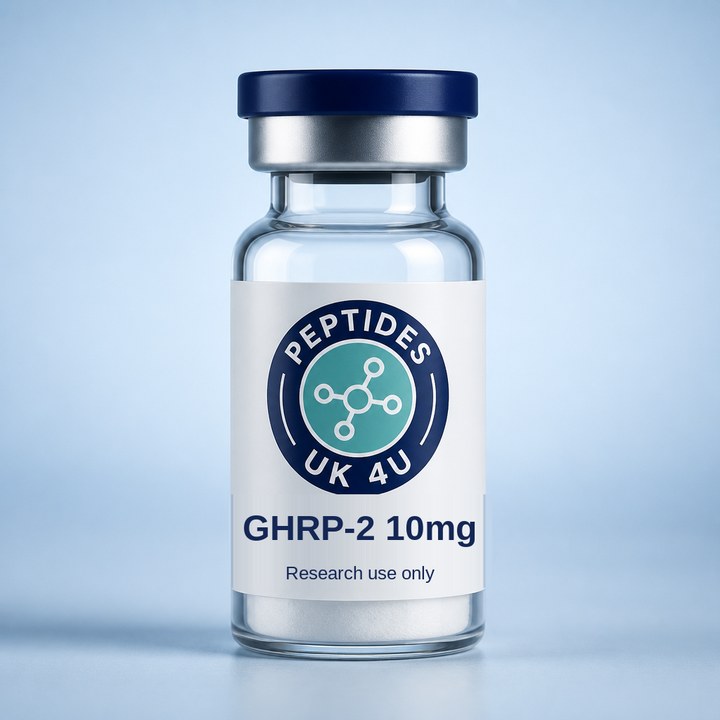
GHRP-2 is a synthetic peptide that stimulates growth hormone release. It is typically administered via subcutaneous injection in doses ranging from 100-300 mcg daily, with protocols often involving gradual titration over several weeks.
- Stimulates growth hormone release by activating ghrelin receptors.
- Commonly dosed at 100-300 mcg daily via subcutaneous injection.
- Reconstitute 10 mg with 3.0 mL bacteriostatic water for 3.33 mg/mL concentration.
- Ideal for diagnostic GH stimulation and growth hormone deficiency research.
- Can be dosed once or multiple times daily depending on protocol.
Reconstitution
Vial strength
10 mg
Bacteriostatic water
3 mL
Concentration
3.33 mg/mL
1 unit = 0.01 mL = 33.3 mcg
- 1Draw 3.0 mL bacteriostatic water using a sterile syringe.
- 2Slowly inject the water down the inner wall of the GHRP-2 vial, minimizing foam.
- 3Gently swirl or roll the vial until the peptide powder completely dissolves; do not shake vigorously.
- 4Label the reconstituted vial with the date and refrigerate it at 2–8 °C (35.6–46.4 °F), protecting it from light.
Dosing schedule
| Phase | Dose | On a U-100 syringe |
|---|---|---|
| Weeks 1–2 | 100 mcg (0.1 mg) | 3 units (0.03 mL) |
| Weeks 3–4 | 150 mcg (0.15 mg) | 4.5 units (0.045 mL) |
| Weeks 5–8 | 200 mcg (0.2 mg) | 6 units (0.06 mL) |
| Weeks 9–12 (optional) | 250–300 mcg (0.25–0.3 mg) | 7.5–9 units (0.075–0.09 mL) |
Protocol detail
| Start | Begin with 100 mcg daily. Increase the dose by approximately 50 mcg every 1–2 weeks as tolerated. |
|---|---|
| Target | Aim for 200 mcg daily by Weeks 5–8. An optional increase to 250–300 mcg can be considered during Weeks 9–12. |
| Frequency | Inject once per day via subcutaneous route. Advanced protocols may involve 2–3 injections daily. |
| Cycle Length | Typically 8–12 weeks, with an optional extension up to 16 weeks, potentially incorporating periodic breaks. |
| Timing | Administer ideally before sleep or on an empty stomach. Remember to rotate injection sites regularly. |
Overview at a glance
| Goal | To stimulate pulsatile growth hormone release and gradually increase IGF-1 levels over time. |
|---|---|
| Schedule | Daily subcutaneous injections for an 8–12 week period, with an option to extend to 16 weeks. |
| Dose Range | 100–300 mcg daily, using a gradual titration approach. |
| Reconstitution | 3.0 mL of bacteriostatic water per 10 mg vial, resulting in a concentration of approximately 3.33 mg/mL for precise syringe measurements. |
| Storage | Lyophilized powder should be stored frozen; reconstituted solution must be refrigerated and used within about 4 weeks. |
How it works
GHRP-2 functions as a growth hormone-releasing peptide by acting as an agonist for ghrelin receptors (GHS-R1a). It binds to receptors in both the pituitary gland and the hypothalamus, leading to a strong, pulsatile release of growth hormone that mimics the body's natural secretion patterns. Clinical studies have shown that even a single 100 mcg subcutaneous dose can significantly elevate GH levels. Consistent administration can also raise IGF-1 levels over several months. However, the body's GH response might lessen with continuous daily use due to tachyphylaxis, which necessitates dose titration and occasional breaks in protocols.
Reported effects
- Strong stimulation of endogenous GH release without suppressing natural production.
- Increase in IGF-1 levels with sustained administration.
- Used as a diagnostic tool for GH deficiency evaluation.
- May support recovery, improve body composition, and enhance sleep quality.
Reported side effects
- Increased appetite (ghrelin-mimetic effect).
- Temporary flushing, warmth, or tingling at the injection site.
- Possible minor increases in cortisol and prolactin at higher doses.
- Water retention or joint stiffness with extended high-dose use.
- Response attenuation (tachyphylaxis) with continuous daily dosing.
Storage
Lyophilised (unmixed)
Freeze at -20 °C (-4 °F) in dry, dark conditions; stable for 1+ years.
After reconstitution
Refrigerate at 2-8 °C (35.6-46.4 °F); use within ~4 weeks; avoid freeze-thaw cycles.
Supplies
| Peptide vials | Plan for 1 vial for an 8-week protocol, 2 vials for 12 weeks, or 3 vials for 16 weeks based on average usage. |
|---|---|
| Insulin Syringes | U-100, 30- or 50-unit syringes are recommended for accuracy. You'll need approximately 7 syringes per week (1 per day). |
| Bacteriostatic Water | A single 10 mL bottle is sufficient for protocols up to 16 weeks, as you only need 3.0 mL per 10 mg vial. |
| Alcohol Swabs | You will need two per day (one for the vial, one for the injection site), so plan for approximately 112 swabs for an 8-week protocol. |
| Sharps Container | A 1-quart container can hold around 100 syringes; a 2-quart size may be needed for longer 16-week protocols. |
Important notes
- Always use a new, sterile insulin syringe for each injection and dispose of it properly in a sharps container.
- Rotate injection sites frequently (abdomen, thighs, upper arms) to prevent local irritation and lipohypertrophy.
- Inject slowly and pause for a few seconds before removing the needle.
- Consider a 5-days-on/2-days-off schedule to help maintain GH response sensitivity during longer protocols.
- Maintain a record of your daily dose and injection site rotation for consistent and organized administration.
Frequently asked questions
What is the best way to store GHRP-2?
Lyophilized GHRP-2 should be frozen at -20 °C (-4 °F) in a dry, dark place for long-term stability. Once reconstituted with bacteriostatic water, it must be refrigerated at 2-8 °C (35.6-46.4 °F) and typically remains viable for about four weeks. Avoid freezing and thawing reconstituted vials.
Why do protocols suggest once-daily dosing before sleep?
Injecting GHRP-2 before sleep is often suggested because it aligns with the body's natural pulsatile release of growth hormone, potentially optimizing its effects. Administering it on an empty stomach is also recommended to maximize the GH response, as food intake can sometimes lessen its effectiveness.
What does 'response attenuation' (tachyphylaxis) mean with GHRP-2, and how can it be managed?
Response attenuation refers to a decreased effectiveness of GHRP-2 over time with continuous daily use, as the body's receptors become less sensitive. To manage this, protocols often include gradual dose titration, cycling (e.g., 5 days on, 2 days off), or periodic breaks from the peptide to help maintain receptor sensitivity and optimize long-term results.
Can I use multiple daily injections of GHRP-2?
Yes, some advanced protocols explore multiple daily injections. However, research suggests that total daily doses in the 600-900 mcg range split over several injections may accelerate response attenuation. It's crucial to understand that increasing frequency might lead to a faster decrease in effectiveness, and a 5-days-on/2-days-off cycling approach might be beneficial to maintain sensitivity.
Educational reference only. These figures summarise how GHRP-2 is commonly described in research literature and supplier documentation. They are not a prescription, not medical advice, and not a recommendation to self-administer anything.
Related protocols
GHRP-2 (5 mg Vial)
Synthetic peptide stimulating growth hormone release via ghrelin receptors.
Sermorelin (10 mg Vial)
Stimulates natural growth hormone, supports IGF-1 levels.
CJC-1295 NO DAC (5 mg Vial)
Stimulates natural growth hormone release for improved body composition and recovery.
CJC-1295 DAC + Ipamorelin Stack (5 mg (+ 5 mg))
Synergistic GH release for enhanced anabolic signaling and body composition.