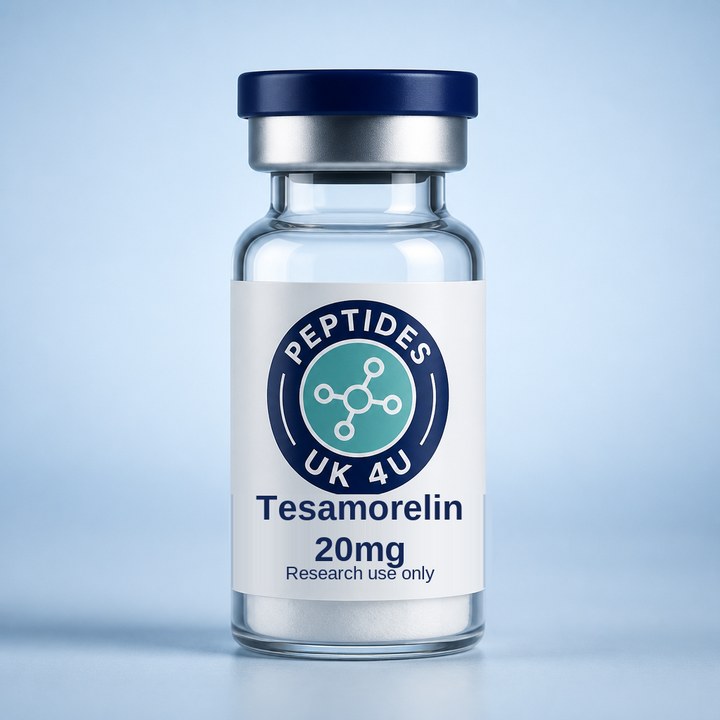
Tesamorelin is a synthetic peptide that mimics Growth Hormone-Releasing Hormone (GHRH), stimulating the body's natural production of growth hormone and IGF-1. It is typically dosed at 2 mg daily via subcutaneous injection, often in the evening, to help reduce visceral fat and improve metabolic markers.
- FDA-approved to reduce visceral adipose tissue in HIV-associated lipodystrophy.
- Boosts endogenous Growth Hormone and IGF-1 levels.
- Dosed subcutaneously once daily.
- Significant reduction in visceral fat observable in 3-6 months.
- Evening injection aligns with natural GH pulsatility.
Reconstitution
Vial strength
20 mg
Bacteriostatic water
3 mL
Concentration
6.67 mg/mL
1 unit = 0.01 mL = 66.7 mcg
- 1Draw 3.0 mL of bacteriostatic water with a sterile syringe.
- 2Slowly inject the water down the inner wall of the Tesamorelin vial, avoiding direct contact with the powder to prevent foaming.
- 3Gently swirl the vial until the powder is completely dissolved; do not shake.
- 4Label the reconstituted vial with the date and refrigerate it at 2-8 °C (35.6-46.4 °F), protected from light.
- 5Use the reconstituted solution within 7 days if bacteriostatic water is used.
Dosing schedule
| Phase | Dose | On a U-100 syringe |
|---|---|---|
| Week 1 | 1 mg / 1000 mcg | 15 units (0.15 mL) |
| Weeks 2-12+ | 2 mg / 2000 mcg | 30 units (0.30 mL) |
Protocol detail
| Week 1 | Begin with 1 mg (1000 mcg) once daily to evaluate tolerability. |
|---|---|
| Weeks 2+ | Increase to the standard FDA-approved dose of 2 mg (2000 mcg) once daily. |
| Frequency | Administer once per day via subcutaneous injection, ideally in the evening. |
| Cycle Length | Consider a cycle length of 12-26 weeks; clinical studies support use for up to 52 weeks under medical supervision. |
| Timing | Evening administration is recommended; remember to consistently rotate injection sites. |
Overview at a glance
| Goal | To reduce visceral adipose tissue and enhance lipid profiles by consistently raising GH/IGF-1 levels. |
|---|---|
| Schedule | Daily subcutaneous injections, typically for 12-26 weeks, extendable to 52 weeks with medical oversight. |
| Dose | 2 mg (2000 mcg) daily following an initial 1-week titration period. |
| Reconstitution | Add 3.0 mL of bacteriostatic water to a 20 mg vial, resulting in approximately 6.67 mg/mL concentration. |
| Storage | Lyophilized vials should be refrigerated; once reconstituted, refrigerate and use within 7 days. Avoid freezing reconstituted solution. |
How it works
Tesamorelin functions by mimicking the natural human Growth Hormone-Releasing Hormone (GHRH), binding to receptors in the pituitary gland. This interaction stimulates the pulsatile release of the body’s own growth hormone, subsequently raising IGF-1 levels. This hormonal cascade promotes lipolysis, which breaks down fat, along with protein synthesis and overall metabolic improvements. In cases like HIV-associated lipodystrophy, daily Tesamorelin effectively reduces visceral fat and improves blood lipid profiles over several months. Research also explores its potential in reducing liver fat and enhancing cognitive function in aging individuals.
Reported effects
- Significant reduction in visceral adipose tissue
- Improved lipid profiles and potential liver fat reduction
- Enhanced cognitive function in older adults (under research)
- Well-tolerated with sustained benefits over long-term use
Reported side effects
- Injection-site reactions (redness, itching, pain, bruising)
- Musculoskeletal symptoms (joint pain, muscle aches, mild swelling)
- Occasional carpal tunnel-like symptoms (tingling, numbness)
- Requires monitoring of IGF-1 levels
- Small increases in HbA1c observed in some patients
Storage
Lyophilised (unmixed)
Refrigerate at 2-8 °C (35.6-46.4 °F). Newer formulations (Egrifta SV) stable at 20-25 °C (68-77 °F) before reconstitution.
After reconstitution
Refrigerate at 2-8 °C (35.6-46.4 °F) and use within 7 days when reconstituted with bacteriostatic water.
Supplies
| Peptide vials | For an 8-week protocol, approximately 6 vials (105 mg total) are needed. For 12 weeks, 9 vials (161 mg total). For 16 weeks, 11 vials (217 mg total). |
|---|---|
| Insulin Syringes (U-100, 1 mL) | About 7 syringes per week (1 per day). Therefore, 56 for 8 weeks, 84 for 12 weeks, and 112 for 16 weeks. |
| Bacteriostatic Water (10 mL bottles) | You'll need 3.0 mL per Tesamorelin vial. For an 8-week protocol (6 vials), 18 mL is needed (2 x 10 mL bottles). For 12 weeks (9 vials), 27 mL (3 x 10 mL bottles). For 16 weeks (11 vials), 33 mL (4 x 10 mL bottles). |
| Alcohol Swabs | Two per day (one for the vial, one for the injection site). Approximately 112 for 8 weeks (2 x 100-count boxes), 168 for 12 weeks (2 x 100-count boxes), and 224 for 16 weeks (3 x 100-count boxes). |
Important notes
- Always use a new, sterile insulin syringe for each injection and dispose of it in a sharps container.
- Rotate injection sites to minimize local irritation (abdomen, thighs, upper arms, at least 2 inches from navel).
- Inject slowly and wait a few seconds before withdrawing the needle.
- Monitor IGF-1 levels periodically due to its potent GH-stimulating effects; observe blood glucose particularly in diabetic patients.
- Maintain a daily log of doses and injection site rotation for consistency.
Frequently asked questions
What is the primary benefit of Tesamorelin?
Tesamorelin is primarily used to significantly reduce visceral adipose tissue (fat around internal organs), and it has been FDA-approved for this purpose in patients with HIV-associated lipodystrophy. It also improves lipid profiles and may have cognitive benefits.
How long does it take to see results with Tesamorelin?
Visible reductions in visceral adipose tissue typically become measurable after 3 to 6 months of consistent daily use. Continued benefits are observed with extended use.
Why is Tesamorelin often injected in the evening?
Injecting Tesamorelin in the evening is often recommended because it aligns with the body's natural pulsatile release of growth hormone, which tends to be higher during nocturnal sleep. This timing may optimize its effects.
Are there any conditions where Tesamorelin should not be used?
Yes, Tesamorelin is contraindicated in individuals with active malignancies, as it may accelerate the growth of latent tumors. It is also not recommended during pregnancy or for those with known hypersensitivity to Tesamorelin or mannitol.
Educational reference only. These figures summarise how Tesamorelin is commonly described in research literature and supplier documentation, including the Tesamorelin listing at peptidesuk4u.co.uk. They are not a prescription, not medical advice, and not a recommendation to self-administer anything.
Related protocols
Tesamorelin (10 mg Vial)
GHRH analog stimulating GH for visceral fat reduction and metabolic health.
Tesamorelin (5 mg Vial)
Synthetic GHRH analog boosting natural Growth Hormone for fat reduction.
CJC-1295 DAC (2 mg Vial)
Long-acting GHRH analog for sustained growth hormone release.
Ipamorelin (5 mg Vial)
Selective growth hormone secretagogue for lean mass, recovery, and fat metabolism.