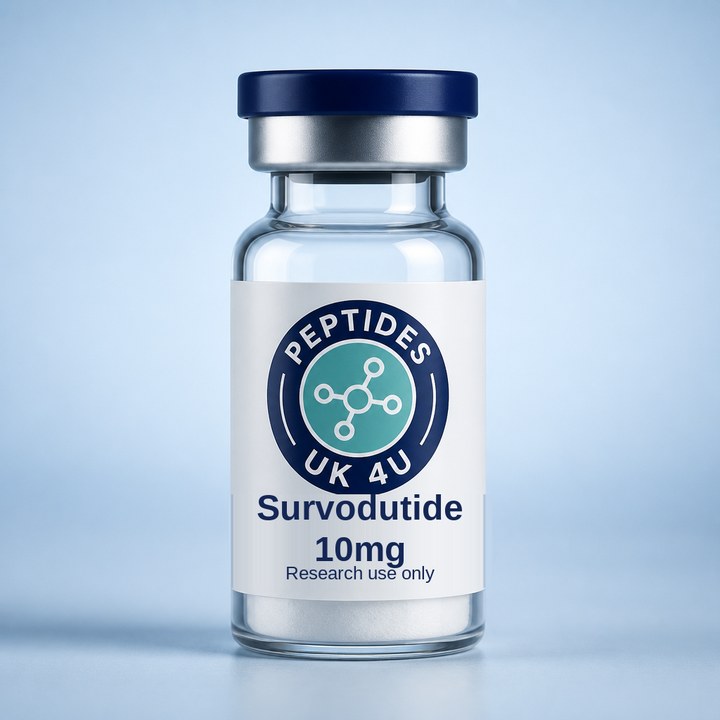
Survodutide is an investigational dual GLP-1/glucagon receptor agonist being developed for obesity and metabolic liver disease. It is typically administered via subcutaneous injection once weekly, with a gradual titration of the dose over several weeks to minimize potential side effects.
- Dual GLP-1/glucagon receptor agonist.
- Investigational for obesity and metabolic liver disease.
- Administered once weekly via subcutaneous injection.
- Requires gradual dose titration.
- Demonstrated significant weight loss in trials.
Reconstitution
Vial strength
10 mg
Bacteriostatic water
2 mL
Concentration
5 mg/mL
1 unit = 0.01 mL = 50 mcg (with U-100 insulin syringe)
- 1Draw 2.0 mL of bacteriostatic water using a sterile syringe.
- 2Carefully inject the water down the wall of the vial, avoiding direct contact with the peptide powder to prevent foaming.
- 3Gently swirl or roll the vial until the powder completely dissolves; do not shake vigorously.
- 4Label the reconstituted vial with the date and concentration, then refrigerate at 2–8 °C (35.6–46.4 °F), protected from light.
Dosing schedule
| Phase | Dose | On a U-100 syringe |
|---|---|---|
| Weeks 1–2 | 0.6 mg | 12 units (0.12 mL) |
| Weeks 3–4 | 1.2 mg | 24 units (0.24 mL) |
| Weeks 5–6 | 1.8 mg | 36 units (0.36 mL) |
| Weeks 7–8 | 2.4 mg | 48 units (0.48 mL) |
| Weeks 9–10 | 3.6 mg | 72 units (0.72 mL) |
| Weeks 11–12 | 4.8 mg | 96 units (0.96 mL) |
| Week 13+ | 6.0 mg | 120 units (1.20 mL) |
Protocol detail
| Start | Begin with 0.6 mg weekly and increase the dose by 0.6 mg every two weeks, provided it is well-tolerated. |
|---|---|
| Target | Aim to reach a weekly dose of 4.8–6.0 mg by weeks 11–13. |
| Frequency | Administer once per week via subcutaneous injection. |
| Cycle Length | Minimum of 12–16 weeks; phase 3 trials have investigated durations of 48–72 weeks. |
| Timing | Administer on the same day each week and consistently rotate the injection sites. |
Overview at a glance
| Goal | To support improvements in metabolic health and manage weight by activating both GLP-1 and glucagon receptors. |
|---|---|
| Schedule | Weekly subcutaneous injections, typically for 12–16 weeks or potentially longer. |
| Dose Range | 0.6–6.0 mg weekly, with a gradual increase over 10–12 weeks. |
| Reconstitution | Add 2.0 mL of bacteriostatic water to a 10 mg vial to achieve a 5 mg/mL concentration, enabling accurate unit measurements. |
| Storage | Lyophilized peptide should be frozen; reconstituted solution must be refrigerated, protected from light, and kept from freezing and thawing repeatedly. |
How it works
Survodutide functions as a dual agonist, activating both glucagon-like peptide-1 (GLP-1) and glucagon receptors. The GLP-1 activation helps regulate blood sugar and promotes feelings of fullness, while the glucagon activation boosts energy expenditure and fat breakdown in the liver. This combined action is thought to deliver superior benefits for body weight and liver health compared to targeting GLP-1 alone. Studies have shown survodutide not only leads to significant weight loss but also improves markers of liver health.
Reported effects
- Significant dose-dependent weight loss (12.5–14.9%)
- Improvements in liver biomarkers (e.g., in NAFLD/NASH)
- Potential for metabolic improvement
- Enhanced satiety and improved glycemic control
Reported side effects
- Nausea
- Vomiting
- Diarrhea
- Constipation
- Gastrointestinal upset (especially during dose escalation)
Storage
Lyophilised (unmixed)
Freeze at ≤−20 °C (≤−4 °F) in dry, dark conditions; minimize moisture exposure.
After reconstitution
Refrigerate at 2–8 °C (35.6–46.4 °F); protect from light and avoid repeated freeze–thaw cycles. Allow vials to reach room temperature before opening.
Supplies
| Peptide vials | Approximately 2 vials for an 8-week protocol, 4 for 12 weeks, and 7 for 16 weeks (10 mg each). |
|---|---|
| Insulin Syringes (U-100) or 1 mL Luer-lock Syringes | One per week for the duration of the protocol (e.g., 8–16 syringes). |
| Bacteriostatic Water (10 mL bottles) | One 10 mL bottle for 8–12 weeks of protocol, two 10 mL bottles for 16 weeks. |
| Alcohol Swabs | Two per week (one for vial, one for injection site); a 100-count box is recommended for longer protocols. |
Important notes
- Always use sterile, new syringes and dispose of them safely in a sharps container.
- Rotate injection sites (e.g., abdomen, thighs, upper arms) to minimize local skin irritation.
- Inject slowly and steadily, waiting a few seconds before withdrawing the needle.
- Carefully document weekly doses, injection sites, and any observations related to tolerability.
- For doses exceeding 100 units (1.0 mL), consider using a 1 mL Luer-lock syringe or dividing the dose into two separate injections.
Frequently asked questions
What is the primary difference between Survodutide and other GLP-1 agonists?
Survodutide is a dual GLP-1/glucagon receptor agonist, meaning it activates both receptor types. Most other GLP-1 agonists only target the GLP-1 receptor. This dual action is believed to offer additional benefits for weight loss and metabolic health.
How long will it take to see results with Survodutide?
Clinical trials have shown dose-dependent weight loss results over periods like 46 weeks. Individual results may vary, but gradual titration and consistent weekly dosing are crucial for effectiveness. Visible changes are generally observed over several weeks to months.
Can I adjust the dosage on my own if I experience side effects?
The dosing protocol for Survodutide involves gradual titration to manage side effects, particularly gastrointestinal ones. It is not recommended to adjust the dosage outside of a structured protocol. Consult a professional if side effects become unmanageable.
Is Survodutide approved for human use?
No, Survodutide is currently an investigational compound in clinical trials for obesity and metabolic liver disease. It is not yet approved for general human use and is intended for research purposes only.
Educational reference only. These figures summarise how Survodutide is commonly described in research literature and supplier documentation. They are not a prescription, not medical advice, and not a recommendation to self-administer anything.
Related protocols
Cagrilintide + Semaglutide (10 mg Blend)
Dual-action peptide for significant weight loss and metabolic control.
Mazdutide (10 mg Vial)
Dual GLP-1/glucagon agonist for weight loss and metabolic improvement.
Mazdutide (5 mg Vial)
Dual GLP-1/glucagon agonist for weight management and metabolic health.
Retatrutide (10 mg Vial)
Triple-agonist peptide for significant weight loss and metabolic health.