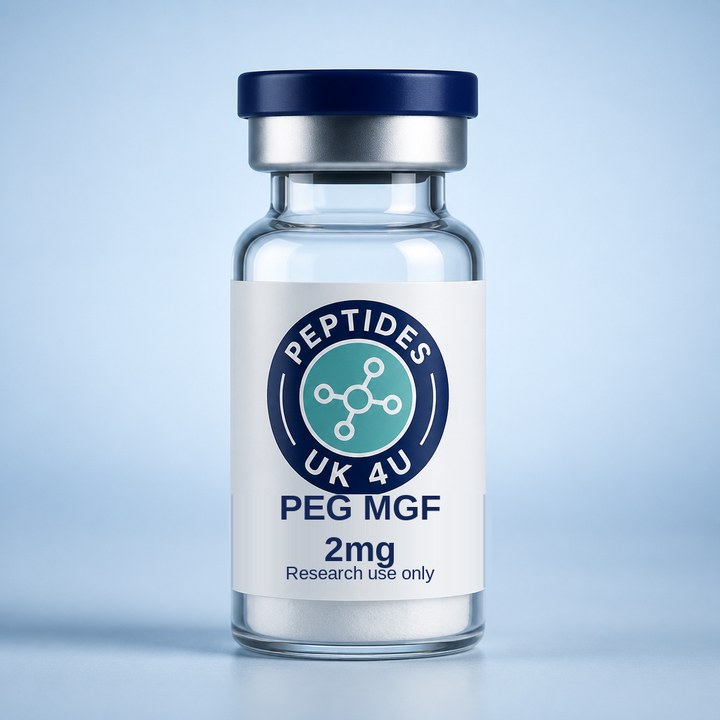
PEG MGF is a modified growth factor variant designed to promote muscle repair and regeneration. This peptide is typically dosed subcutaneously at 200-500 mcg daily, with a gradual increase over several weeks. It requires reconstitution with bacteriostatic water before use.
- Pegylated MGF for extended half-life.
- Supports muscle and tissue repair.
- Administered once daily subcutaneously.
- Gradual dose titration over an 8-week cycle.
Reconstitution
Vial strength
2 mg
Bacteriostatic water
3 mL
Concentration
0.667 mg/mL
1 unit = 0.01 mL = 6.67 mcg
- 1Draw 3.0 mL of bacteriostatic water using a sterile syringe.
- 2Inject the water slowly down the interior wall of the peptide vial, avoiding direct contact with the powder to prevent foaming.
- 3Gently swirl or roll the vial until the powder is completely dissolved. Do not shake.
- 4Label the reconstituted vial with the date and refrigerate it at 2–8 °C (35.6–46.4 °F), protected from light.
Dosing schedule
| Phase | Dose | On a U-100 syringe |
|---|---|---|
| Weeks 1–2 | 200 mcg | 30 units (0.30 mL) |
| Weeks 3–4 | 300 mcg | 45 units (0.45 mL) |
| Weeks 5–6 | 400 mcg | 60 units (0.60 mL) |
| Weeks 7–8 | 500 mcg | 75 units (0.75 mL) |
Protocol detail
| Start | Begin with 200 mcg daily and increase the dose by approximately 100 mcg every two weeks, as tolerated. |
|---|---|
| Target | Aim for a daily dose of 400–500 mcg by Weeks 5–8. |
| Frequency | Inject once per day via subcutaneous route. |
| Cycle Length | An 8-week cycle is suggested, with the option to extend to 12–16 weeks. |
| Timing | Choose a consistent time for daily injections and remember to rotate injection sites. |
Overview at a glance
| Goal | Support muscle recovery and regeneration through MGF’s satellite cell activation and local growth factor signaling. |
|---|---|
| Schedule | Daily subcutaneous injections for 8 weeks, with an optional extension to 12–16 weeks. |
| Dose Range | 200–500 mcg daily with gradual titration. |
| Reconstitution | 3.0 mL bacteriostatic water per 2 mg vial (~0.667 mg/mL) for accurate unit measurements. |
| Storage | Lyophilized form stored frozen; reconstituted form refrigerated. Avoid repeated freeze–thaw cycles. |
How it works
Mechano-growth factor (MGF) is an IGF-1 variant produced in muscle tissue following exercise or damage. Its unique C-terminal E peptide locally activates satellite cells, initiating muscle repair and growth processes separate from systemic IGF-1. Pegylation extends MGF's presence in the body, allowing for once-daily subcutaneous administration rather than frequent local injections. Animal studies suggest PEG MGF can enhance muscle regeneration, bone healing, and cartilage repair over several weeks by promoting this localized cellular activity. It provides a sustained anabolic signal where it's needed most for recovery.
Reported effects
- Enhances muscle regeneration and repair
- Promotes satellite cell activation
- May improve bone and cartilage healing
- Supports local protein synthesis
Reported side effects
- Mild injection site reactions
Storage
Lyophilised (unmixed)
Store at -20 °C (-4 °F) in dry, dark conditions; minimize moisture exposure.
After reconstitution
Refrigerate at 2–8 °C (35.6–46.4 °F); protect from light. Avoid freeze-thaw cycles.
Supplies
| Peptide vials (PEG MGF, 2 mg each) | Approximately 10 vials for an 8-week cycle; 17 for 12 weeks; 24 for 16 weeks. |
|---|---|
| Insulin Syringes (U-100) | Seven syringes per week, totaling about 56 for 8 weeks, 84 for 12 weeks, and 112 for 16 weeks. |
| Bacteriostatic Water (10 mL bottles) | Roughly 3 bottles for an 8-week cycle, 6 for 12 weeks, and 8 for 16 weeks. |
| Alcohol Swabs | Two per day (one for vial, one for injection site), which means about 112 for 8 weeks, 168 for 12 weeks, and 224 for 16 weeks. |
Important notes
- Use new, sterile insulin syringes for each injection.
- Dispose of used syringes in a designated sharps container.
- Rotate injection sites regularly to minimize local irritation.
- Document daily doses and injection sites for consistency.
- No clinical trials on PEG MGF have been completed yet; effects are primarily observed in animal and cell models.
Frequently asked questions
What is the key difference between PEG MGF and standard MGF?
PEG MGF is pegylated, meaning it has polyethylene glycol molecules attached. This modification extends its half-life significantly, allowing for less frequent dosing (once daily) compared to native MGF, which would require much more frequent local injections.
Why is a gradual increase in dosage recommended for PEG MGF?
A gradual increase allows the body to adapt to the peptide's effects and helps assess individual tolerance. This titrated approach starts with a lower dose and slowly increases it to the target range, optimizing benefits while minimizing potential side effects. It also aligns with observed preclinical research protocols.
Can I shake the vial during reconstitution?
No, it is important to avoid shaking the vial during reconstitution. Shaking can damage the delicate peptide structure and lead to foaming, which can make accurate dosing difficult. Instead, gently swirl or roll the vial until the powder is fully dissolved.
Are there any human clinical trials for PEG MGF?
Currently, no human clinical trials have been completed for PEG MGF. Its observed effects and benefits are primarily derived from animal studies and research conducted at the cellular level. Therefore, its safety and efficacy in humans remain unestablished in a clinical setting.
Educational reference only. These figures summarise how PEG MGF is commonly described in research literature and supplier documentation. They are not a prescription, not medical advice, and not a recommendation to self-administer anything.
Related protocols
BPC-157 (5 mg Vial)
A synthetic gastric peptide investigated for tissue repair and healing.
CJC-1295 DAC (2 mg Vial)
Long-acting GHRH analog for sustained growth hormone release.
GHRP-2 (5 mg Vial)
Synthetic peptide stimulating growth hormone release via ghrelin receptors.
GHRP-6 (10 mg Vial)
Mimics ghrelin to stimulate growth hormone release.