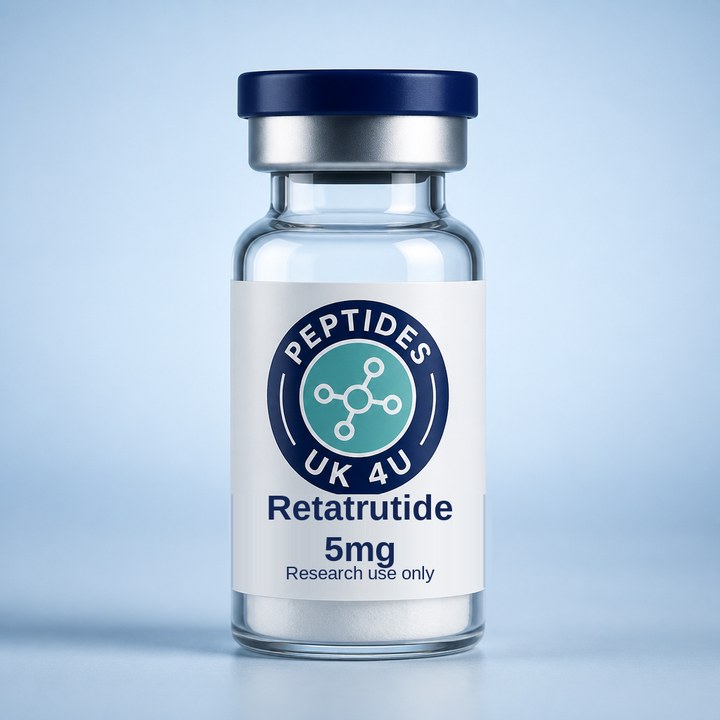
Retatrutide is a multi-receptor agonist peptide currently in research for significant weight loss and metabolic improvement. It is administered via weekly subcutaneous injections, with doses gradually increasing over several weeks to a maximum of 12 mg per week. Reconstitution involves adding 1.0 mL of bacteriostatic water to a 5 mg vial to achieve a concentration of 5.0 mg/mL.
- Triple-agonist targeting GLP-1, GIP, and glucagon receptors.
- Administered once weekly via subcutaneous injection.
- Achieved up to 24% body weight loss in clinical trials for obesity.
- Gradual dose escalation is crucial to manage gastrointestinal side effects.
- Not FDA-approved; currently for research use only.
Reconstitution
Vial strength
5 mg
Bacteriostatic water
1 mL
Concentration
5 mg/mL
1 unit = 0.01 mL ≈ 50 mcg (on a U-100 insulin syringe)
- 1Draw 1.0 mL of bacteriostatic water with a sterile syringe.
- 2Inject the water slowly down the inside wall of the peptide vial, avoiding foaming.
- 3Gently swirl or roll the vial until the powder completely dissolves; do not shake.
- 4Label the reconstituted vial with the date and refrigerate it at 2-8 °C (35.6-46.4 °F), protected from light.
- 5Use the reconstituted solution within 4 weeks.
Dosing schedule
| Phase | Dose | On a U-100 syringe |
|---|---|---|
| Weeks 1-4 | 2 mg (2000 mcg) | 40 units (0.40 mL) |
| Weeks 5-8 | 4 mg (4000 mcg) | 80 units (0.80 mL) |
| Weeks 9-12 (Standard) | 6 mg (6000 mcg) | 120 units (1.20 mL) |
| Weeks 9-12 (Aggressive) | 8 mg (8000 mcg) | 160 units (1.60 mL) |
| Weeks 13+ (Standard) | 8 mg (8000 mcg) | 160 units (1.60 mL) |
| Weeks 13+ (Aggressive) | 12 mg (12000 mcg) | 240 units (2.40 mL) |
Protocol detail
| Start | Initiate with 2 mg weekly for four weeks to evaluate tolerance and minimize side effects. |
|---|---|
| Escalate | Increase the dose by 2-4 mg every four weeks as tolerated, following a gradual titration schedule. |
| Target Dose | Aim for 6-8 mg weekly in a standard approach, or up to 12 mg weekly for advanced/aggressive protocols, based on individual response and tolerance. |
| Frequency | Administer once per week via subcutaneous injection, ideally on the same day each week for consistency. |
| Cycle Length | A minimum cycle length of 24 weeks is suggested, with clinical trials extending to 48 weeks for comprehensive results. |
| Timing | Injections can be given at any consistent day or time, but it's important to systematically rotate injection sites with each dose to prevent local irritation. |
Overview at a glance
| Goal | Support significant weight reduction and improve metabolic health by activating GLP-1, GIP, and glucagon receptors. |
|---|---|
| Schedule | Weekly subcutaneous injections for 12–48 weeks, typically administered on the same day each week. |
| Dose Range | Weekly doses vary from 2 mg to 12 mg, with gradual increases every four weeks to ensure tolerance. |
| Reconstitution | Add 1.0 mL of bacteriostatic water to a 5 mg vial, yielding a concentration of approximately 5.0 mg/mL for precise unit measurement. |
| Storage (Lyophilized) | Store frozen at -20 °C (-4 °F) or colder. |
| Storage (Reconstituted) | Refrigerate at 2-8 °C (35.6-46.4 °F) for up to four weeks. |
How it works
Retatrutide functions as a triple agonist, simultaneously activating GLP-1, GIP, and glucagon receptors. This multi-pathway action enhances insulin secretion in the presence of glucose and suppresses appetite, similar to other incretin mimetics. Uniquely, its glucagon receptor agonism boosts metabolic rate and energy expenditure, intensifying fat burning and weight loss beyond what GLP-1/GIP alone can achieve. The peptide is modified to have an extended half-life of approximately 6 days, allowing for convenient once-weekly dosing. This combined hormonal activation leads to a significant reduction in calorie intake, increased satiety, and improved lipid metabolism, delivering powerful results in weight reduction and glycemic control.
Reported effects
- Exceptional weight loss (average 22-24% in 48 weeks at higher doses).
- Significant glycemic control in type 2 diabetes (HbA1c reductions of 1.3-2.0%).
- Improvements in cardiometabolic markers (blood pressure, LDL cholesterol, waist circumference).
- Reduced liver fat content with resolution of hepatic steatosis.
- High response rate, with 100% of participants achieving at least 5% weight reduction at higher doses.
Reported side effects
- Commonly includes mild-to-moderate nausea, vomiting, and diarrhea.
- Gastrointestinal symptoms are typically dose-dependent and transient.
- Side effects are primarily observed during initial dose escalation.
- No severe hypoglycemia or serious treatment-related adverse events reported.
- Safety profile is comparable to GLP-1 agonists when titrated properly.
Storage
Lyophilised (unmixed)
Freeze at -20 °C (-4 °F) or colder in dry, dark conditions; stable for up to 24 months.
After reconstitution
Refrigerate at 2-8 °C (35.6-46.4 °F) for up to 4 weeks; protect from light.
Supplies
| Peptide vials | Retatrutide (5 mg each): 12 weeks Standard (to 6 mg): 10 vials; 24 weeks Standard (to 8 mg): 29 vials; 12 weeks Aggressive (to 8 mg): 12 vials. |
|---|---|
| Insulin Syringes | U-100, 1 mL capacity: 1-3 syringes per week (depending on dose); 12 weeks: 12-36 syringes; 24 weeks: 24-72 syringes. |
| Bacteriostatic Water | 10 mL bottles: ~1.0 mL per vial for reconstitution. 1 bottle per 10 vials. If reconstituting 29 vials, 3 bottles are needed. |
| Alcohol Swabs | 4-8 swabs per week (for vial and injection sites); 12 weeks: ~75 swabs (recommend 100-count box); 24 weeks: ~150 swabs (recommend 2 x 100-count boxes). |
Important notes
- Use a new, sterile insulin syringe for each injection and dispose of it in a sharps container.
- Rotate injection sites (abdomen, thighs, upper arms) systematically to reduce irritation and fat accumulation.
- For doses exceeding 5 mg with 1.0 mL reconstitution, multiple vials must be prepared to achieve the required volume.
- If the injection volume exceeds 1.0 mL, split it into 2-3 separate injections at different sites for better absorption.
- Inject slowly and pause before withdrawing the needle to ensure complete dose delivery.
- Maintain a record of weekly doses, dates, and injection sites for consistent tracking.
- Gradual dose titration is essential to mitigate gastrointestinal side effects; avoid skipping escalation steps.
Frequently asked questions
What is the primary benefit of Retatrutide over other weight loss peptides?
Retatrutide is a triple-agonist, acting on GLP-1, GIP, and glucagon receptors. This unique combination not only reduces appetite and enhances glucose metabolism but also boosts metabolic rate and fat burning, leading to more substantial weight loss compared to single or dual agonist therapies.
How should I manage gastrointestinal side effects during Retatrutide dosing?
Gastrointestinal side effects like nausea, vomiting, and diarrhea are common, especially during dose escalation. It is critical to adhere to the gradual titration schedule to allow your body to adapt. If symptoms are severe or persistent, consult a healthcare provider.
Can I inject Retatrutide more than once a week to increase effectiveness?
No, Retatrutide is designed for once-weekly administration due to its extended half-life. Injecting more frequently will not necessarily increase effectiveness and may heighten the risk of side effects. Always follow the prescribed weekly dosing schedule.
What happens if I forget to take my weekly Retatrutide dose?
If you miss a dose, administer it as soon as you remember, provided it's not close to your next scheduled dose. Then resume your regular weekly schedule. Do not double dose to make up for a missed dose.
Educational reference only. These figures summarise how Retatrutide is commonly described in research literature and supplier documentation, including the Retatrutide listing at peptidesuk4u.co.uk. They are not a prescription, not medical advice, and not a recommendation to self-administer anything.
Related protocols
Retatrutide (10 mg Vial)
Triple-agonist peptide for significant weight loss and metabolic health.
Retatrutide (30 mg Vial)
Triple-agonist peptide for substantial weight loss and metabolic health.
Retatrutide (40 mg Vial)
Triple-agonist peptide for substantial weight loss and metabolic health.
Retatrutide (20 mg Vial)
Triple-agonist peptide for substantial weight loss and metabolic health.